 Lynden Siding
 Allura and James Hardie Are Not the Same Product
If you've been collecting siding quotes in Lynden, you've probably had at least one contractor offer Allura fiber cement as a lower-cost alternative to James Hardie. On paper, the pitch makes sense: both are Portland cement, sand, and cellulose fiber composites, both come pre-primed or factory-finished, and both are sold as a step up from vinyl or wood. We get why homeowners ask about it. But after years of installing fiber cement across Whatcom County, we made a deliberate call to install James Hardie products exclusively and to pass on Allura, even when it would let us quote a lower number. This page explains that decision honestly, including what Allura does reasonably well, so you can make an informed call rather than just take our word for it.
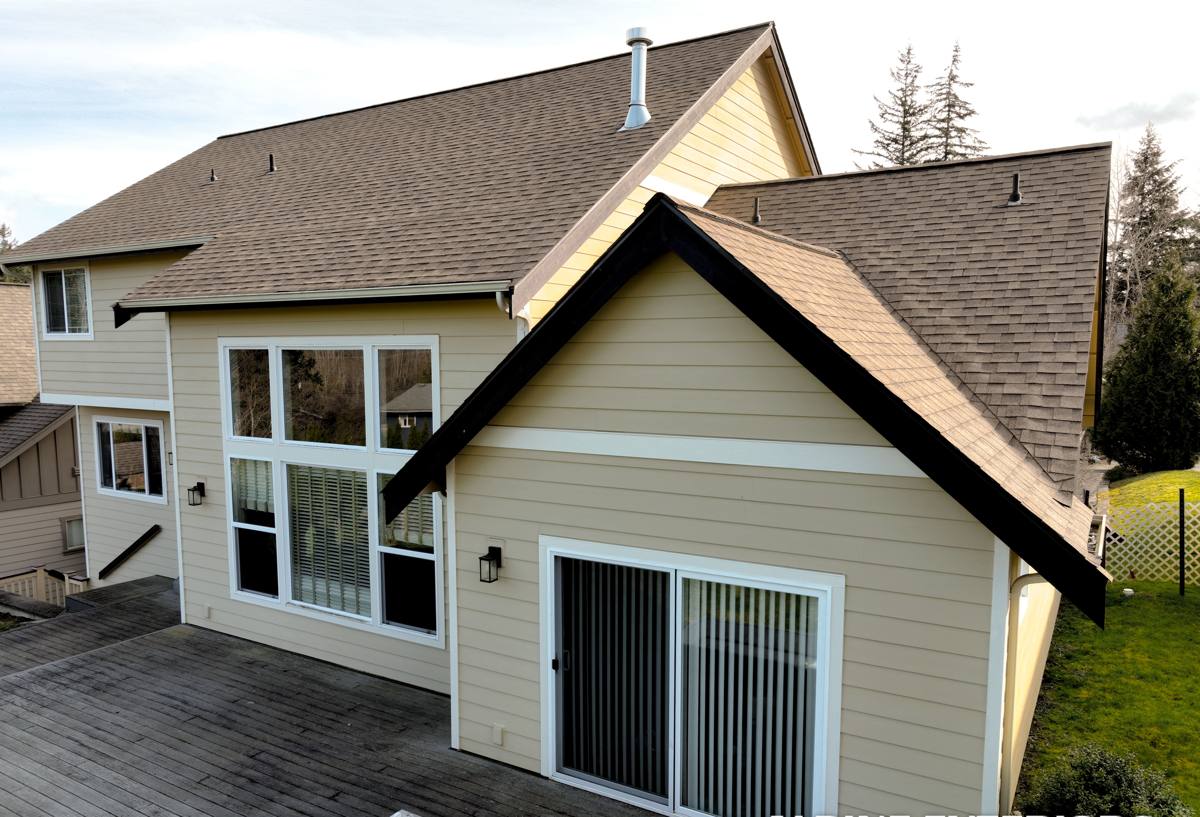
What Allura Gets Right
Allura fiber cement is a legitimate building product, not a knockoff. It's manufactured to meet the same general ASTM C1186 fiber cement standard that governs the category, it holds paint and factory finish reasonably well, and it shares fiber cement's core advantages over vinyl and wood: it doesn't warp, it resists insects, and it's non-combustible. For a homeowner comparing fiber cement to vinyl siding, Allura is a real step up in durability and fire performance. If your only choice were Allura versus vinyl, Allura would usually win.
The issue isn't that Allura is a bad material in a vacuum. It's that once you put it side by side with James Hardie in the specific conditions Lynden and the rest of Whatcom County throw at a house — salt-laden air off the Strait of Georgia and Bellingham Bay, long stretches of driving rain, and a moss season that can run eight months of the year — the gaps in finish system, warranty structure, and local support start to matter a lot more than the sticker price.
Where the Two Products Actually Diverge
Factory Finish
James Hardie's ColorPlus finish is a baked-on, multi-coat factory finish applied and cured under controlled conditions, engineered specifically to resist UV fading and to hold color consistency across a full elevation. Allura's factory-finished lines exist, but the company's broader lineup leans more heavily on primed panels meant to be field-painted after installation. Field-applied paint is only as good as the crew, the weather window, and the paint itself — and in Whatcom County, where dry, warm painting windows are short and rain returns fast in the fall, field finishing is a real scheduling risk. A finish that's baked on at the factory doesn't have that problem.
Moisture Management at the Product Level
Both products are cement-based, so both are far more moisture-tolerant than wood or OSB-based siding. But how a product sheds and manages water at the plank level, at butt joints, and at cut edges is where manufacturing tolerances and recommended detailing start to separate the two. Hardie's HZ5 product line is specifically engineered for climates with sustained moisture exposure and freeze-thaw cycling, which describes a lot of Pacific Northwest winters. We haven't found an equivalent climate-zone-specific engineering commitment from Allura backed by the same level of installer documentation and field support in this region.
Warranty Structure
This is the part that matters most once the sale is done and the crew has left. James Hardie backs its siding with a long, non-prorated limited warranty and a separate ColorPlus finish warranty, and — critically for resale — that warranty is transferable to a subsequent homeowner within a defined window. Allura's warranty coverage exists but is structured differently and is less consistently transferable in our experience reviewing the paperwork homeowners bring us after a competitor's install. If you plan to sell this house in Lynden in the next decade — and most people eventually do — a warranty that dies with the original owner is worth a lot less than one that survives the sale.
Manufacturer Support and Local Supply
James Hardie has invested heavily in the Pacific Northwest market: regional distribution, trained installer networks, and manufacturer field reps who actually show up when a detail question comes up mid-project. Allura's distribution and installer support network in Whatcom County is thinner. That matters when a job needs a specific trim profile, a touch-up kit years later, or a manufacturer rep to weigh in on a warranty claim. Product availability isn't a marketing detail — it's what determines whether your siding gets fixed correctly and quickly if something goes wrong.
How This Plays Out in Lynden's Climate Specifically
Lynden sits inland from Bellingham Bay but still gets meaningful salt air on wind off the Strait, on top of the rainfall Whatcom County sees most of the year. That combination is hard on any exterior product, but it's especially hard on painted or field-finished surfaces, because salt air accelerates the breakdown of paint film and any coating that isn't fully cured and bonded before it goes up. A factory-baked finish that's cured under controlled heat and time is simply more resistant to that kind of chemical and UV stress than a finish applied on-site in variable weather.
Then there's moss. Whatcom County's long damp season means north-facing walls, shaded elevations, and anything near mature trees or fences stay wet longer and grow moss and algae readily. Moss growth itself isn't unique to one brand of fiber cement — it's a function of shade, moisture, and surface texture on any siding material — but a finish that's more UV- and moisture-stable holds up better to the cleaning it'll eventually need, and a factory finish with documented cleaning guidance gives us (and you) a clear, warranty-safe way to remove it without damaging the surface.
Side-by-Side: Allura vs. James Hardie
| Factor | Allura Fiber Cement | James Hardie |
|---|---|---|
| Factory finish | Mostly primed for field paint; some factory-finished lines | ColorPlus baked-on factory finish across primary lines |
| Climate-specific engineering | General fiber cement formulation | HZ5 zone-engineered for Pacific Northwest moisture/freeze-thaw |
| Warranty transferability | Varies by line; often limited transfer | Transferable limited warranty within defined window |
| Regional installer network | Thinner in Whatcom County | Established, trained network with manufacturer support |
| Touch-up and replacement stock | Less consistently available locally | Broadly stocked through regional distributors |
| Core material durability | Non-combustible, insect- and rot-resistant | Non-combustible, insect- and rot-resistant |
Cost: Where the Real Trade-Off Sits
We won't quote you numbers here, because material and labor pricing shifts and varies by scope, but we'll tell you honestly how the cost trade-off breaks down. Allura material typically runs somewhat cheaper than James Hardie, and if a contractor is field-painting Allura instead of installing factory-finished product, the quoted price can look meaningfully lower up front. What that comparison usually leaves out is the cost that shows up later: repainting a field-finished surface within a decade instead of holding color for much longer, a warranty claim that's harder to resolve because the transfer terms are murkier, or replacement pieces that take weeks to source instead of days. A lower bid on install day isn't the same as a lower cost over the life of the siding.
Installation Sensitivity Isn't Optional
Fiber cement in general — Allura included — is not a forgiving product to install poorly. Proper fastening patterns, correct clearances at grade and roof lines, sealed cut edges, and correct flashing and weather-resistive barrier integration all matter more in a wet climate than in a dry one, because any gap in the water management chain gets tested constantly instead of occasionally. This is true of Hardie too — a bad Hardie install can fail just as badly as a bad Allura install. The difference is that Hardie's installation guidelines are extensively documented, widely taught, and enforced through a certified installer program, which gives us (and you) a clear standard to install to and be held accountable against. That documentation and training infrastructure is a real part of what you're paying for, not just the plank itself.
What to Ask Any Contractor Quoting Fiber Cement Siding
- Is the finish factory-applied and warrantied, or will it be primed and painted on-site after installation?
- Is the warranty transferable to a future homeowner, and for how long after the sale?
- Is this specific product line engineered or rated for Pacific Northwest moisture and freeze-thaw exposure?
- Can replacement panels and trim be sourced locally within a reasonable timeframe if a piece is ever damaged?
- Is the installer certified or trained specifically on this manufacturer's installation requirements?
- What does the manufacturer's own documentation say about clearance at grade, decks, and roof lines in a wet climate?
Why We Standardized on James Hardie
We're not paid more to install Hardie over Allura — if anything, the material cost difference cuts the other way. We standardized on James Hardie because after installing and later repairing fiber cement siding across Whatcom County, the pattern was consistent: factory-finished ColorPlus surfaces held their color and required less maintenance over time, the HZ5 line was genuinely engineered for the kind of sustained wet weather Lynden sees, the warranty actually meant something when a homeowner needed it, and the local supply chain meant a damaged plank could be matched and replaced without a long wait. Refusing to install every fiber cement brand on the market isn't about brand loyalty — it's about only putting our name behind an installation we're confident will still be performing well in twenty or thirty years on a house that gets this much rain and this much salt air.
If you're weighing fiber cement options for a home in Lynden or anywhere else in Whatcom County, we're glad to walk through what we see in the field and why James Hardie is the one product line we stand behind completely. Reach out for a free, no-pressure estimate — we'll look at your specific house, your exposure, and your budget, and give you a straight answer.