 Lynden Siding
 Siding in Bellingham: A Different Kind of Weather Fight
Bellingham sits where the Salish Sea meets the foothills, and that location shapes everything about how a home's exterior ages here. Homes closer to the water deal with salt-laden air that finds its way into every seam and fastener. Homes tucked back toward the hills get less salt but more shade, more standing moisture, and a longer window every year for moss and algae to take hold. Add in Whatcom County's long, gray, wet stretch from fall through spring, and you have a climate that is genuinely hard on exterior materials — not in a dramatic, single-storm way, but through slow, repeated cycles of wetting, drying, and organic growth that most siding products were never engineered to handle indefinitely.
We're a Lynden-based crew that works throughout Whatcom County, including Bellingham, and we've built our business around one material choice: James Hardie fiber cement siding. This page walks through what Bellingham homes tend to face, how we approach siding (and the roofing, window, and deck work that often goes with it), and why we think a local, Hardie-only contractor is worth the drive over from Lynden.
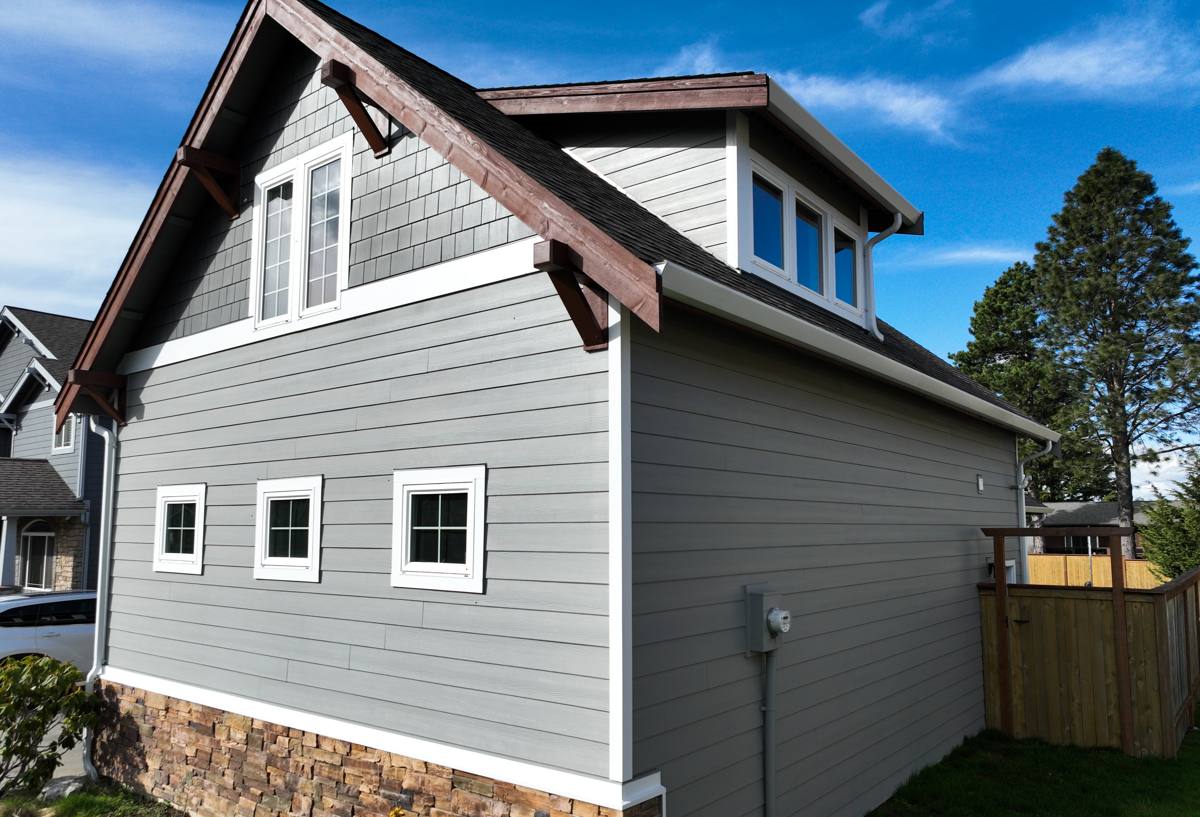
What Bellingham's Climate Actually Does to a House
Salt Air and Corrosion
Proximity to the water means airborne salt settles on siding, trim, and fasteners over time. On products with exposed metal fasteners, painted wood, or seams that aren't properly sealed, that salt accelerates corrosion and paint failure. It's a slow process, which is exactly why it's easy to underestimate until you're looking at rust streaks or lifted paint a decade in.
Driving Rain and Wind-Driven Moisture
Storms coming off the water don't just fall straight down — wind pushes rain sideways into wall assemblies, especially on exposed elevations. This tests not just the siding material itself but the quality of the water-resistive barrier, flashing details, and caulking behind it. A siding product that handles vertical rain fine can still fail if it can't shed wind-driven moisture at seams and penetrations.
The Long Moss and Algae Season
Bellingham's combination of moisture, mild temperatures, and shaded lots (especially near mature trees) creates near-ideal conditions for moss, algae, and mildew growth on exterior surfaces for much of the year. Untreated or absorbent materials — bare wood, some engineered wood products, certain fiber cement without factory finishes — give organic growth something to root into. That growth holds moisture against the surface, which compounds every other problem.
Why We Only Install James Hardie
We used to get asked why we don't offer more siding options. The honest answer is that after years in this trade, we settled on one product because it's the one we trust to perform in exactly the conditions Bellingham and the rest of Whatcom County throw at a house.
- Non-combustible core: Hardie fiber cement is engineered from cement, sand, and cellulose fiber — it doesn't feed a fire the way wood-based products can.
- Factory-applied ColorPlus finish: baked-on color resists fading and chipping far better than field-applied paint, and it holds up to salt air exposure without the repaint cycle wood siding demands.
- Climate-engineered HZ5 formulation: Hardie makes region-specific product lines, and the HZ5 line used in the Pacific Northwest is formulated for wetter, cooler climates — that's a meaningful difference from a one-size-fits-all product.
- Moisture and rot resistance: fiber cement doesn't swell, rot, or delaminate the way wood and some engineered wood products can when they take on repeated moisture.
- Strong transferable warranty: a real, documented warranty that can pass to the next owner matters in a market where homes change hands.
We're upfront that we don't install LP SmartSide, vinyl, Cemplank, Allura, primed spruce, or cedar. Each of those products has legitimate uses and reasonable people choose them — but we've made a professional call that in this climate, on the homes we work on, Hardie gives homeowners the best long-term outcome for the investment. If you want to understand the specific trade-offs with any of those alternatives, we're happy to walk through them honestly rather than just steering you toward what we sell.
How a Bellingham Siding Project Works With Us
Assessment
We start with a walk-around of the home, looking at current siding condition, trim, water intrusion signs, moss or algae buildup, and anything unusual about the lot — heavy shade, exposure to prevailing wind and rain, proximity to mature trees. We also check what's happening behind the siding where accessible, since water damage is often worse than what's visible from the street.
Prep and Moisture Management
Before any new siding goes up, we address the water-resistive barrier and flashing details. This is the part of the job that doesn't show in photos but determines whether the siding performs for decades or fails early. In a climate with driving rain and long wet seasons, this step isn't optional — it's the difference between a siding job and a siding problem waiting to happen.
Installation to Manufacturer Spec
James Hardie's warranty and real-world performance depend on correct installation — proper fastener placement, clearances, caulking, and flashing. We install to spec, not to whatever is fastest.
Finish Details
Trim, corners, and transitions are where a lot of siding jobs cut corners. We treat these as part of the system, not an afterthought.
Beyond Siding: Roofing, Windows, and Decks
Siding rarely fails in isolation. A roof that's shedding water poorly, windows with failed flashing, or a deck ledger board holding moisture against the house all interact with how the siding performs. We handle roofing, windows, and decks as well as siding, which means we can look at a Bellingham home's exterior as one connected system rather than a series of unrelated projects. That matters most at transitions — where a roofline meets a wall, where a window is set into siding, where a deck attaches to the house — because that's where most real-world water problems start.
Comparing Common Siding Approaches
| Factor | James Hardie Fiber Cement (HZ5) | Untreated Wood / Cedar | Vinyl |
|---|---|---|---|
| Moisture resistance | Strong — engineered for wet climates | Variable, needs ongoing maintenance | Doesn't absorb, but can trap moisture behind it |
| Fire behavior | Non-combustible core | Combustible | Can soften/deform under heat |
| Moss/algae resistance | Factory finish resists organic growth | Absorbent surface, prone to growth | Resists growth but seams can trap debris |
| Finish longevity | Factory-baked ColorPlus finish | Repaint/reseal every few years | Color molded in, but can fade and become brittle |
| Salt air performance | Well-suited with correct fastener/flashing detail | Accelerated wear near coast | Generally stable but seams and fasteners vary |
What to Look For When Vetting a Siding Contractor
- Licensed and insured in Washington, with proof available on request
- Willing to explain their moisture barrier and flashing approach, not just the siding brand
- Manufacturer-informed installation practices, not shortcuts around fastener spacing or clearances
- Clear, written scope of work before any deposit changes hands
- Local presence and reputation you can verify, not just a traveling crew passing through the region
- Straight answers about product trade-offs, including products they choose not to install and why
Cost Factors Homeowners Should Understand
Every Bellingham home is different, so we won't quote a number without seeing the job, but a few factors consistently drive cost on siding projects in this area:
- Existing condition: how much of the old siding, sheathing, or framing needs repair before new siding goes on
- Home size and complexity: square footage, number of corners, stories, and trim details
- Access: lots with heavy landscaping, slopes, or tight setbacks take more time
- Product selection: Hardie panel, lap, and shingle profiles carry different material and labor costs
- Scope beyond siding: whether roofing, window, or deck work is bundled into the same project
Why a Local Crew Matters Here
We're based in Lynden and work Whatcom County regularly, which means we're not guessing at how Bellingham's microclimate — the salt exposure, the shaded lots, the moss season that runs longer than most homeowners expect — affects an exterior. We're also around after the job is done, which matters for warranty support and for the kind of follow-up questions that come up a year or two into owning a new exterior. A contractor who's local isn't just convenient — it's someone with a reputation in the community that depends on the work holding up.
If you're weighing a siding, roofing, window, or deck project on a Bellingham home, we're happy to take a look and give you a straightforward, no-pressure estimate — request one using the form below.