 Lynden Siding
 Why Birch Bay Homes Wear Out Faster Than Homes Inland
Birch Bay sits right on the water, and that changes what siding has to deal with compared to a house even a few miles inland in Lynden or elsewhere in Whatcom County. Homes here face a combination most siding products were never really engineered for: near-constant salt-laden air off the bay, wind-driven rain that hits walls at an angle instead of falling straight down, and a long, damp shoulder season where moss and algae get every opportunity to take hold. None of this is dramatic on any given day. It's the accumulation over years that separates a siding job that still looks good at year fifteen from one that's chalking, swelling, or growing green streaks by year seven.
Salt air is corrosive to fasteners and finishes in ways plain rainwater isn't. Combined with the marine humidity that sits over Birch Bay for a good chunk of the year, you get a slower drying cycle for the exterior envelope than a similar house would see on the east side of the county. Siding that can't shed water fast or handle repeated wetting and drying without swelling is going to show it here first.
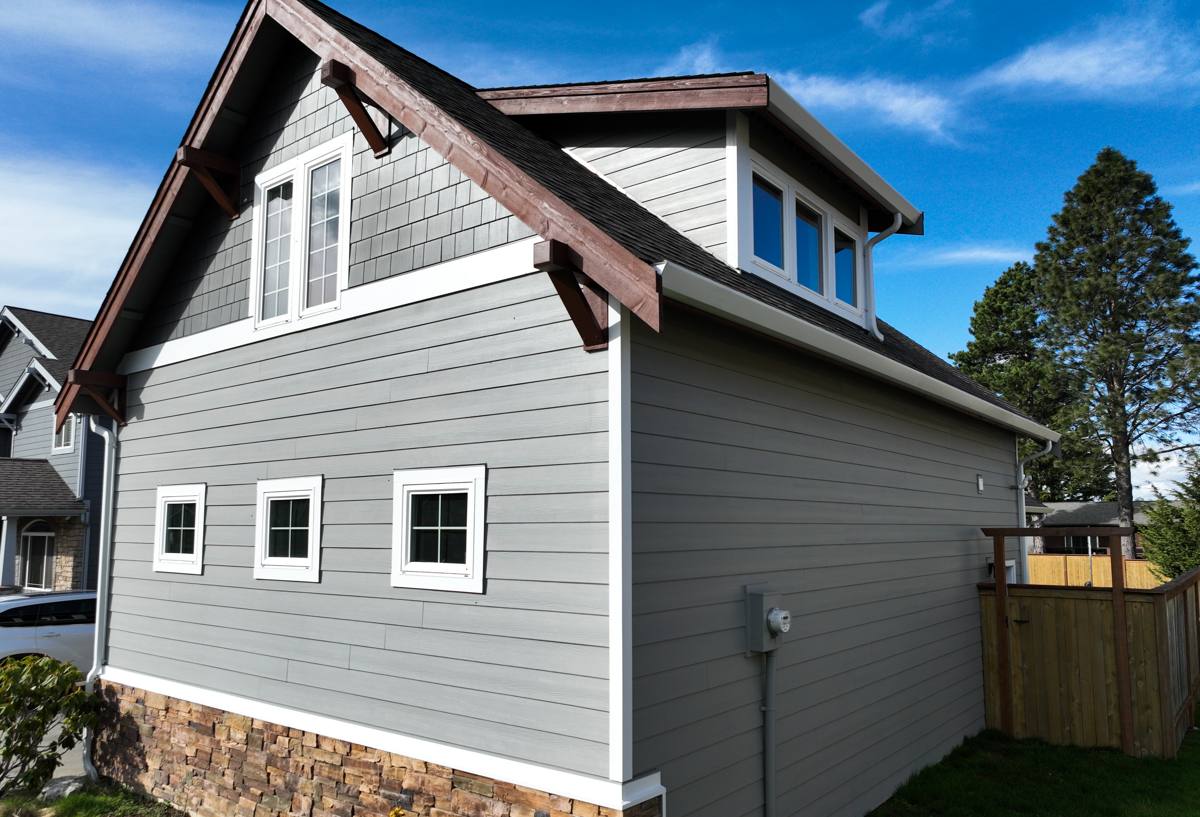
What We See on Birch Bay Exteriors
Wind-Driven Rain and Wall Saturation
Birch Bay's exposure to open water means storms don't just drop rain straight down — they push it sideways into siding, trim, and window flashing. That kind of driving rain finds every gap in a lap joint, every under-caulked seam, and every spot where flashing was skipped to save time. Over the years, that's where we find rot starting on older homes, usually at butt joints, corner boards, and anywhere trim meets siding without proper flashing behind it.
Moss, Algae, and the Long Wet Season
The maritime climate around Birch Bay keeps humidity elevated for months at a stretch, especially on north- and west-facing walls that don't get much direct sun to dry them out. That's prime territory for moss and algae growth on siding surfaces, particularly wood-based products with any texture for spores to grip. It's mostly a cosmetic issue at first, but moss holds moisture against the wall longer, which accelerates whatever underlying problem is already there.
Salt Air and Metal Components
Fasteners, flashing, and hardware near the coast corrode faster than the same materials would inland. This isn't unique to Birch Bay, but it's more pronounced here than in most of the rest of Whatcom County simply because of proximity to the water. It's part of why we pay close attention to fastener spec and flashing materials on every coastal job, not just the siding panel itself.
Why We Only Install James Hardie Fiber Cement
Lynden Siding Replacement made a deliberate decision years ago to standardize on James Hardie fiber cement siding and stop installing everything else — no vinyl, no LP SmartSide, no Cemplank or Allura, no primed spruce or cedar. That's not a marketing angle; it's a standard we hold because of what we've seen play out on homes across this region, and Birch Bay's coastal exposure makes the case even stronger.
Fiber cement is non-combustible and dimensionally stable in a way that wood-based and engineered wood products aren't. It doesn't swell and shrink with every wet-dry cycle the way an OSB-core product can, which matters enormously in a location where the wet cycle rarely fully lets up. James Hardie's ColorPlus factory finish is baked on under controlled conditions, which gives it better UV and moisture resistance than field-applied paint — an advantage that shows up over a decade of coastal weather, not in the first year.
We're not saying every other product is without merit. Vinyl is inexpensive and low-maintenance in mild climates. Engineered wood sidings can look good and install quickly. Cedar has real appeal for homeowners who want a natural look. But each comes with a trade-off — moisture sensitivity, impact vulnerability, ongoing maintenance, or a shorter realistic service life — that we're not willing to install and then answer for years later when a Birch Bay homeowner calls about a problem we saw coming from the first walkaround.
How James Hardie's Product Lines Fit This Climate
James Hardie makes climate-engineered HZ product lines specifically formulated for different regions. For the Pacific Northwest, that means a formulation tuned for moisture exposure and freeze-thaw cycling rather than a one-size-fits-all product. Combined with a factory ColorPlus finish, that's a meaningfully different proposition than a field-painted or unfinished product exposed to Birch Bay's air from day one.
Comparing Siding Options for a Coastal Whatcom County Home
| Material | Moisture Behavior in Coastal Air | Maintenance | Fire Resistance | Typical Longevity |
|---|---|---|---|---|
| James Hardie Fiber Cement | Dimensionally stable, factory-sealed finish | Low — occasional wash | Non-combustible | 30+ years with proper install |
| Vinyl | Can warp/crack in temperature swings; seams allow water behind panel | Low, but limited repair options | Combustible, can melt/deform | 15-25 years, shorter near coast |
| LP SmartSide / Engineered Wood | Vulnerable to edge swelling if seals fail | Moderate — inspect seams/caulking | Combustible | 20-30 years if maintained |
| Cedar / Primed Spruce | Absorbs moisture, prone to rot in wet seasons without upkeep | High — repaint/reseal cycle | Combustible | 15-25 years with regular maintenance |
Full Exterior Envelope: Siding, Roofing, Windows, and Decks
Siding doesn't work in isolation, and on a Birch Bay property that's especially true. Roofing, window flashing, and even decking all interact with how water moves around and off the building. We handle all four because a siding job that ignores a leaking roof valley or a poorly flashed window is just deferring the same water problem to a different surface.
Roofing
A roof that's shedding water properly, with intact flashing at valleys and penetrations, keeps that water off the wall assembly in the first place. On coastal homes we pay particular attention to how roof drainage interacts with siding at the eaves and gable ends.
Windows
Window flashing is one of the most common failure points we find during siding tear-off, especially on older Birch Bay homes. Replacing siding is a natural point to correct flashing details that were never right to begin with, rather than resealing the same problem back into the wall.
Decks
Decks facing the water take their own beating from salt air and rain, and the ledger connection where a deck meets the house is another spot where water intrusion into the wall assembly commonly starts. We look at that connection as part of any exterior scope on a waterfront or near-waterfront property.
What a Siding Replacement Looks Like Here
- On-site assessment of existing siding, trim, flashing, and any moisture or rot found during removal
- Removal of old siding down to sheathing, with a full look at the wall assembly before anything new goes up
- Repair of any damaged sheathing or framing found underneath — this is common on older coastal homes and gets addressed before re-siding, not covered over
- Installation of a code-compliant weather-resistive barrier suited for a high-moisture coastal exposure
- Correct flashing at all windows, doors, corners, and penetrations — this is where most long-term failures start if skipped
- Installation of James Hardie fiber cement siding to manufacturer specification, including proper fastening and clearances for a coastal climate
- Final walkthrough and warranty documentation
Signs a Birch Bay Home May Need Siding Attention Soon
- Visible moss or algae streaking, especially on north- or west-facing walls
- Soft or spongy spots when pressing on siding near the bottom courses or around windows
- Paint or finish that's chalking, peeling, or has lost its sheen faster than expected
- Gaps opening up at trim boards, corners, or butt joints
- Visible rust staining around fasteners or metal flashing
- Interior drywall or trim staining near exterior walls, which can indicate water getting through
Why a Local Crew Matters in Birch Bay
A crew that works across Whatcom County regularly knows which details matter most on a given site and which don't. On a Birch Bay job, that means defaulting to more conservative flashing and fastening details than you'd use on a home a few miles inland, because the exposure calls for it. It also means we're not learning the local climate on your project — we've already seen what a decade of salt air and driving rain does to different products and installation approaches across this region, and we bring that experience to every estimate.
Being local also means we're accountable after the job is done. If something needs a look five years down the road, we're still here, in the same county, working on the same kinds of homes.
Cost Factors for a Birch Bay Siding Project
| Factor | Why It Matters Here |
|---|---|
| Extent of moisture/rot damage found at tear-off | Coastal homes more often need sheathing or framing repair before re-siding |
| Home size and wall complexity | More corners, trim, and penetrations mean more flashing detail work |
| Siding profile and color selection | James Hardie offers multiple plank widths and ColorPlus finishes at different price points |
| Window and flashing condition | Failed flashing found during tear-off should be corrected, not resealed |
| Scope beyond siding | Bundling roofing, window, or deck work can be more efficient than separate projects later |
If your Birch Bay home is due for new siding, or you're just noticing early signs of moss, staining, or wear from the coastal air, we're happy to come take a look. A free, no-pressure estimate is the easiest way to find out what's actually going on with your exterior and what it would take to fix it right.