 Lynden Siding
 Why Color Choice Matters More in Lynden's Climate
Picking a siding color feels like the fun part of a siding project, right up until you realize the color you choose has to survive a Whatcom County winter, a wet spring, and a summer of UV exposure without fading, chalking, or peeling. Lynden sits close enough to Puget Sound and the Strait of Georgia that homes here deal with a steady dose of salt-tinged air, long stretches of driving rain off the water, and a moss season that can run from October well into May. That combination is hard on paint film. It is a lot less hard on a factory-applied finish engineered to take it.
This is where the color conversation and the product conversation become the same conversation. On fiber cement, how the color gets onto the board matters as much as which color you pick. That is the whole reason we standardized on James Hardie siding with ColorPlus Technology instead of offering primed boards that get field-painted after installation, or alternative fiber cement and composite products that don't offer a comparable factory finish system.
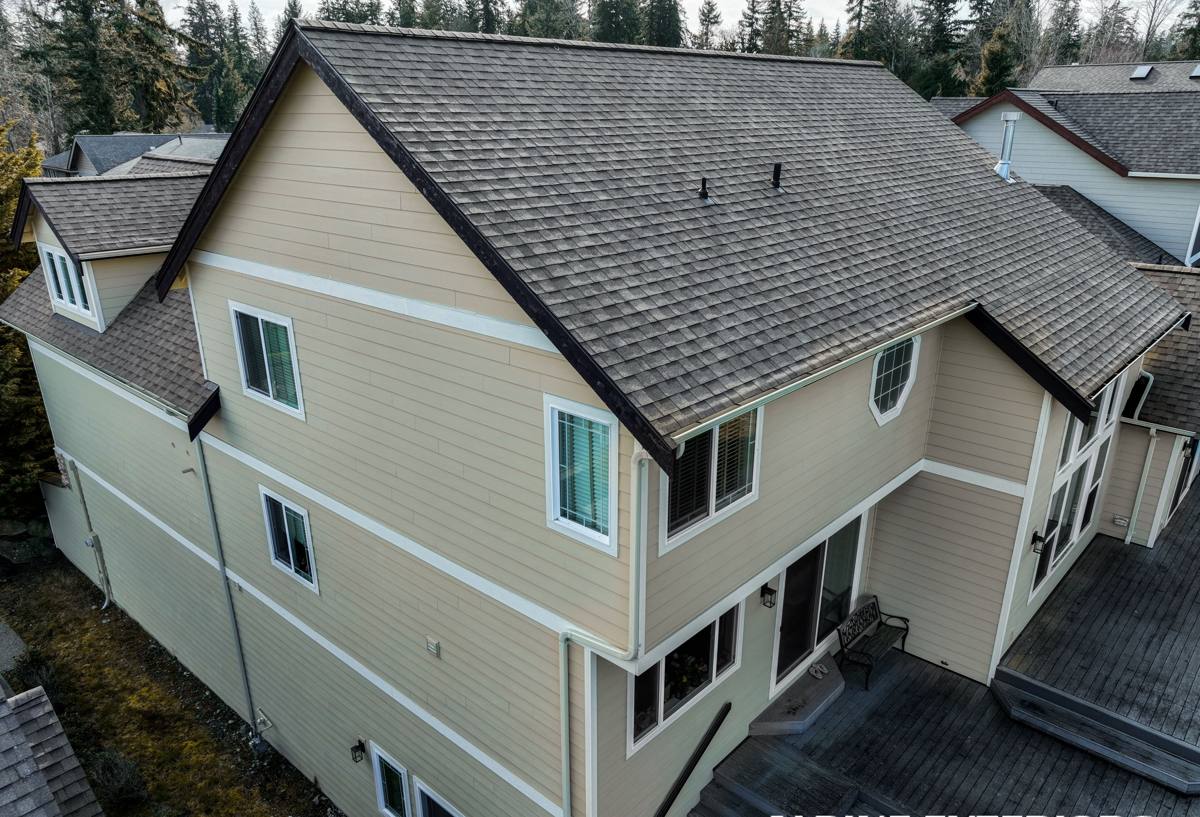
What ColorPlus Technology Actually Is
ColorPlus is James Hardie's factory finishing process. Instead of shipping primed boards to a jobsite where a crew brushes, rolls, or sprays paint on-site, ColorPlus boards are coated and cured in a controlled factory environment, typically with multiple coats baked on before the siding ever leaves the plant. The result is a finish that's more uniform, more consistently cured, and considerably more resistant to fading and moisture intrusion than a coat of paint applied in the field, where temperature, humidity, and application technique all vary.
Baked-On Finish vs. Field-Applied Paint
A field-applied paint job is only as good as the weather conditions on the day it's sprayed and the skill of whoever's holding the sprayer. Paint applied too cold, too wet, or too thin will fail early — and on the Whatcom County coast, you don't always get a long dry window to work with. ColorPlus finishes are cured under factory conditions every time, which removes that variable entirely. It's also why ColorPlus siding carries a stronger finish warranty than what you'd typically get on a repainted primed board.
Why This Matters for Lynden Homes Specifically
Salt-laden air accelerates the breakdown of lower-quality paint films by attacking the bond between coating and substrate. Add Lynden's rain totals and the moss and algae growth that comes with sustained dampness, and you have an environment that punishes any weak point in a finish. A baked-on, multi-coat factory finish gives the color system a real head start against all three of those stressors.
The James Hardie Color Systems
James Hardie organizes its ColorPlus offering into a few different tiers, and understanding the difference helps you set realistic expectations before you start picking swatches.
The Statement Collection
This is Hardie's core, broadly available palette — a curated set of colors chosen to work well across architectural styles and regions, from deep charcoals and navy blues to warm neutrals and classic whites. These are the colors most homeowners land on, and they're generally the most readily stocked, which keeps lead times shorter.
Regional and Designer Palettes
Depending on the product line and region, Hardie also offers additional curated palettes developed with input from architects and designers, aimed at colors that read well in specific regional light and against specific regional building styles — think the muted, weather-appropriate tones that tend to suit Pacific Northwest homes rather than colors developed for high desert or coastal Southeast light.
Custom and Special-Order Color Matching
If you're matching an HOA requirement, a trim color already on the house, or a very specific vision, custom color matching is possible on certain Hardie products, though it typically comes with longer lead times and sometimes a per-order minimum. We'll tell you upfront if a custom match is going to affect your timeline — no surprises mid-project.
Matching Color to Whatcom County Architecture
Lynden has a real mix of housing stock — farmhouse-style homes on larger lots, newer craftsman and modern-farmhouse builds, and plenty of straightforward ranch and two-story homes from past decades. Color choice interacts with all of that.
- Lighter, warmer neutrals tend to read well against the region's frequent cloud cover and soft light, without looking stark or clinical.
- Deep charcoal, black, and navy tones have become popular on newer builds, but they absorb more heat and show dust, pollen, and water spotting more visibly — worth weighing if low-maintenance appearance is a priority.
- Board-and-batten and horizontal lap siding read differently in the same color; if you're mixing textures on one elevation, it helps to see physical samples in Lynden's actual daylight before committing.
- Trim, fascia, and soffit colors should be planned alongside the field color, not as an afterthought — mismatched sheens or slightly-off whites are one of the most common regret points homeowners mention.
ColorPlus vs. Field-Painted Siding: A Side-by-Side Look
| Factor | ColorPlus (Factory-Applied) | Field-Applied Paint on Primed Siding |
|---|---|---|
| Application environment | Controlled factory conditions, every board | Whatever the weather is on install day |
| Coating consistency | Multiple cured coats, uniform thickness | Varies by crew, sprayer, and technique |
| Typical repaint interval | Often 15 years or more before touch-up is needed | Commonly 5-8 years in wet coastal climates |
| Touch-up availability | Matched touch-up product available from the color line | Depends on saved paint code and product still being manufactured |
| Warranty on finish | Separate, extended finish warranty from Hardie | Typically covered only by the paint manufacturer's standard product warranty |
Maintenance, Fading, and the Warranty Behind the Color
No exterior finish is maintenance-free, and we won't tell you ColorPlus is. What it does offer is a meaningfully longer runway before you're looking at a repaint, plus a manufacturer warranty structure that backs the finish specifically — not just the substrate underneath it. That warranty is transferable to a subsequent homeowner in most cases, which matters if you're not planning to be in the house forever; it's a real selling point when the time comes to list.
What Realistic Upkeep Looks Like
In Lynden's climate, realistic upkeep means an annual rinse-down to knock off pollen, road film, and the early stages of moss or algae growth, particularly on north-facing walls and anywhere siding sits close to trees or shaded fence lines. A soft wash with a garden hose and mild detergent is usually enough; pressure washers should be used cautiously and from a distance, since aggressive pressure can drive water behind trim and flashing regardless of what siding product is installed.
What Voids Coverage
Warranty coverage on any siding finish typically assumes the product was installed to the manufacturer's written specifications — correct fastening, proper clearances from grade and roof lines, and correctly flashed and caulked joints. This is why installation quality and color longevity aren't really separate topics. A perfect color choice installed with the wrong fasteners or without proper clearance from the ground will still fail early, warranty or no warranty.
Installation Details That Protect Your Color Investment
A few installation specifics have an outsized effect on how a ColorPlus finish performs over time, and they're worth asking any contractor about directly.
Fasteners and Touch-Up
Hardie specifies particular fastener types and placement for its products, and part of a clean installation is keeping fastener heads properly seated and, where needed, touched up with matched product rather than left bare or over-driven, which can crack the board's factory finish at the point of impact.
Caulking and Joint Treatment
Butt joints, corners, and penetrations (vents, hose bibs, light fixtures) need to be sealed with a caulk compatible with fiber cement and the ColorPlus finish. Poor caulking is one of the most common sources of early moisture staining and localized color changes around joints — not a flaw in the color system itself, but an installation shortcut that shows up as one.
Clearance and Drainage
Siding held too close to grade, patios, or roof lines traps moisture against the board. In a climate with Lynden's rainfall, that's a fast track to staining and premature wear regardless of how good the underlying finish is. Correct clearances are a code and manufacturer requirement, not an optional refinement.
A Practical Checklist Before You Choose
- Look at physical color samples outdoors, in overcast Pacific Northwest light, not just under indoor showroom lighting.
- Check the color against your roof, existing stonework or brick, and any features that won't be changing.
- Ask whether your chosen color is in the standard Statement Collection or requires a special order, and what that does to your timeline.
- Confirm what touch-up product is available for that specific color and how it's applied if a board is ever damaged.
- Get the finish warranty terms in writing, including whether it's transferable if you sell the home.
- Ask your contractor to walk through their fastening, caulking, and clearance approach — not just the color catalog.
Why We Only Install James Hardie
We don't offer LP SmartSide, vinyl, Cemplank, Allura, or primed wood siding, and color performance is a real part of why. James Hardie's ColorPlus system, paired with its HZ5 climate-engineered product line built for wet, moderate coastal climates like ours, gives us a finish and substrate combination we can stand behind on every home we side in Lynden. That's not a knock on every alternative product in isolation — it's that we'd rather install one system correctly and back it with a warranty that means something than offer a menu of options with inconsistent long-term performance in this specific climate.
If you're planning a siding replacement and want to talk through color options, HZ5 product specifics, or what correct installation looks like for your home, we're glad to walk through it. Reach out for a free, no-pressure estimate using the form below.