 Lynden Siding
 Two Products, One Category — Why the Comparison Gets Confusing
Homeowners in Lynden researching a siding replacement quickly run into a wall of look-alike products. Cemplank and James Hardie are both sold as "fiber cement siding," both come in lap and panel profiles, and both get pitched by installers as a step up from vinyl. On a spec sheet, they can look nearly identical: similar thickness, similar density claims, similar fire resistance. That surface-level similarity is exactly why this comparison matters — the differences that actually affect how your siding performs on a Whatcom County home aren't on the front of the brochure. They're in the manufacturing consistency, the factory finish system, the product engineering for specific climates, and the warranty fine print.
We're a Hardie-only contractor, so we'll say up front where we land. But this page isn't a takedown of Cemplank — it's a straight comparison of what each product is, where they overlap, and where the gap is wide enough that we decided years ago not to install anything but Hardie.
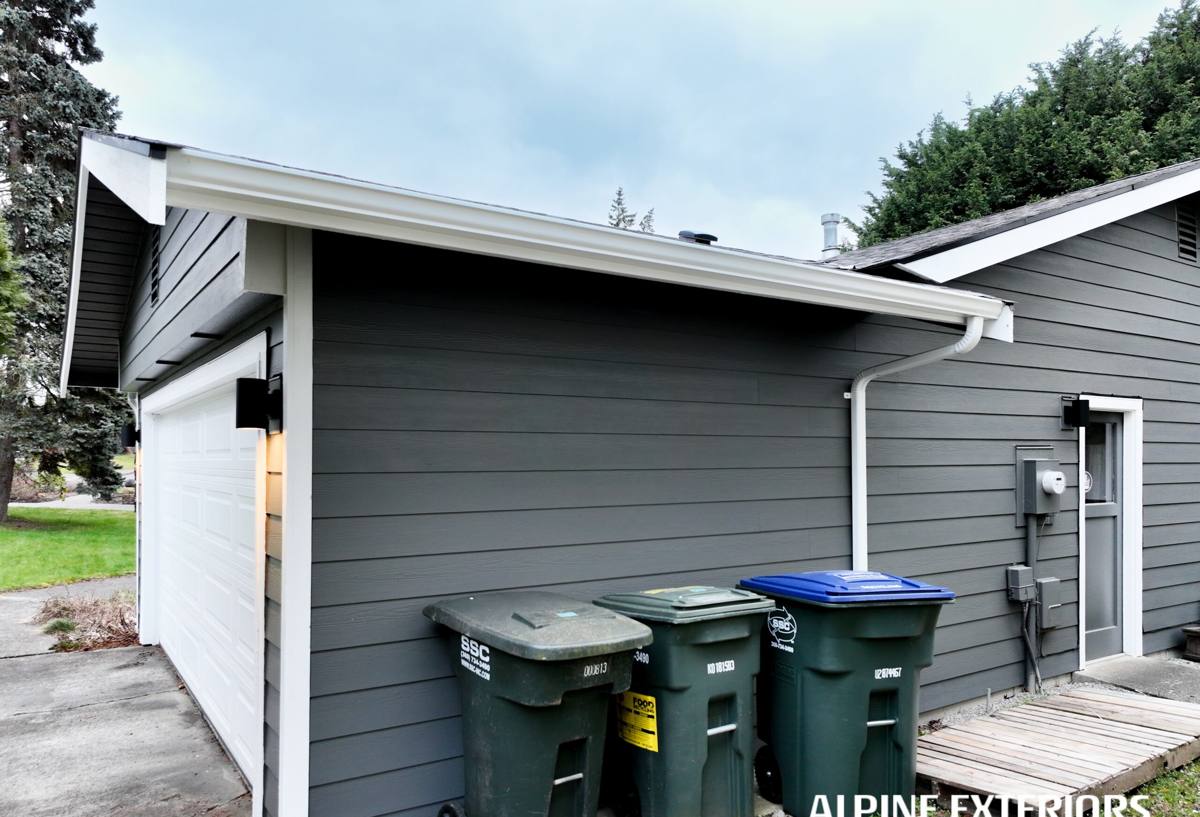
What Cemplank Gets Right
Cemplank is a real fiber cement product, manufactured by Etex (the parent company that also owns Nichiha and several other building material brands). It's non-combustible, resists rot and insect damage the way all cement-based siding does, and holds paint or factory finish far better than wood. For a homeowner comparing it only against vinyl or engineered wood, Cemplank is a legitimate upgrade — it's not a knockoff product or a corner-cutting substitute. Etex has real fiber cement manufacturing experience, and Cemplank is sold and installed across the country by contractors who stand behind it.
Where Cemplank is often positioned is as a lower-cost fiber cement option, frequently sold through big-box and lumberyard channels rather than through a dedicated dealer network. That distribution model isn't a defect in the product itself, but it does shape a few things downstream — installer training, finish consistency, and the depth of technical support available when a job runs into a tricky detail. Those are the areas where the real-world differences start to show.
Where the Two Products Genuinely Overlap
- Both are Portland cement, sand, and cellulose fiber composites — not vinyl, not wood, not a proprietary "engineered" plastic blend.
- Both resist fire, woodpeckers, and rot in ways that vinyl and untreated wood cannot.
- Both are available in lap siding, panel siding, and trim profiles suitable for most residential exteriors.
- Both require correct fastening, clearances, and caulking details to perform as designed — neither is forgiving of sloppy installation.
Manufacturing Consistency and Product Engineering
James Hardie built its business specifically around fiber cement and has spent decades refining the formulation for different climate zones. Its HZ5 product line, for example, is engineered specifically for the wetter, more freeze-cycle-prone climates of the Pacific Northwest — different from the HZ10 formulation sold in the arid Southwest. That's not marketing language; it reflects a real decision to tune the cement-to-fiber ratio and moisture resistance for the actual weather a region sees. Cemplank does not offer that same degree of regional product differentiation — it's manufactured to a broader specification meant to perform adequately across a wider range of climates, rather than being tuned specifically for a place like Lynden.
That distinction matters more here than in most parts of the country. Whatcom County sits close enough to the Salish Sea that homes get real salt air exposure, on top of some of the wettest, longest rainy seasons in the Lower 48 and a moss season that can run most of the year on north-facing walls. Siding that's engineered with margin for that combination — sustained moisture, salt, and biological growth — has less room for error than siding built to a generic national spec.
Factory Finish: ColorPlus vs. Field-Applied or Standard Finishes
This is one of the most underrated differences between the two products. Hardie's ColorPlus finish is baked on in a controlled factory environment, in multiple coats, with a bond that's tested to resist fading, chipping, and cracking far longer than a field-applied paint job — and it comes with its own dedicated finish warranty separate from the substrate warranty. Cemplank is more commonly sold primed, requiring the contractor or homeowner to arrange final paint after installation, or in a more limited range of factory finish options depending on the distributor. A field-painted finish is only as good as the paint, the prep, and the weather conditions on the day it was applied — variables a factory finish removes entirely.
Cemplank vs. James Hardie: Side-by-Side
| Factor | Cemplank | James Hardie |
|---|---|---|
| Manufacturer | Etex Group | James Hardie Building Products |
| Climate-specific formulations | Limited regional differentiation | HZ5 zone engineering for PNW moisture and freeze cycles |
| Factory finish | Often primed; finish options vary by distributor | ColorPlus baked-on finish standard on most lines |
| Finish warranty | Varies by product and finish type | Separate, transferable finish warranty on ColorPlus products |
| Substrate warranty | Limited warranty, terms vary by product line | Long-term limited warranty, non-prorated in early years |
| Distribution | Big-box and lumberyard channels common | Dealer network with dedicated technical and installer support |
| Installer training programs | Less standardized nationally | Preferred Contractor / Elite training programs |
Installation Sensitivity — Where a Good Product Goes Bad
No fiber cement product installs itself correctly. Both Cemplank and Hardie require proper clearance from grade and roof lines, correct fastener spacing, and caulked joints that are actually sealed — not just cosmetically finished. Where this becomes a real issue is that a less standardized installer training pipeline means more variability in how a crew handles those details. We've seen call-backs on other brands where the siding itself wasn't the problem — the installation was. Butt joints without proper flashing, missing kick-out flashing at roof-to-wall intersections, or fasteners driven too close to panel edges will cause water intrusion regardless of which manufacturer's name is on the box.
This is really an installer-quality issue as much as a product issue, but it compounds with a product that has more finish and formulation variability. When a home is getting driving rain off the Nooksack valley for months at a time, there's very little tolerance for a joint that was caulked but not actually sealed.
Why Lynden's Climate Raises the Stakes
Lynden homes deal with a specific combination of stressors: moisture that doesn't let up for months, moss and algae growth on shaded and north-facing walls that can start within a year or two if a surface holds any texture or porosity, occasional coastal-influenced salt air, and UV exposure during the drier summer stretch that tests whatever finish is on the siding. None of that is exotic — it's just persistent. Siding here doesn't fail from one dramatic event; it fails slowly, from small gaps in moisture management and finish durability that get worse every wet season. That's why the engineering and finish differences between products matter more here than they might in a drier, milder climate.
Warranty: Read the Actual Terms, Not the Headline
Every fiber cement manufacturer offers some form of limited warranty, and on paper the numbers can look similar. The real differences are in the terms: whether the warranty is prorated after the first several years, whether the finish is covered separately from the substrate, whether the warranty is transferable to a future homeowner without a fee or paperwork hurdle, and what voids coverage (often improper installation, which loops back to installer quality). Hardie's warranty structure has been tested at scale for decades, with a well-established claims process. That track record — and the transferability that protects resale value — is part of why we standardized on it.
Cost Factors to Weigh, Not Just the Sticker Price
Cemplank is frequently the lower upfront cost option, and for a homeowner on a tight budget that's a real consideration worth respecting. But the honest cost comparison has to include more than the invoice.
| Cost Factor | What to Consider |
|---|---|
| Upfront material and labor | Cemplank is often modestly less expensive per square |
| Repainting cycle | Primed or lower-tier finishes may need repainting sooner than a factory-baked finish |
| Warranty claim value | A warranty is only worth what it pays out — check proration schedules |
| Resale transferability | Easier transfer terms can matter to a future buyer's inspection and financing |
| Long-term maintenance | Moss, mildew, and caulk maintenance costs accrue over the life of the siding |
What to Ask Any Contractor Before You Sign
- Is the product's finish factory-applied, and is that finish covered by its own warranty?
- Is this specific product line rated or formulated for Pacific Northwest moisture and freeze-thaw conditions?
- What is the manufacturer's warranty proration schedule, and is it transferable to a future owner?
- What installer certification or training does your crew have with this specific product?
- How are butt joints, roof-to-wall intersections, and kick-out flashing detailed on this job?
- What does the warranty require to stay valid, and what would void it?
Why We Install Only James Hardie
We're not going to tell you Cemplank is a bad product — it isn't. It's a legitimate fiber cement option that plenty of homeowners live with successfully. Our decision to install only James Hardie comes down to wanting one standard we can fully vouch for on every job: a factory finish we don't have to hope holds up, a formulation engineered for the specific moisture and freeze-cycle conditions Whatcom County sees, a warranty structure with a long track record, and a manufacturer training and support system that backs our crews when a detail gets tricky. For siding that has to survive Lynden's rain, moss, and salt air for decades, that margin is worth it to us — and we think it's worth it to the homeowners we build for.
If you're weighing siding options for a home in Lynden or elsewhere in Whatcom County, we're glad to walk through what we see on your specific house and give you a free, no-pressure estimate — no obligation, just a straight answer about what your home needs.