 Lynden Siding
 Exterior Work Built for Deming's Climate
Deming sits in the shadow of the foothills along the Nooksack River corridor, east of Lynden, where the tree cover is heavier, the rainfall lingers longer, and the marine air moving in off the Whatcom County lowlands keeps everything a little damp for most of the year. Homes out here don't get baked by sun the way properties further inland do. They get soaked, shaded, and left to dry slowly, which is a different kind of stress on a house than what you'd see in a drier climate. Add in driving rain that comes sideways during winter storms and a moss season that can run from October through May, and you've got an exterior envelope that's working hard every single day just to keep the structure behind it dry.
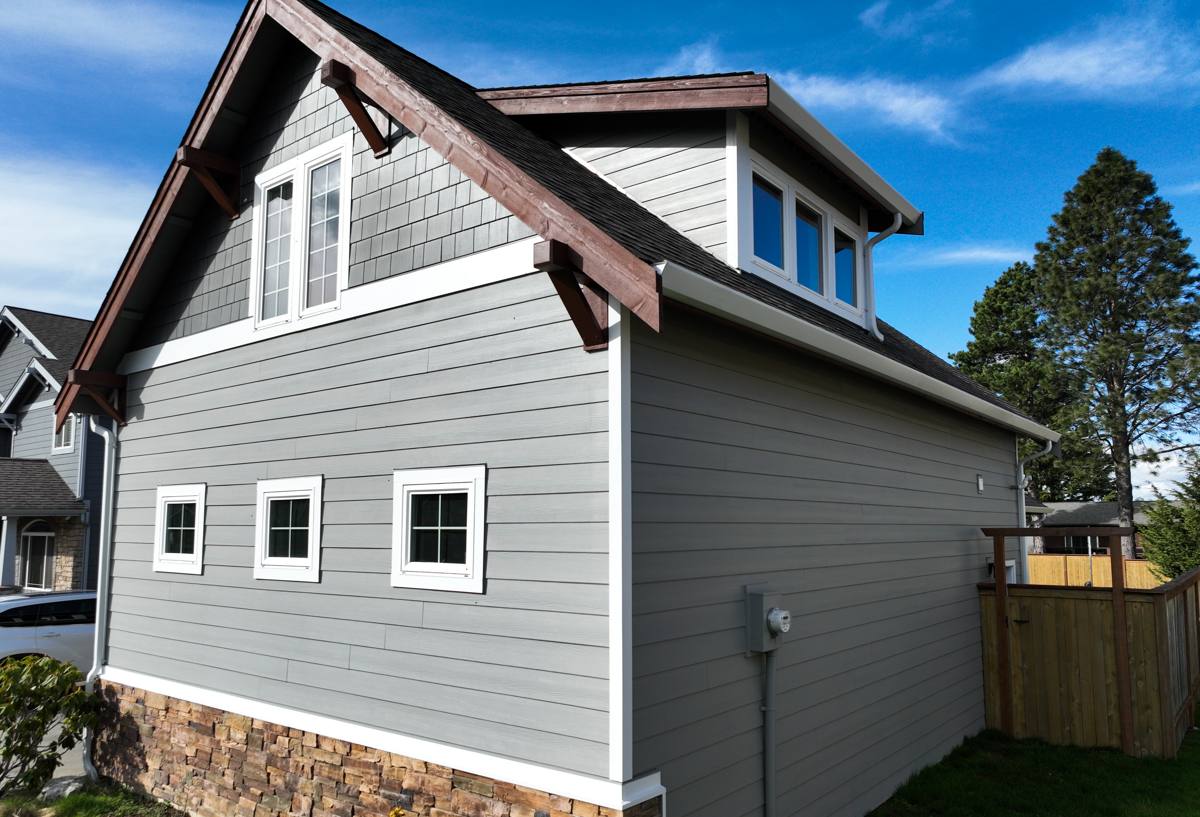
We've been doing siding, roofing, window, and deck work throughout this part of Whatcom County long enough to know that Deming homes need materials and installation details that actually match the conditions, not generic products pulled off a shelf. That's the whole reason we standardized on James Hardie fiber cement siding for every siding job we do, in Deming and everywhere else we work.
What the Local Climate Does to Siding
Moisture That Doesn't Let Up
The forested, low-lying terrain around Deming holds humidity close to structures longer than open, wind-exposed sites. Siding here doesn't get a quick dry-out after a storm the way it might in a sunnier microclimate. Wood-based products — cedar, primed spruce, and engineered wood siding like LP SmartSide — depend on paint film and edge sealing to keep water out. Once that film is compromised at a cut edge, a nail hole, or a caulk joint that's failed, moisture gets in and has very little incentive to leave. That's when you start seeing swelling, soft spots, and eventually rot.
Moss, Algae, and Organic Growth
Constant shade from the tree canopy plus persistent moisture is exactly the recipe moss and algae need. It's not just cosmetic — organic growth holds water against the siding surface and, on porous or textured materials, works into the substrate over time. Smooth, factory-finished siding with a dense fiber cement core resists that kind of buildup far better than wood grain textures that give spores something to grip.
Driving Rain and Wind-Driven Water
Storms moving through this corridor often bring rain at an angle, not straight down. That means water gets forced up under laps, into seams, and against trim details that a calmer climate would never test. Flashing, house wrap integration, and lap installation have to be done correctly — the material itself is only half the equation.
Why We Only Install James Hardie Fiber Cement
We don't install vinyl, LP SmartSide, Cemplank, Allura, primed spruce, or cedar. That's a deliberate standard, not a lack of options. Here's the honest reasoning:
- Vinyl expands and contracts with temperature swings, can warp or crack in cold snaps, and doesn't hold up structurally the way a rigid fiber cement panel does over decades.
- LP SmartSide and other engineered wood products perform reasonably well in drier climates, but in a wet, shaded environment like Deming's, any breach in the factory coating opens the door to moisture absorption and swelling at the strand-board core.
- Cemplank and Allura are also fiber cement, and not bad products — but we've built our installation training, warranty relationships, and color-matching systems around one manufacturer so every crew member knows the product inside and out, with no guesswork between job sites.
- Primed spruce and cedar are beautiful and traditional, but they demand a maintenance schedule — recaulking, repainting, checking for soft spots — that most homeowners underestimate until they're dealing with rot at year eight or ten.
James Hardie fiber cement is non-combustible, dimensionally stable, and manufactured with a factory-applied ColorPlus finish that's baked on rather than field-painted, which matters enormously in a climate where field-applied paint has fewer good drying windows. Hardie also engineers specific product lines (their HZ5 formulation) for regions with freeze-thaw cycles and sustained moisture, which describes Deming's winters well.
Siding Installation Done Right
The product is only as good as the install. On every Hardie siding job we do, we pay close attention to the details that actually determine whether a house stays dry for the next 30 years:
- Proper water-resistive barrier and flashing integration behind the siding, not just over it
- Correct lap exposure and fastening per Hardie's published installation specs, which affects both appearance and performance
- Sealed and back-primed cut edges on-site wherever field cuts are unavoidable
- Rain screen or drainage gap detailing where the wall assembly calls for it
- Trim and butt joint sealing designed to shed water instead of trapping it
Installed off-spec, even the best siding product can fail early. Installed to spec, Hardie siding is built to go decades with minimal upkeep — which is the entire point of paying for a premium material in the first place.
Roofing, Windows, and Decks — The Rest of the Envelope
Siding doesn't work in isolation. A house is a system, and in a climate like this, every component either helps keep water moving away from the structure or gives it a place to collect.
Roofing
Roof condition directly affects siding performance. Poor flashing at roof-to-wall transitions, clogged gutters, or worn-out valleys send water exactly where siding is least equipped to handle it — behind laps and into trim joints. When we're on a Deming property for siding work, we look at the roof line as part of the same conversation.
Windows
Old or improperly flashed windows are one of the most common sources of hidden water intrusion we find during siding tear-off. Replacing siding without addressing failing window flashing just buries the same problem under new material. We integrate window flashing details with the siding install rather than treating them as separate jobs.
Decks
Decks in this area face the same moss, moisture, and shade exposure as siding, plus standing water on horizontal surfaces. Ledger board attachment and flashing where a deck meets the house wall is one of the highest-risk water intrusion points on the entire structure, and it deserves the same attention to detail as any siding seam.
Cost Factors for Deming Homes
Every property is different, but these are the variables that most affect the scope and cost of a siding project out here:
| Factor | Why It Matters |
|---|---|
| Existing siding material | Removal of old cedar or wood siding is more labor-intensive than removing vinyl; hidden rot found underneath adds sheathing repair |
| Home size and complexity | Cut-up facades with lots of gables, dormers, or trim detail take longer and use more material than simple rectangular walls |
| Tree cover and site access | Wooded lots common around Deming can mean tighter staging, more hand-carrying of material, and scheduling around wet ground conditions |
| Moisture damage discovered during tear-off | Sheathing or framing repair from long-term moss and moisture exposure is common on older homes and should be budgeted as a possibility, not assumed |
| Siding profile and finish | Lap width, panel vs. plank, and ColorPlus vs. field-painted options all affect material cost |
| Trim and accessory work | Fascia, soffit, and window trim replacement alongside siding adds cost but avoids mismatched materials aging at different rates |
What to Check When Hiring a Siding Contractor Here
Whatcom County has no shortage of exterior contractors, but not all of them are set up to handle the specific demands of a shaded, high-moisture site like Deming. Before hiring anyone for siding, roofing, window, or deck work in this area, a homeowner should ask:
- Do they carry current Washington contractor licensing and insurance, and can they show proof without hesitation?
- Are they a certified or factory-trained installer for the specific siding product they're proposing?
- Will they explain their flashing and water management details, not just the visible siding material?
- Do they inspect for existing moisture damage before quoting, rather than after tear-off surprises them?
- Can they provide a written scope that separates material, labor, and any contingency for hidden repairs?
- Are they familiar with this specific area's conditions, or is it a generic quote copied from a drier climate job?
A Local Crew That Knows This Ground
Working around Lynden, Deming, and the rest of Whatcom County day in and day out means we've seen what actually fails on these homes and what holds up. That local pattern recognition is worth more than a glossy brochure — it's why we standardized on one siding system we trust completely instead of offering a menu of products with different failure points, and it's why we treat roofing, windows, and decks as connected parts of the same water-management problem rather than separate line items.
If you're weighing a siding project in Deming, or want a second opinion on roofing, windows, or a deck, we're happy to come take a look. There's no pressure and no cost to get an honest assessment and a written estimate — just fill out the form below to get started.