 Lynden Siding
 Board & Batten Siding for Bellingham Homes
Board and batten has become one of the most requested looks in Bellingham over the past several years — it shows up on new farmhouse-style builds along the edges of town, on remodels near the waterfront, and on additions where homeowners want a cleaner, more vertical profile than traditional lap siding gives them. It's a strong look. It's also a siding style that punishes a sloppy install faster than almost any other profile, which matters a lot in a climate like ours.
Bellingham sits close enough to the water that homes deal with salt-laden air, long stretches of driving rain off the Sound, and a moss and algae season that can run most of the year on shaded elevations. Board and batten siding — with its vertical wide boards and narrow battens covering the seams — creates more joints, more fastener penetrations, and more transition points than a standard lap profile. Every one of those details has to be flashed and sealed correctly, or the style that looks great on day one starts showing problems by year three or four.
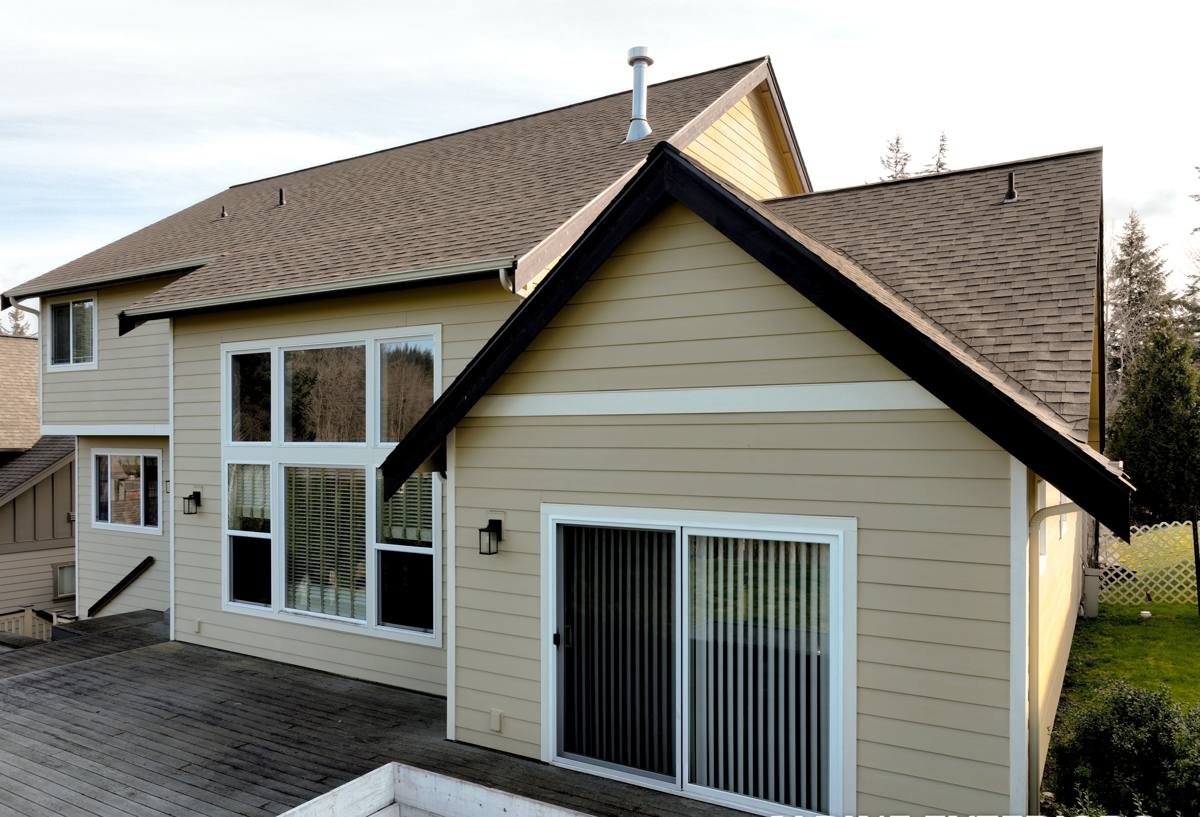
Why This Style Needs Extra Attention Here
Vertical siding sheds water differently than horizontal lap siding. On a lap profile, gravity does most of the work — each board overlaps the one below it, and water runs down and off. Board and batten relies more heavily on the battens themselves, the caulk or sealant at the seams, and the quality of the water-resistive barrier behind the whole assembly to keep moisture out. In a region that sees sustained rain events rather than quick downpours, that assembly has to hold up over days at a time, not just minutes.
Add in salt air near the coast and the moss growth that thrives in Whatcom County's damp, mild winters, and you've got three separate stresses working on the same siding at once: moisture intrusion at the joints, corrosion risk on fasteners and trim, and organic growth that traps moisture against the wall if it's not addressed. A board and batten job that ignores any one of these will age poorly, regardless of which siding material sits underneath.
What Goes Wrong With a Rushed Board & Batten Install
- Battens fastened without a proper gap or sealant strategy, trapping moisture against the wall instead of shedding it
- Water-resistive barrier gaps or short laps behind the boards, invisible until moisture damage shows up years later
- Fasteners driven through both the board and batten without accounting for expansion and contraction, leading to splitting or fastener pull-through
- Poor flashing at window and door transitions, where vertical siding creates more cut lines than lap siding
- Battens spaced or sized inconsistently, which reads as a workmanship shortcut even before any water problem shows up
Why We Only Install This in James Hardie Fiber Cement
Board and batten is available in several materials — vinyl, engineered wood, cedar, and fiber cement all get sold in this profile. We install it only in James Hardie fiber cement, and the reasoning is the same reasoning behind every siding job we take on: this style demands a material that won't swell, cup, or rot at the cut ends and joints, because board and batten has more of both than any other common profile.
Engineered wood and cedar board and batten can look excellent when new, but both are organic materials, and organic materials absorb moisture at cut edges and fastener holes. In a climate with Bellingham's rain totals and moss pressure, that's a maintenance commitment — recoating, resealing cut ends, and watching for soft spots — that most homeowners don't want to sign up for indefinitely. Vinyl board and batten avoids the rot question but flexes and fades over time, and it doesn't hold paint if a homeowner ever wants to change the color down the road.
James Hardie fiber cement is cement, sand, and cellulose fiber — it doesn't absorb water the way wood does, and it won't corrode or rust. It's also non-combustible, which matters given wildfire smoke seasons have become a regular late-summer concern even on the wet side of the state. Hardie's factory-applied ColorPlus finish is baked on and warrantied against peeling and cracking, so the color holds without the recoat cycle that wood and some engineered products need. That combination — dimensional stability, moisture resistance, and a finish that's engineered rather than field-applied — is why it's the only material we put behind a board and batten job.
HardiePanel Vertical Siding
For board and batten specifically, most Bellingham installs use HardiePanel vertical siding as the field panel, with HardieTrim boards as the battens. HardiePanel comes in a Select Cedarmill or smooth finish and is engineered as part of Hardie's HZ5 product line, built for the Pacific Northwest's wet-side climate zone rather than a generic national spec. That regional engineering is a real distinction — it's why we don't substitute in a siding line built for a drier climate just because it's cheaper.
Our Process for a Board & Batten Job in Bellingham
1. Assessment and Wall Prep
We start by evaluating the existing wall assembly — sheathing condition, any signs of past moisture intrusion, and the state of window and door flashing. Board and batten only performs as well as what's behind it, so this step isn't skipped even on homes that look fine from the curb.
2. Water-Resistive Barrier and Flashing
A continuous, properly lapped water-resistive barrier goes down first, with flashing integrated at every window, door, and penetration before a single piece of siding goes up. This is the step that determines whether the assembly actually sheds Bellingham's rain or just looks like it does.
3. Panel and Batten Installation
HardiePanel goes up to Hardie's fastening and clearance specifications — correct fastener spacing, correct gaps at inside and outside corners, and proper clearance above rooflines, decks, and grade. Battens are then installed over the panel seams with attention to expansion gaps, so the assembly can handle our seasonal humidity swings without cracking or splitting.
4. Trim, Caulking, and Finish Details
Trim, corners, and any transitions get finished per manufacturer spec, and caulking is applied only where Hardie's installation guidelines actually call for it — over-caulking a fiber cement assembly can trap moisture just as easily as under-caulking it, which is a detail that gets missed by crews who don't install Hardie regularly.
5. Final Walkthrough
We walk the finished job with the homeowner, checking sightlines, batten spacing consistency, and paint/finish quality before calling it complete.
Why a Crew That Already Works Bellingham Matters
Board and batten installation isn't fundamentally different in Bellingham than anywhere else in Whatcom County, but the climate consequences of getting it wrong show up faster here. A crew that regularly works this area already knows which elevations take the worst of the driving rain, where moss pressure tends to build fastest, and how to sequence a job around our wetter months instead of fighting them. That local pattern recognition is the difference between a spec sheet followed on paper and an install that's actually built for the wall it's going on.
Cost Factors to Expect
| Factor | Why It Affects Price |
|---|---|
| Wall complexity | More corners, dormers, and transitions mean more cut battens and more flashing detail work |
| Existing siding removal | Tear-off and disposal of old material adds labor before the new assembly can start |
| Sheathing or moisture repair | Any rot or water damage found during removal needs to be addressed before new siding goes up |
| Panel and batten finish | Smooth vs. Cedarmill texture and custom trim widths affect material cost |
| Home height and access | Two-story walls and limited access add scaffolding or lift time |
We give firm numbers only after seeing the actual wall condition — anyone quoting a board and batten job sight-unseen is guessing, and on this profile the guess is usually wrong in the homeowner's favor until the invoice arrives.
Signs Your Current Siding Needs a Second Look
- Soft spots or visible swelling along batten edges or panel seams
- Persistent moss or algae streaking that returns within a season of cleaning
- Caulk that's cracked, pulled away, or missing at seams and trim joints
- Paint or finish that's peeling rather than just fading
- Any staining on interior walls near exterior corners, which can point to moisture already past the siding
If you're considering board and batten siding for a Bellingham home, we're happy to take a look and walk you through what a correct install involves for your specific wall. Reach out for a free, no-pressure estimate using the form below.