 Lynden Siding
 Exterior Work for Abbotsford Homes, Built for a Fraser Valley Climate
Abbotsford sits just across the border from Lynden, close enough that a lot of homeowners there already cross into Whatcom County regularly for work, shopping, or family. It made sense for us to extend our siding, roofing, window, and deck work north to serve Abbotsford directly, because the climate on both sides of the line is really the same climate. Homes here deal with salt-tinged air carried in off the Salish Sea and the Fraser Valley's low-lying wetlands, driving rain that comes in sideways more often than straight down, and a moss season that can run most of the year on shaded roofs and walls. That combination wears down exterior materials faster than most homeowners expect, and it's exactly the kind of environment where the difference between a properly installed exterior and a cut-corner one shows up within a handful of years, not decades.
We handle siding, roofing, windows, and decks for Abbotsford homes, and we treat those four trades as one connected exterior system rather than four separate line items. On siding specifically, we install James Hardie fiber cement exclusively — no LP SmartSide, no vinyl, no Cemplank, no Allura, no primed spruce, no cedar. That's a professional standard we hold to on every job, not a marketing angle, and it's rooted in what we've seen repairing and replacing exterior systems in this exact stretch of the Pacific Northwest and southwest British Columbia.
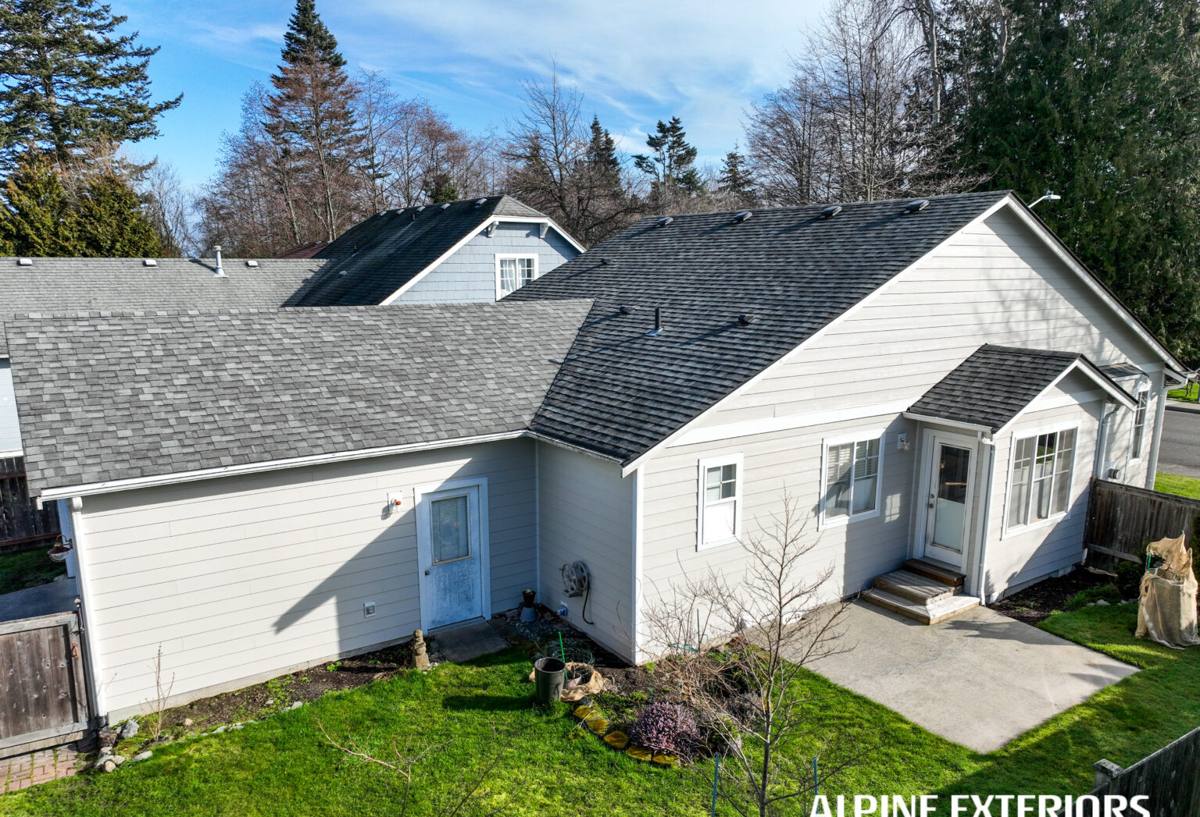
What This Climate Does to a House
Salt Air and Coastal Influence
Abbotsford isn't right on the water, but the Fraser Valley funnels marine air inland from the Salish Sea, and that air carries enough salt content to matter for exterior materials over time. Salt-laden moisture accelerates corrosion on fasteners, hardware, and any metal flashing or trim that isn't rated for it, and it can also work into porous or poorly sealed siding surfaces faster than plain rainwater would on its own. It's a slower, quieter kind of wear than a wind-driven storm, but it adds up over the life of a roof or wall system.
Driving Rain
Rain in this region rarely falls straight down for long. Wind pushes it sideways into wall assemblies, window flashing, and the transitions where roofs meet walls, which is a tougher test than a simple annual rainfall total suggests. A siding or roofing system that would perform fine in a calmer, drier climate can fail here specifically because water is finding its way in from the side, not just from above, and that's a detail a lot of national contractors don't build for.
A Long Moss Season
Mild temperatures, tree cover, and near-constant moisture add up to a moss and mildew season across the Fraser Valley and Whatcom County that runs most of the year, not just a few wet months. Shaded roof planes and north-facing walls are usually first to show it. Any material that holds moisture against the surface instead of shedding it and drying between rain events becomes a growth surface over time, and that growth does more than look bad — it holds water against the substrate underneath.
Freeze-Thaw Swings
Abbotsford sees more winter cold snaps than towns right on the coast, in part because of cold air that funnels down through the valley corridor from the interior. Combined with the region's heavy moisture load, that means exterior materials here go through real freeze-thaw cycling, not just occasional frost. Materials and installation details that aren't built for that cycling tend to show cracking, cupping, or seam failure well ahead of schedule.
Why We Only Install James Hardie Siding
We used to offer a wider range of siding products. We stopped, and the reason came from what we kept finding on tear-offs and service calls in this climate, not from a supplier arrangement or a sales incentive.
- Non-combustible core: Fiber cement doesn't feed a fire the way wood-based siding products can, which matters for both safety and insurance considerations.
- Factory-applied ColorPlus finish: The color is baked on under controlled factory conditions instead of applied in the field, which holds up better against fading, chalking, and moisture than site-painted finishes.
- Climate-engineered HZ product lines: Hardie's HZ5 formulation is built for regions with significant moisture exposure and freeze-thaw cycling — a fair description of a Fraser Valley winter.
- Dimensional stability: Fiber cement doesn't swell, warp, or cup the way engineered wood products can when they repeatedly absorb and release moisture over a wet season.
- Strong transferable warranty: Hardie backs the product with one of the more robust warranty structures in the industry, provided the installation follows their spec.
LP SmartSide, vinyl, Cemplank, Allura, primed spruce, and cedar all have a legitimate place in the market, and plenty of homeowners are satisfied with them. We're not here to tell anyone those products are junk. We've simply made a professional call that in a climate carrying salt air, driving rain, and a moss season that barely takes a break, we'd rather install one system we fully stand behind than offer a cheaper option that quietly shifts maintenance risk onto the homeowner down the road.
Roofing for Abbotsford Homes
The roof takes the most direct hit from this climate — wind, driving rain, salt air, and moss all land there first before anything else on the house. A roof system needs correctly lapped flashing at every penetration and wall transition, underlayment suited to sustained moisture exposure, and ventilation that lets the roof deck and attic actually dry out between storms instead of staying damp. In a valley environment like Abbotsford's, where fog and humidity can linger well after a storm passes, ventilation isn't an upsell — it's what keeps a roof deck from staying wet long enough to invite rot or moss growth underneath the shingles. We build roofing systems around those fundamentals as the baseline on every job.
Windows: Where Siding and Weatherproofing Meet
A surprising number of exterior moisture problems actually start at the windows, even when the visible damage eventually shows up somewhere else on the wall. Poorly flashed windows let wind-driven rain track down into the wall cavity behind the siding, and by the time it shows up as staining or soft trim, it's often been happening for a while unnoticed. With the salt air and driving rain this area sees, window flashing details carry real weight. When we install windows or coordinate window replacement with a siding project, we integrate the flashing into the whole wall assembly instead of treating the window as a standalone swap.
Decks Built for a Wet Valley Climate
Decks take on standing moisture and moss growth on horizontal surfaces that don't drain and dry as quickly as a vertical wall does. In a climate with Abbotsford's rainfall and humidity, a deck surface can stay damp far longer after a storm than one in a drier region. Framing, fastener corrosion resistance, and board spacing all matter more here than they would somewhere drier, because a deck built without those considerations tends to develop soft spots, rot, and slippery moss buildup well before it should.
Cost Factors Across Siding, Roofing, Windows, and Decks
| Project | What Drives Cost | Climate-Specific Consideration |
|---|---|---|
| Siding | Home size, tear-off vs. overlay, trim complexity | Substrate repair if moisture has already worked behind old siding |
| Roofing | Roof size, pitch, number of penetrations and valleys | Underlayment and flashing quality for sustained rain and salt air exposure |
| Windows | Number of openings, frame material, full-frame vs. insert replacement | Flashing integration built for wind-driven rain |
| Decks | Size, framing material, railing style | Drainage and corrosion-resistant fasteners for a consistently damp climate |
Exact numbers depend on the home and the scope of work, which is why we walk each property before putting together a real estimate instead of quoting off a generic price list.
Signs an Abbotsford Home Needs Exterior Attention
- Moss or dark staining on siding or roof surfaces that returns quickly after cleaning
- Soft or spongy siding, especially low on the wall or around window trim
- Peeling or chalking paint, or visible warping, on shaded and north-facing walls
- Missing, curling, or granule-shedding shingles on the roof
- Rust staining near fasteners or hardware, a sign salt air is accelerating corrosion
- Drafts, fogging, or visible gaps around window frames
- Soft boards or spongy footing on an older deck
Why a Local, Cross-Border Crew Matters
Homeowners in Abbotsford sometimes assume a contractor has to be based on their side of the line to really understand the area, but the exterior challenges here don't stop at the border. Salt air, driving rain, and a long moss season behave the same way in Abbotsford as they do a short drive south in Lynden, and a crew that works this stretch of the Pacific Northwest and southwest B.C. day to day sees how those conditions actually play out on real houses over a full year. That experience shapes practical decisions on install day — where extra flashing attention matters most, which wall orientations stay wet longest, which fastener choices hold up against salt exposure — rather than applying a generic approach built for a drier region.
Get a Free, No-Pressure Estimate
If your Abbotsford home needs new siding, a roof inspection or replacement, window work, or a deck built for this climate instead of against it, we're glad to take a look and give you a straightforward, honest assessment. Reach out using the form below to schedule a free estimate — no pressure, no upsell script.