 Lynden Siding
 Custer's Climate Is Harder on Siding Than Most Homeowners Realize
Custer sits close enough to the Salish Sea and Birch Bay that salt-laden air is a regular part of the weather mix, not an occasional event. Add Whatcom County's long wet season, the near-constant tree cover that keeps yards shaded and damp, and a moss season that can run from fall through spring, and you have a combination that wears out the wrong siding material faster than most homeowners expect. This isn't a page about siding in general — it's about what actually holds up on a Custer home, and what a correct installation looks like when the goal is 30-plus years of performance, not just a fresh coat of curb appeal.
Siding on a Custer home has to manage three things at once: repeated moisture exposure from driving rain that comes in sideways off open fields and waterfront, airborne salt that accelerates corrosion and finish breakdown, and constant low-light dampness that feeds moss and algae growth on north-facing and shaded walls. Any one of those is manageable. All three together, year after year, is what separates siding that lasts from siding that becomes a maintenance project.
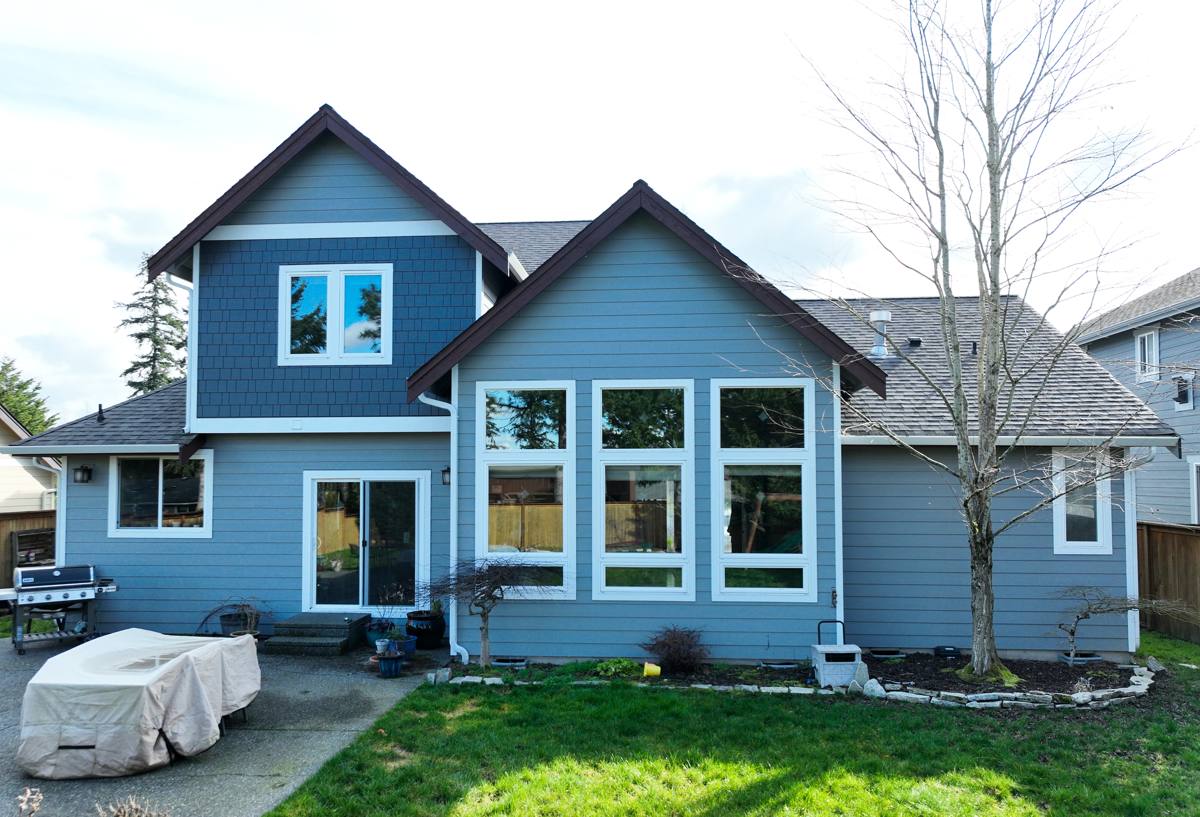
What Salt Air, Driving Rain, and Moss Actually Do to Siding
Salt Air
Airborne salt is corrosive to fasteners, trim flashing, and metal accessories, and it accelerates the breakdown of paint and coatings on materials that weren't engineered with a marine-adjacent climate in mind. Over time, homes closer to open water or exposed to onshore wind see faster fading, chalking, and finish failure than the same product would show further inland.
Driving Rain
Wind-driven rain doesn't just wet the surface of a wall — it pushes moisture into every gap, seam, and fastener penetration it can find. Siding systems that rely on face-sealed joints or that swell and warp when saturated are the ones that fail first. What matters is how a product and its installation detail handle water that's actively being forced sideways, not just water running down in a straight line.
Moss and Algae
Shaded, damp walls in Whatcom County grow moss and algae readily, especially on north and east exposures under tree cover. This isn't just cosmetic — sustained organic growth holds moisture against the siding surface, which is a problem for any material that can absorb water or that provides organic material (like wood cellulose) for moss to root into.
Why We Install Only James Hardie Fiber Cement
We standardized on James Hardie siding for every home we work on, including in Custer, because it's engineered for exactly these conditions. Fiber cement is non-combustible, doesn't swell or rot when it takes on moisture, and holds its factory-applied ColorPlus finish far longer under UV and salt exposure than field-applied paint on wood-based products. Hardie's HZ5 product line is specifically engineered for climates with high moisture exposure — which describes Whatcom County's coastal zone well.
We don't install LP SmartSide, vinyl, Cemplank, Allura, primed spruce, or cedar. Each of those has legitimate uses somewhere, but none of them hold up to the salt-air-plus-driving-rain-plus-moss combination as reliably as fiber cement does over a 20-to-30-year ownership horizon, and we'd rather stand behind one product installed correctly than offer several and hope the cheaper ones work out.
How Hardie Compares for Custer's Conditions
| Factor | James Hardie Fiber Cement | Vinyl | Wood / Cedar / Primed Spruce |
|---|---|---|---|
| Moisture response | Dimensionally stable, doesn't swell or rot | Doesn't rot but can warp; seams leak | Absorbs water, prone to rot without upkeep |
| Salt air / finish life | Factory ColorPlus finish resists fading and chalking | Fades and becomes brittle over time | Paint/stain breaks down faster near salt air |
| Moss/algae resistance | Non-organic, nothing for moss to root into | Surface growth possible, hard to clean without damage | Organic surface feeds moss growth |
| Fire rating | Non-combustible | Combustible | Combustible |
| Typical warranty | Long transferable manufacturer warranty | Varies, often shorter | Finish warranty only, if any |
What a Correct Installation Actually Involves
Fiber cement siding is only as good as the installation behind it. Most of the "siding problems" homeowners in this region deal with — staining, buckling, caulk failure at joints, moisture getting behind the wall — trace back to installation shortcuts, not the material itself. A correct James Hardie install includes:
- A proper weather-resistive barrier and drainage plane behind the siding, so any water that does get past the surface has somewhere to go
- Correct fastener type, spacing, and penetration depth — under- or over-driven nails are one of the most common failure points we find on re-sides
- Manufacturer-specified clearances at grade, roofline, and deck/patio intersections so wood-to-ground or siding-to-hardscape contact doesn't trap moisture
- Properly lapped and sealed joints, with flashing (not just caulk) doing the real water-shedding work at windows, doors, and trim transitions
- Factory-primed or factory-finished cut edges resealed on site per Hardie's specifications, so field cuts don't become the weak point in an otherwise sound install
Every one of these details matters more in Custer's climate than it would in a drier region, because there are more chances per year for water to find a gap and more months of the year where that moisture doesn't get a chance to fully dry out between rain events.
Our Process for a Custer Siding Installation
1. On-Site Assessment
We walk the home, check the current siding and sheathing condition, look at grading and drainage around the foundation, and note shaded/damp zones where moss has been an issue. This tells us whether we're dealing with a straightforward re-side or whether there's underlying moisture damage to address first.
2. Tear-Off and Substrate Check
Old siding comes off and we inspect the sheathing underneath. Any soft, delaminated, or moisture-damaged sheathing gets flagged and repaired before anything new goes up — installing new siding over a compromised substrate just hides a problem, it doesn't fix it.
3. Weather Barrier and Flashing
We install or verify a continuous weather-resistive barrier and correctly flash all penetrations, windows, and doors. This is the layer that actually protects the home if wind-driven rain gets past the siding face — it matters as much as the siding itself.
4. Hardie Installation to Manufacturer Spec
Panels or planks go up per James Hardie's installation guidelines: correct fasteners, correct clearances, correct joint treatment. We don't deviate from spec to save time, because deviations are exactly what shows up as callbacks two or three winters later.
5. Final Walkthrough
We review the completed job with the homeowner, confirm caulking and trim details, and go over basic care so the siding performs the way it's designed to for decades, not just for the first few years.
Cost Factors for a Custer Siding Job
| Factor | How It Affects the Job |
|---|---|
| Home size and wall complexity | More corners, gables, and trim details mean more labor and material cuts |
| Substrate condition | Rotted or moisture-damaged sheathing found during tear-off adds repair scope |
| Product line and profile | Lap siding, panels, and shingle-style Hardie products have different material and labor costs |
| Access and site conditions | Steep lots, tree cover, or tight access around the home affect crew time |
| Trim and accessory scope | Full trim replacement alongside siding is more involved than siding alone |
We give firm numbers only after seeing the specific home — broad ranges without an on-site look aren't useful to homeowners trying to plan a real budget.
What to Check Before You Hire Anyone for This Job
- Ask specifically what siding brand and product line they install, and why — a contractor who installs everything usually isn't specialized in any one system's installation details
- Confirm they follow the manufacturer's written installation instructions, not just "how we've always done it"
- Ask how they handle substrate damage found during tear-off, and whether that's disclosed and priced separately or hidden in a lump sum
- Check that flashing and weather-barrier work is included and explained, not just the visible siding
- Ask about warranty coverage — both the manufacturer's product warranty and the contractor's workmanship warranty
- Look for local experience — a crew that already works in Whatcom County's coastal and rainy conditions will catch details a crew from a drier region might miss
Why a Crew That Already Works in Custer Matters
Siding installation isn't identical everywhere. A crew that primarily works in drier inland climates may not think twice about clearances at grade or the extra attention wind-driven rain demands at window flashing — details that are routine for a crew that works Whatcom County's coastal communities regularly. Familiarity with Custer's specific mix of salt exposure, rainfall patterns, and shaded, moss-prone lots means fewer surprises during the job and a siding system that's set up to handle the conditions it will actually face, not generic conditions from a manufacturer spec sheet.
We also know what local moisture and moss issues look like when we tear off old siding, which means we can flag problems early instead of discovering them mid-project.
Long-Term Value for Custer Homeowners
James Hardie siding, installed correctly, is a long-horizon investment. The ColorPlus factory finish reduces repainting frequency, the non-combustible fiber cement composition holds up to the region's moisture cycle without rotting or swelling, and the manufacturer's transferable warranty protects the investment if the home changes hands before the siding's useful life is up. For a home in Custer's climate, that combination of durability and warranty backing matters more than it would in a milder, drier region — this is a place where the wrong siding choice shows its weaknesses early, and the right one earns its cost back in avoided maintenance and repair.
If you're weighing a siding replacement or new installation in Custer, we're glad to take a look and walk you through what your home specifically needs. Request a free, no-pressure estimate using the form below — there's no obligation, just an honest assessment.