 Lynden Siding
 Why Ferndale Homes Need a Different Siding Conversation
Ferndale sits close enough to the water that salt air is a real factor in how a home's exterior ages, and far enough into Whatcom County's marine climate that it gets the same driving rain and extended damp season as the rest of the Lynden area. That combination — airborne salt, sustained moisture, and a moss season that can run from fall through spring — is hard on siding materials that weren't built to handle all three at once. It's one thing for a product to survive rain. It's another for it to hold its finish, resist moisture intrusion at the seams, and keep moss and mildew from taking hold on a north-facing wall that barely sees direct sun for months at a time.
We install James Hardie fiber cement siding exclusively, and Ferndale is a good example of why. Homes here need a siding system that's dimensionally stable in wet-dry cycling, doesn't feed mold and moss the way some organic or wood-based products can, and holds its factory finish without the homeowner having to repaint every several years just to keep ahead of the weather.
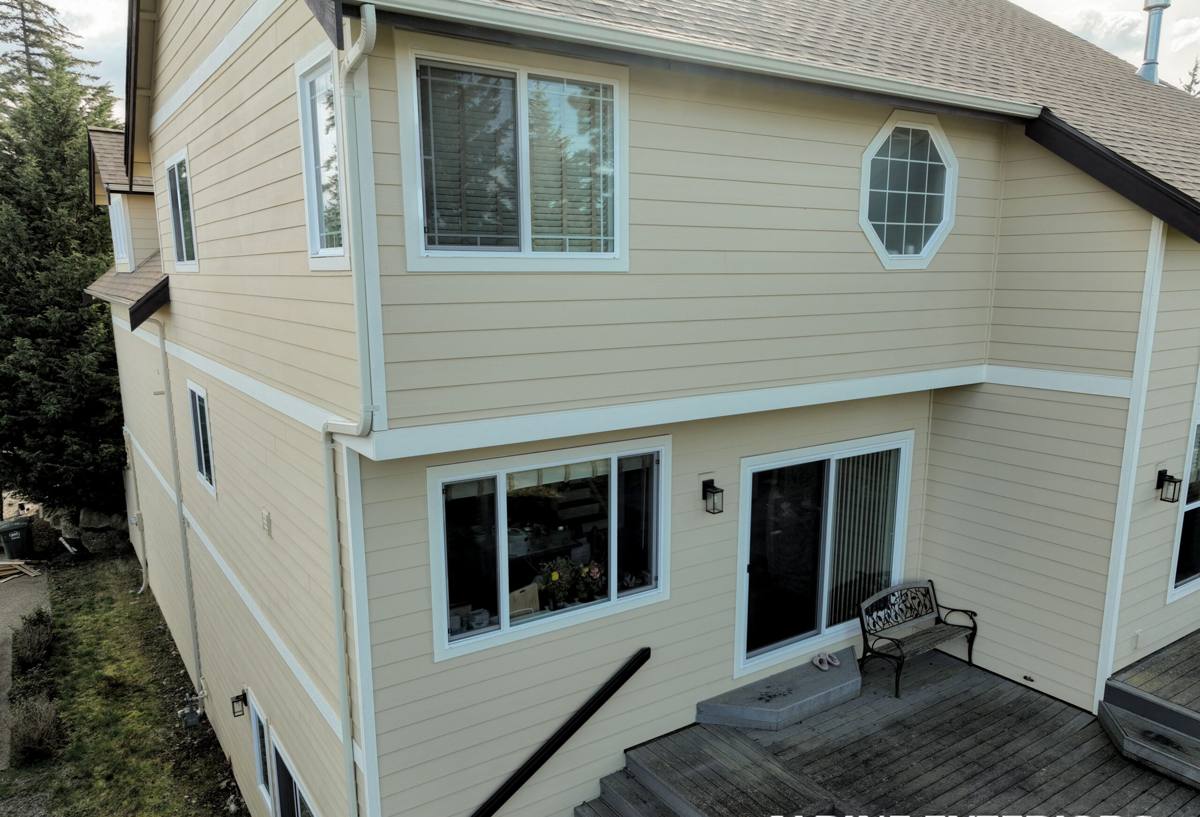
What Salt Air and Moss Actually Do to Siding
Salt air doesn't just affect homes right on the shoreline — it travels, and in a coastal Whatcom County community like Ferndale it's a low-level factor on most exteriors, not just the ones with a water view. Combined with the region's rain and humidity, it accelerates corrosion of exposed fasteners and trim, and it can degrade lower-quality paint finishes faster than a homeowner would expect from the age of the siding.
Moss is the other half of the equation. Ferndale gets enough shade, moisture, and mild temperatures for moss and algae to establish on siding surfaces, especially on north- and west-facing walls, under eaves, and anywhere airflow is limited. Once moss gets a foothold on a porous or wood-based surface, it holds moisture against the material and accelerates whatever decay process is already underway. On a properly installed fiber cement system, moss can still grow on the surface, but it isn't feeding on the substrate the way it can with wood or wood-composite products — it's a cleaning issue, not a structural one.
Why This Matters More Here Than in Drier Climates
A siding product that performs fine in a dry inland climate can behave very differently after a few winters in a marine environment like Ferndale's. The freeze-thaw cycles are milder here than in a true cold climate, but the trade-off is near-constant low-grade moisture exposure for much of the year. That's a different kind of stress test, and it's the one that actually matters for a Whatcom County home.
Why We Install Only James Hardie
James Hardie fiber cement is engineered specifically for climate zones like this one. The HZ5 product line is formulated for the kind of moisture cycling and moderate freeze-thaw exposure common in the Pacific Northwest, and the ColorPlus factory finish is baked on under controlled conditions rather than field-applied, which means better, more consistent resistance to fading and moisture intrusion at the color layer. Fiber cement itself is non-combustible, doesn't rot, and isn't a food source for the moss, mildew, and insects that a damp climate like Ferndale's tends to encourage.
We don't install LP SmartSide, vinyl, Cemplank, Allura, primed spruce, or cedar, and that's a deliberate standard, not a marketing line. Each of those products has legitimate uses and reasonable performance in the right setting. But we've made a professional judgment that in a coastal Whatcom County climate — salt air, sustained rain, long moss season — the long-term maintenance burden and moisture risk of those alternatives isn't worth it compared to what a correctly installed Hardie system delivers. We'd rather install one product well and stand behind it than offer several and hope the climate cooperates.
What Correct Installation Looks Like
James Hardie siding performs the way it's engineered to only when it's installed to the manufacturer's specifications. This is the part that gets skipped or rushed on a lot of jobs, and it's where a huge share of premature siding failures actually originate — not in the material itself.
- Proper water-resistive barrier and flashing details behind the siding, not just at the obvious points like windows and doors
- Correct fastener type, spacing, and penetration depth — over-driven or under-driven nails are a common cause of early failure
- Minimum clearance maintained between the bottom of the siding and grade, decks, patios, and roof lines to keep splash-back and standing moisture away from the board
- Properly sized gaps at butt joints and corners, caulked and treated per Hardie's specifications, not just butted tight
- Correct panel or lap orientation and overlap for the specific product line being installed
- Field-cut edges sealed where required, since factory-primed or ColorPlus edges are the ones engineered for moisture resistance
Skip any of these and you can end up with moisture getting behind the siding regardless of how good the board itself is. In a climate that stays damp as long as Ferndale's does, that mistake shows up faster than it would somewhere drier.
Choosing the Right Hardie Line and Finish for Ferndale
Not every Hardie product is the right fit for every house, and part of our process is matching the line and finish to the home's exposure. A wall that takes direct wind-driven rain off the water needs different attention at the joints and flashing than a sheltered wall on the lee side of the house, even though both might use the same siding product.
| Consideration | Why It Matters in Ferndale |
|---|---|
| Lap vs. panel siding | Lap profiles shed driving rain well and are a common, proven choice for coastal-exposure walls |
| ColorPlus vs. field-painted | Factory finish holds up better against salt air and UV without the maintenance cycle of field paint |
| Trim and fascia material | Matching Hardie trim resists the same moisture and moss pressure as the field siding, unlike mismatched wood trim |
| Fastener material | Corrosion-resistant fasteners matter more near the coast where salt accelerates rust |
| Wall orientation | North and west exposures need extra attention to moss-prone detailing and ventilation clearance |
Our Process for a Ferndale Job
We start with an on-site assessment of the specific home — its orientation, existing siding condition, moisture damage if any, and how exposed each wall is to prevailing weather. From there we walk the homeowner through product and color selection, give a clear written scope, and handle removal of the old siding, correction of any water-resistive barrier or sheathing issues we find underneath, and full installation to Hardie's fastening and clearance specifications. We don't cover up problems that show up mid-tear-off; if we find rot or moisture damage under the old siding, we flag it and address it before anything new goes up. Closing a job over a hidden problem in this climate just guarantees it resurfaces.
What to Expect During the Job
- An initial walk-around and written estimate before any work begins
- Removal of existing siding and inspection of the sheathing and barrier underneath
- Repair of any water damage or rot found before new siding goes on
- Installation per James Hardie's fastening, clearance, and flashing specifications
- Final walk-through so the homeowner knows what was done and what to expect long-term
Why Hiring a Crew That Already Works This Area Matters
A siding contractor who mainly works drier or inland areas can install a technically correct system and still miss details that matter specifically in a marine, salt-air environment — things like extra attention at butt joints on exposed walls, or flashing choices that account for wind-driven rain rather than just vertical rainfall. A crew that regularly works Ferndale and the surrounding Whatcom County coastal communities has already seen how these homes weather over time, which informs decisions on-site that a generic install wouldn't necessarily catch.
It also matters for warranty follow-through. James Hardie's warranty coverage depends on the product being installed correctly, and if something does need attention down the road, having a contractor who's local, knows the home, and knows the climate makes that a straightforward conversation instead of a complicated one.
Maintenance Expectations After Installation
James Hardie siding is low-maintenance, not no-maintenance. In a climate like Ferndale's, that mainly means periodic gentle washing to keep moss, algae, and salt residue from building up on the surface, and an occasional visual check of caulking at joints and trim over the years. It does not mean repainting on a short cycle the way some wood or wood-composite sidings do — the ColorPlus finish is built to hold up without that. We're happy to walk homeowners through simple upkeep steps after installation so the siding keeps performing the way it's designed to for the long haul.
If you're weighing siding options for a home in Ferndale or elsewhere around Lynden, we're glad to take a look and give you a straightforward, no-pressure estimate — just fill out the form below and we'll get in touch.