 Lynden Siding
 Sumas Sits in One of Whatcom County's Toughest Wind Corridors
Sumas has a climate problem most siding products were never designed to handle. The town sits at the base of the Sumas Gap, the low pass where cold, dense air funnels out of British Columbia's Fraser Valley and accelerates as it drops into Washington. Locals know these as outflow winds, and they hit Sumas and the surrounding lowlands harder and more often than most of the rest of Whatcom County. Add in the driving rain that rolls off the Salish Sea weather systems and settles over the Nooksack lowlands, plus a long, damp shoulder season that keeps north-facing walls shaded and wet for weeks at a stretch, and you get siding conditions that punish anything with a weak moisture seal or a joint that wasn't detailed correctly.
That combination — wind-driven rain plus persistent shade and moisture — is exactly what grows moss and algae on siding, and it's exactly what finds every gap in flashing, every unsealed butt joint, and every fastener that wasn't set to spec. Homes in Sumas don't need siding that merely looks good. They need a system that's engineered for sustained moisture exposure and wind loading, installed by people who've actually dealt with what this specific stretch of the county throws at a house.
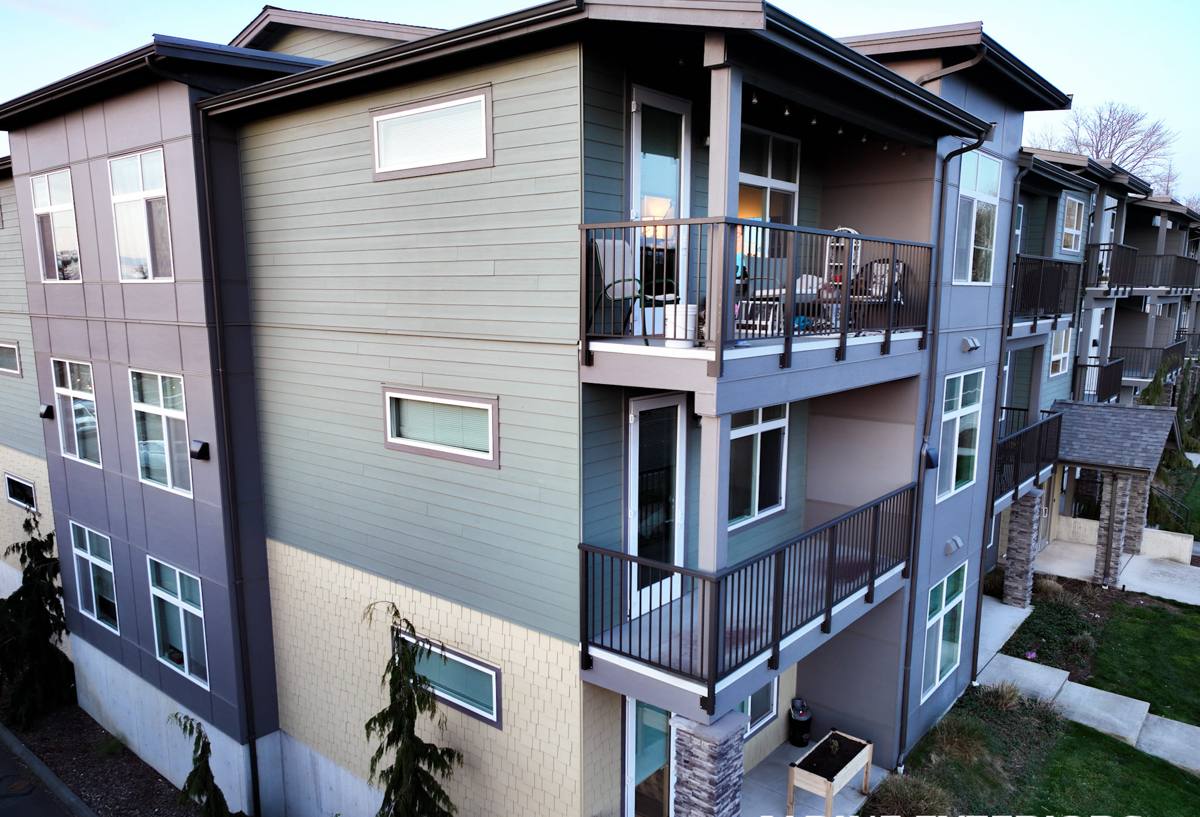
Why We Install Only James Hardie Fiber Cement
We standardized on James Hardie fiber cement siding for every home we work on, including in Sumas, and we don't install vinyl, LP SmartSide, Cemplank, Allura, primed spruce, or cedar. That's not a marketing position — it's a decision based on what holds up in this climate over decades, not just through the first few winters.
Fiber cement is cement, sand, and cellulose fiber pressed and cured into a dense, stable plank. It doesn't absorb water the way wood-based products do, it won't soften or swell at cut edges and joints the way engineered wood siding can if water gets behind it, and it's non-combustible — a real consideration given how dry Whatcom County summers have trended in recent years. James Hardie's HZ5 product line is specifically engineered for the wet, freeze-prone Pacific Northwest climate zone that Sumas sits in, with a formulation and factory finish designed to handle repeated wet-dry cycling without cracking or delaminating.
The factory-applied ColorPlus finish matters here too. It's baked on under controlled conditions and backed by its own finish warranty, which means the color coat isn't fighting Sumas humidity and UV exposure the way a field-applied paint job does. Fewer repaint cycles, less maintenance, and a finish that was engineered to shed the kind of driving rain this area sees rather than absorb it.
What We Tell Homeowners About the Alternatives
Vinyl is inexpensive and low-maintenance in mild climates, but it can distort under sustained wind loading and its seams and J-channels give wind-driven rain more opportunities to work behind the panel — a real liability in a wind corridor like Sumas. LP SmartSide and other engineered wood products perform well when installation is flawless, but any cut edge, nail hole, or joint that isn't fully sealed becomes a path for moisture into a wood-based core, and that's a hard standard to guarantee over 20-plus years of Whatcom County weather. Cedar and primed spruce are beautiful but need a maintenance commitment — recoating, caulking, moisture monitoring — that most homeowners underestimate until the siding is already showing damage. We'd rather put a product on your house that doesn't ask that much of you.
What a Correct Fiber Cement Installation Actually Involves
Fiber cement's long-term performance depends almost entirely on installation detail. The material itself is durable; the failures we see on older installs almost always trace back to shortcuts at the flashing, fastening, or joint level. On a Sumas home, where wind and rain both work harder to find a way in, these details matter even more than average.
- Weather-resistive barrier installed and lapped correctly before any siding goes up, with attention to seams that will sit behind high-exposure walls
- Rainscreen or proper drainage gap where wall assembly and code call for it, so any moisture that does get behind the siding can drain and dry instead of sitting against the sheathing
- Z-flashing and head flashing at every window, door, and horizontal trim transition — the single most common gap we find on re-sides
- Minimum clearances maintained at grade, roof lines, and decks so siding isn't wicking moisture from soil or standing water
- Butt joints sealed per Hardie's installation spec, not just caulked as an afterthought
- Fasteners set to the correct depth and spacing — overdriven nails crack the board's edge and create a moisture entry point that shows up years later
- Corner boards and trim installed with proper gap and sealant to allow for expansion without trapping water
Any one of these done wrong won't fail immediately. It fails in year six or eight, usually on the wall that takes the worst of the outflow wind and rain, which in Sumas is often the same wall every time. That's why we treat flashing and joint detail as the actual job, not the siding panel itself.
Our Process on a Sumas Job
| Stage | What Happens |
|---|---|
| Walkthrough & assessment | We inspect existing siding, sheathing, and trim for hidden moisture damage before quoting — common on homes with older wood or vinyl siding in this area |
| Scope & estimate | Written scope covering removal, any sheathing repair, house wrap, flashing, siding, and trim — no vague allowances |
| Prep & tear-off | Remove existing siding, inspect and repair sheathing, address any rot or moisture damage found underneath |
| Weather barrier & flashing | Install house wrap and flashing at every penetration before a single piece of siding goes up |
| Hardie installation | Install to manufacturer spec — fastening, joints, clearances, and trim detail done to hold up against wind-driven rain |
| Final walkthrough | Joint and caulk inspection, cleanup, and a review of the warranty paperwork with the homeowner |
Choosing the Right Hardie Product for a Sumas Home
James Hardie makes several siding profiles, and the right choice depends on the home's style and exposure, not just preference.
| Product | Best For | Notes |
|---|---|---|
| HardiePlank lap siding | Most traditional homes | The most common choice; available in smooth or cedar-textured finish |
| HardiePanel vertical siding | Accent walls, gables, modern styles | Often paired with lap siding for a mixed-material look |
| HardieShingle | Craftsman and cottage-style homes | Gives a shingle look without the moisture upkeep of real wood shakes |
| HardieTrim | Corner boards, window and door trim | Matches the durability of the field siding instead of mixing in wood trim that ages differently |
For homes on higher-exposure walls in Sumas — typically the walls facing the outflow wind path or open fields with little windbreak — we'll often recommend the standard smooth finish over heavy cedar texture, since deep texture grooves can hold more moisture and debris in a climate with this much sustained dampness.
What Drives Cost on a Fiber Cement Job Here
| Factor | Why It Matters |
|---|---|
| Sheathing condition | Rot or moisture damage found during tear-off adds repair scope before new siding goes up |
| Home size & wall complexity | More corners, gables, and trim transitions mean more labor and flashing detail |
| Siding profile mix | Combining lap, panel, and shingle products costs more than a single profile throughout |
| Trim scope | Full trim replacement with HardieTrim costs more upfront but avoids mismatched material aging |
| Access & site conditions | Steep lots, outbuildings, or landscaping close to the home can add labor time |
We give firm, written estimates after an in-person walkthrough — not a phone quote — because sheathing condition and trim scope genuinely can't be judged from a photo, especially on older Sumas homes where a prior siding job may be hiding damage underneath.
Living With Fiber Cement Siding in Sumas
Fiber cement is low-maintenance, not no-maintenance. A few habits keep it performing the way it's supposed to over a 30-plus year lifespan in this climate.
- Rinse siding annually, focusing on north- and west-facing walls where moss and algae take hold first in a shaded, damp climate
- Keep gutters clear so overflow doesn't run down the wall and saturate a section of siding repeatedly
- Trim back vegetation and landscaping so air can circulate and walls can dry between rain events
- Recaulk joints and trim gaps if you see cracking or gaps opening up — small sealant failures are cheap to fix and expensive to ignore
- Watch for any soft spots or discoloration near ground level, which can signal moisture wicking from grade
None of this is labor-intensive, but it's a different mindset than "install it and forget it," and we'd rather set that expectation upfront than have a homeowner surprised five years in.
Why Hiring a Crew That Already Works Sumas Matters
Installation quality is the whole ballgame with fiber cement, and installation quality depends on a crew that understands what a specific location does to a house. A crew that mostly works drier, more sheltered parts of the county may not think twice about flashing detail on a wall that never sees real wind-driven rain. On a Sumas property exposed to outflow winds and long stretches of damp shade, that same shortcut becomes a callback in a few years, not a few decades.
We work throughout Lynden and the surrounding Whatcom County communities, including Sumas, and we bring the same flashing, fastening, and clearance standards to every job regardless of size. That consistency — plus sticking to one manufacturer's system we know inside and out — is how we keep siding performing the way it's supposed to in a climate that doesn't forgive shortcuts.
If your Sumas home needs new siding, or you want a second opinion on an existing installation, we're happy to walk the property with you and give a straightforward, no-pressure estimate — just fill out the form below.