 Lynden Siding
 Why Blaine's Coastal Climate Is Hard on Siding
Blaine sits right on Semiahmoo Bay, at the northern edge of Whatcom County, which means homes here deal with a combination of stresses that inland Lynden properties don't face to the same degree. Salt-laden air moves off the water and settles on exterior surfaces year-round. Add Whatcom County's long, wet fall-through-spring stretch of driving rain, plus the shaded, damp conditions that let moss and algae take hold on north-facing walls and anything under tree cover, and you have a climate that actively works to break down the wrong siding material.
Salt air is corrosive to exposed metal fasteners and hardware, and it accelerates the breakdown of many paint and coating systems faster than the same product would wear inland. Driving rain — rain pushed sideways by wind, common in storms coming off the Strait of Georgia and the bay — finds every gap, seam, and poorly lapped joint in a siding system and drives water behind it. And moss doesn't just look bad; a moss mat holds moisture against the wall surface for weeks at a time, which is exactly the condition that rots wood-based products and delaminates poorly bonded engineered products.
None of this is unique to any one house in Blaine — it's the baseline condition every exterior surface in this part of Whatcom County has to survive, year after year, for decades. That's the lens we use when we talk about siding installation here: not "what looks good going up," but "what's still doing its job in twenty years."
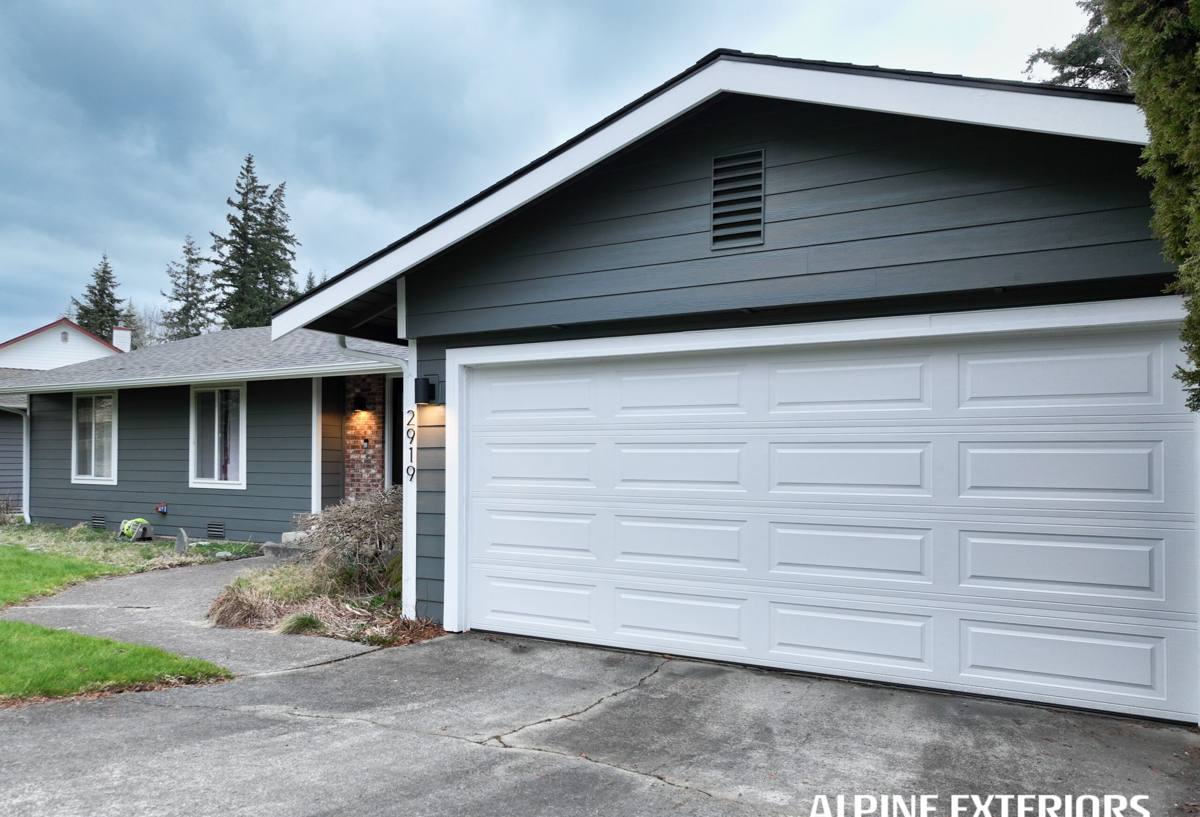
What Blaine Homes Actually Need From a Siding System
Moisture Management, Not Just Moisture Resistance
A lot of siding failures aren't caused by water getting behind the siding — that happens to some degree on almost every home. They're caused by water that gets behind the siding and then has nowhere to go and nothing to dry against. In a climate with as much sustained wet weather as Blaine gets, the assembly behind the siding (weather-resistant barrier, flashing, drainage plane) matters as much as the siding material itself.
Material That Doesn't Feed Moss and Rot
Wood-based and wood-derived siding products give moss, algae, and fungal growth an organic surface to anchor into. Once that growth establishes on a north-facing wall or a shaded elevation near mature trees, it's a maintenance cycle that never really ends — clean it, watch it come back, and eventually it's led to soft or delaminating siding underneath. A non-organic, cement-based material doesn't feed that growth cycle the same way.
A Finish That Holds Up to Salt Air
Field-applied paint on siding near the water tends to chalk, fade, and need repainting sooner than the same product inland, because salt air accelerates UV and moisture breakdown of the coating. A factory-applied finish engineered to resist that — rather than a coat of paint applied on site under whatever weather happened to show up that week — holds color and integrity longer in exactly this kind of exposure.
Why We Install Only James Hardie Fiber Cement
We don't install LP SmartSide, vinyl, Cemplank, Allura, primed spruce, or cedar. That's not a marketing position — it's a standard we hold because of what we've seen these products do, and not do, in Pacific Northwest coastal conditions over time. Each of those products has real strengths in the right application. But for a home on or near Semiahmoo Bay dealing with salt air, driving rain, and a long moss season, the trade-offs stack up:
- Vinyl is affordable and low-maintenance, but it's a thin material that can warp, crack, or blow off in wind-driven storms, and it doesn't hold up structurally the way a heavier fiber cement panel does over decades.
- LP SmartSide and other engineered wood products use wood strand technology that performs well when installation and maintenance are followed exactly, but any breach in the finish or caulking gives moisture a wood-based substrate to work into — a real risk in a climate this wet.
- Primed spruce and cedar are natural wood. They need ongoing repainting and sealing to keep water out, and in a moss-prone, salt-air environment, that maintenance schedule is demanding and unforgiving of gaps.
- Cemplank and Allura are also fiber cement products, and fiber cement as a category is the right call for this climate — but we've standardized on James Hardie specifically for its HZ5 formulation (engineered for the Pacific Northwest's moisture exposure), its ColorPlus factory finish, and the strength of its transferable warranty when installed to spec.
James Hardie fiber cement is non-combustible, doesn't feed moss or rot the way organic materials can, and its ColorPlus finish is baked on at the factory under controlled conditions rather than applied on a job site in variable Whatcom County weather. It's engineered for exactly the moisture and durability demands a bay-front and near-coastal climate like Blaine's puts on a wall.
What Correct Installation Involves in Blaine
The siding material is only half the equation. In a climate that pushes rain sideways and keeps humidity high for months, installation details are what actually determine whether a home stays dry behind the siding for the next 30-plus years.
Weather-Resistant Barrier and Drainage Plane
Every installation starts with a continuous weather-resistant barrier behind the siding, and in high-exposure coastal conditions we build in a drainage plane so any moisture that does get behind the panels has a path to drain and dry out rather than sitting against the sheathing.
Flashing at Every Penetration
Windows, doors, hose bibs, vents, light fixtures — every penetration through the siding is a potential entry point for driving rain. Correct flashing at each one, installed in the right sequence with the weather barrier (not just caulked over afterward), is what actually keeps wind-driven rain out.
Proper Fastening and Clearances
James Hardie specifies fastener type, spacing, and placement for a reason — done wrong, panels can crack, pull loose in wind, or trap moisture at the fastener point. We also hold correct clearance from grade, roof lines, and decks, which matters more in a climate where standing moisture and splash-back are a regular occurrence, not an occasional one.
Caulking and Joint Treatment
Every seam, corner, and trim joint is a place water will test. We follow Hardie's joint treatment specifications rather than relying on caulk alone to do the job over the long run — caulk is a backup, not the primary defense.
Fiber Cement vs. Other Siding Options for a Blaine Home
| Factor | James Hardie Fiber Cement | Vinyl | Engineered Wood / Cedar |
|---|---|---|---|
| Moss & algae resistance | Non-organic material, doesn't feed growth | Resistant but can trap moisture behind panels | Organic substrate is vulnerable once finish is compromised |
| Salt air / coastal exposure | Engineered HZ formulations for PNW moisture | Can chalk and become brittle over time | Requires frequent repainting/sealing near salt air |
| Wind-driven rain performance | Heavy panel, correctly flashed and lapped | Thinner material, can flex or blow loose | Depends heavily on finish and joint integrity |
| Fire resistance | Non-combustible | Combustible | Combustible (untreated) |
| Finish longevity | Factory-applied ColorPlus finish | Color molded in, can fade | Field-applied paint, needs recoating |
| Maintenance | Occasional wash, no repainting cycle | Low, but damage often means full panel replacement | Regular repainting/sealing schedule |
Our Process for a Blaine Siding Installation
- On-site assessment: We look at wall orientation, sun and shade exposure, tree cover, and proximity to the bay, since those factors affect moss risk and wind exposure on your specific home.
- Tear-off and substrate check: We remove the old siding and inspect the sheathing for any existing rot or moisture damage before anything new goes up — this is where hidden problems from years of trapped moisture get found and fixed.
- Weather barrier and drainage plane installation: Continuous coverage, correctly lapped, with drainage where the exposure calls for it.
- Flashing at all penetrations: Windows, doors, and any fixtures are flashed before siding goes over them.
- James Hardie panel installation: Installed to manufacturer fastening, spacing, and clearance specifications.
- Joint and trim finishing: Caulking and trim work done to spec, not as an afterthought.
- Final walkthrough: We review the finished work with you and confirm everything meets the standard we hold ourselves to.
Signs Your Blaine Home May Need New Siding
- Soft or spongy spots when you press on the siding, especially near the bottom courses or window trim
- Persistent moss or algae growth that returns quickly after cleaning
- Visible warping, buckling, or panels that have pulled away from the wall
- Paint that's peeling, bubbling, or chalking faster than it used to
- Rising heating bills or drafts that suggest the wall assembly is no longer sealing properly
- Water stains or discoloration on interior walls near exterior corners
Why Hire a Crew That Already Works in Blaine
Siding installation for a bay-front or near-coastal Whatcom County home isn't identical to siding installation twenty miles inland. A crew that regularly works Blaine and the surrounding Lynden area already understands where moss tends to establish first, how far driving rain pushes water up a wall during a winter storm, and which details on a given exposure need extra attention. That local pattern recognition, combined with correct James Hardie installation practice, is what actually produces a siding job that holds up through Whatcom County's wet seasons rather than one that looks right for the first year and starts showing problems by year five.
If you're weighing a siding replacement for a Blaine-area home, we're glad to take a look and give you a straightforward assessment — no pressure, no sales script, just an honest read on your home's exterior and what it actually needs. Reach out for a free estimate using the form below.