 Lynden Siding
 Border-Area Siding Takes a Different Kind of Beating
Homes near the Abbotsford, BC border crossing sit in one of the wetter, greener stretches of the Pacific Northwest. That's good for the farmland this part of Whatcom County is known for, and it's hard on exterior siding. Marine air pushes in off the Sound and the Strait, carrying enough salt to accelerate corrosion on fasteners and trim, even this far inland. Add driving rain that comes in sideways during fall and winter storms, and a moss season that can run from October through May in a shaded, north-facing wall, and you have a climate that finds every weak point in a siding system within a few years.
Wood-based products soften and swell. Vinyl chalks, warps in temperature swings, and gives moisture a place to hide behind it. Even good products fail early when they're installed without the right flashing, gapping, and drainage plane behind them. Replacement done right in this area isn't just about picking a material — it's about building a wall assembly that sheds water fast and keeps it from getting trapped anywhere behind the cladding.
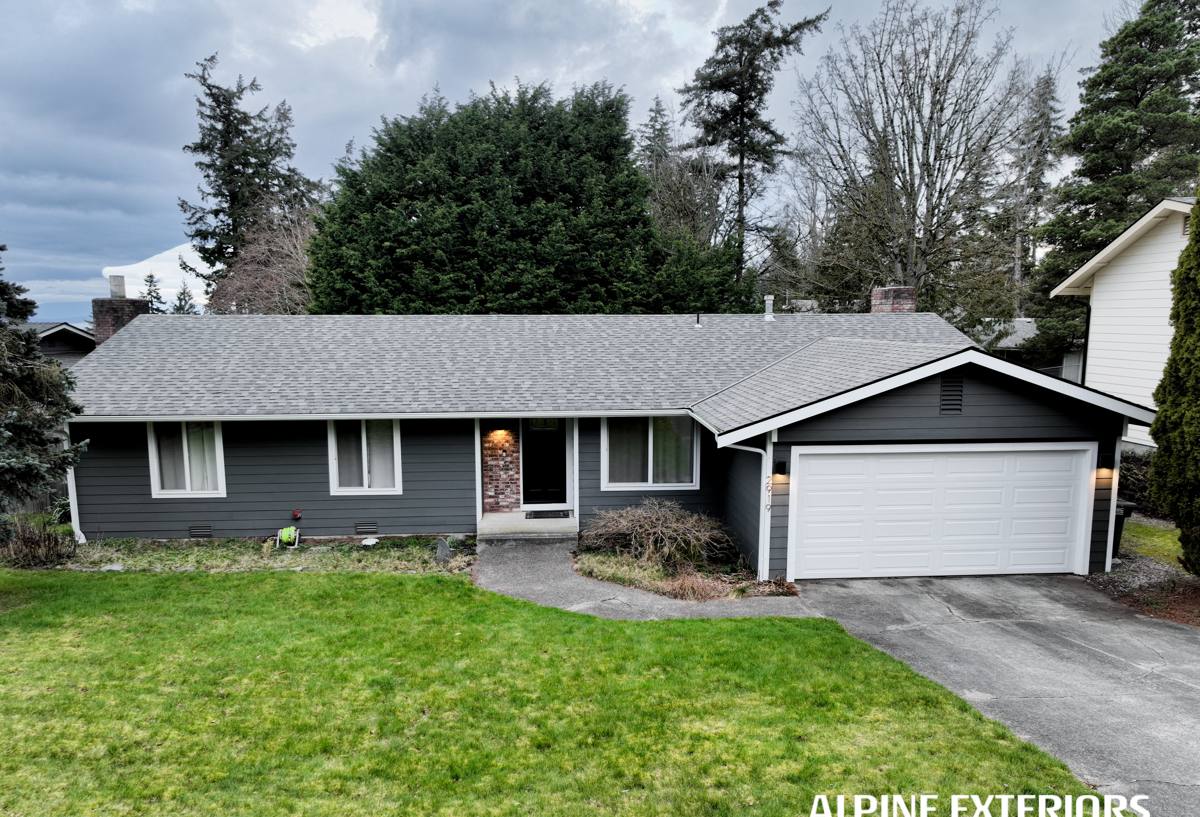
Signs a Home Needs Replacement, Not Another Repair
Homeowners often call us after patching the same section two or three times. That's usually a sign the underlying problem — trapped moisture, a failed weather barrier, or siding that was never properly flashed — is bigger than the visible damage. Some reliable signs that repair has stopped making sense:
- Soft or spongy spots when you press on the siding, especially near the bottom courses or under windows
- Paint that won't hold — bubbling, peeling, or needing repainting every two to three years
- Moss or dark streaking that comes back within a season of cleaning, particularly on shaded north and west walls
- Visible gaps, warping, or cupping in individual boards or panels
- A musty smell in an adjacent room, or moisture damage showing up on interior drywall
- Siding that's original to a home built more than 20-25 years ago, especially wood composite or older masonite products
Any one of these can sometimes be a spot repair. Two or three together, especially with visible interior signs, usually mean the wall assembly behind the siding has been wet for a while and a full replacement is the honest recommendation.
What a Correct Siding Replacement Job Actually Involves
Tear-off and inspection
The old siding comes off in full, not patched around. That's the only way to see what's actually happening at the sheathing — soft spots, old water staining, or evidence that a previous installer skipped flashing at windows and doors. Skipping this step is the single biggest reason siding jobs fail early in a climate like ours.
Weather-resistive barrier and flashing
A new, continuous weather-resistive barrier goes on before any siding, with proper overlap and taped seams. Flashing gets installed at every window, door, deck ledger, and roof-to-wall intersection — the exact spots where driving rain finds its way in if it isn't done right. This is the part of the job a homeowner can't see once it's finished, which is also why it matters most to get it right the first time.
Installation to manufacturer spec
James Hardie fiber cement has specific nailing patterns, gapping requirements, and clearances from grade, decks, and roof lines that are part of keeping the manufacturer's warranty valid. Cutting corners here — over-driving nails, tight-butting boards, or skipping the gap at trim — is common in the industry and shows up as cracking, buckling, or moisture intrusion within a few years.
Why We Install Only James Hardie Fiber Cement
We don't offer vinyl, LP SmartSide, or primed wood siding, and that's a deliberate standard, not a limitation on options. Fiber cement doesn't rot, doesn't feed moss the way wood-based products can, and it's non-combustible — a real consideration given how dry summers have been trending even in a normally wet region. Hardie's ColorPlus factory finish is baked on and warranted against fading and peeling, which matters here because repainting siding on a two-story home in a rainy climate is expensive and hard to schedule around the weather. Hardie also builds its HZ5 formulation specifically for colder, wetter climates like ours, engineered to resist moisture absorption and freeze-thaw stress rather than using a one-size-fits-all product nationwide. We've seen enough early failures on cheaper systems in this climate that we'd rather install one product correctly than offer several and cut corners on any of them.
Our Siding Replacement Process
- On-site assessment — we look at the current siding, the sheathing where accessible, and problem areas like north walls, ground-contact points, and window flashing before quoting anything.
- Written estimate — a clear scope covering tear-off, repair of any damaged sheathing found, materials, and installation, with no vague allowances.
- Scheduling around weather — we plan tear-off in workable weather windows rather than leaving a wall open during a storm system.
- Tear-off and sheathing repair — old material removed, damaged sheathing replaced, structure inspected before anything new goes on.
- Weather barrier, flashing, and Hardie installation — installed to manufacturer spec so the warranty is valid and the wall actually sheds water.
- Final walkthrough — we go over the finished job with the homeowner before calling it done.
What Siding Replacement Costs — and What Actually Drives the Range
Every home is different, but the same handful of factors move the price up or down more than anything else. Broad ranges depend heavily on home size, complexity, and how much of the underlying wall needs repair once the old siding comes off.
| Cost Factor | Why It Matters |
|---|---|
| Home size and wall complexity | More corners, gables, and dormers mean more cutting, flashing, and labor per square foot |
| Condition of the sheathing underneath | Rot found during tear-off has to be repaired before new siding goes on — this is the most common source of a change order |
| Siding profile and trim detail | Lap siding, shingle-style panels, and board-and-batten each price differently, and detailed trim adds labor |
| Story count and access | Two- and three-story walls require staging or lift access, which adds cost and time |
| Tear-off and disposal | Multiple layers of old siding, or hazardous materials like old cement asbestos board, add removal cost |
| Color and finish | Factory ColorPlus finishes cost more upfront than field-painted siding but remove the recurring cost of repainting |
We'd rather walk a property and give a real number than throw out a per-square-foot figure that doesn't hold up once we see what's actually going on behind the old siding.
Choosing a Siding Crew That Actually Works This Border Area
Any contractor can put up siding on a dry, calm day. What separates a crew that gets it right here is experience with this specific climate — knowing where moss builds up first, which wall orientations take the worst of the driving rain, and how to sequence a job so a house isn't sitting open when a weather system rolls through. A few things worth checking before you hire anyone:
- Do they specialize in one siding system, or install whatever's cheapest that week?
- Will they show you the sheathing before it's covered back up, or just tear off and re-side without a real inspection?
- Do they carry current WA state contractor licensing and insurance, and will they put it in writing?
- Can they explain the manufacturer's nailing and gapping requirements without checking a manual?
- Do they offer a written warranty that covers labor, not just materials?
- Are they familiar with jobs in the Lynden, Whatcom County, and Abbotsford, BC border area specifically, or is this their first job out this way?
A crew that's used to this stretch of the border already knows the local building department expectations and the weather patterns that make or break a schedule. That's not something a contractor from a drier part of the state picks up on their first job here.
Maintaining Your New Siding Through Moss Season
Fiber cement is low-maintenance compared to wood or vinyl, but "low-maintenance" isn't "no-maintenance" in a climate this wet. A yearly rinse-down before the wet season sets in, keeping gutters clear so water isn't sheeting down a wall, and trimming back vegetation that shades a wall and keeps it damp will extend the life of any siding system, Hardie included. Correct installation with proper clearances from grade and decks does most of the heavy lifting — the maintenance on top of that is minor by comparison.
If your siding is showing its age, or you just want a straight answer on whether repair or replacement makes sense for your home, we're happy to take a look. Reach out for a free, no-pressure estimate using the form below.