 Lynden Siding
 Acme Doesn't Get Coastal Salt Spray — It Gets Something Just as Hard on Siding
Acme sits back in the Whatcom County foothills, under heavier tree cover than the open, wind-scoured towns closer to the water. That has an upside: homes here take less of the direct salt-laden marine air that hammers siding out toward the coastline. The trade-off is dampness that doesn't leave. Dense canopy blocks sun and airflow, so siding on a shaded wall can stay wet for days after a storm instead of drying out in an afternoon. Add the way a river valley funnels wind-driven rain sideways into gable ends and porch walls, and you get a specific, local kind of stress: not corrosion from salt, but the slow, steady damage of siding that never fully dries between one Pacific storm system and the next.
That's the backdrop for every siding decision we make in Acme. It's also why we standardized on one product system instead of installing whatever a homeowner happened to see at a box store: James Hardie fiber cement, installed the way Hardie's own specs call for, with the flashing and clearance details that matter more here than in a drier climate.
Moss Is the Symptom, Not the Problem
Ask anyone who's lived in Acme through a few winters and they'll tell you about the moss and green algae film that shows up on north-facing walls and anything under a tree limb. That growth isn't cosmetic bad luck — it's a sign that a wall surface is staying wet longer than it should. On some sidings, that constant moisture leads to swelling, delamination, or rot at the seams. On correctly installed Hardie siding, moss and algae are still a maintenance item you'll need to rinse off from time to time, but they're not a structural threat, because the substrate underneath is fiber cement, not wood or a wood-based product that absorbs and holds water.
Why This Company Installs Only James Hardie
We don't carry vinyl, LP SmartSide, Cemplank, Allura, primed spruce, or cedar. That's a deliberate standard, not a lack of options. Each of those products has real strengths — cedar looks great, vinyl is inexpensive, engineered wood goes up fast — but each also has a trade-off that shows up over years, not on install day: vinyl that cracks and fades in UV and cold snaps, engineered wood siding that's sensitive to end-cut sealing and standing moisture, cedar that needs re-staining on a schedule most owners don't keep up with. In a climate like Whatcom County's, where siding spends a large share of the year wet, those trade-offs compound faster than they would somewhere drier.
James Hardie fiber cement is cement, sand, and cellulose fiber, cured into a rigid board that doesn't absorb water the way wood-based siding does, won't feed insects, and is non-combustible. It's also engineered specifically for regional climates — Hardie's HZ5 product line is built for wetter, colder conditions like ours, which matters more in a shaded, damp community like Acme than it would somewhere dry.
The Hardie Products That Make Sense on an Acme Home
HardiePlank Lap Siding
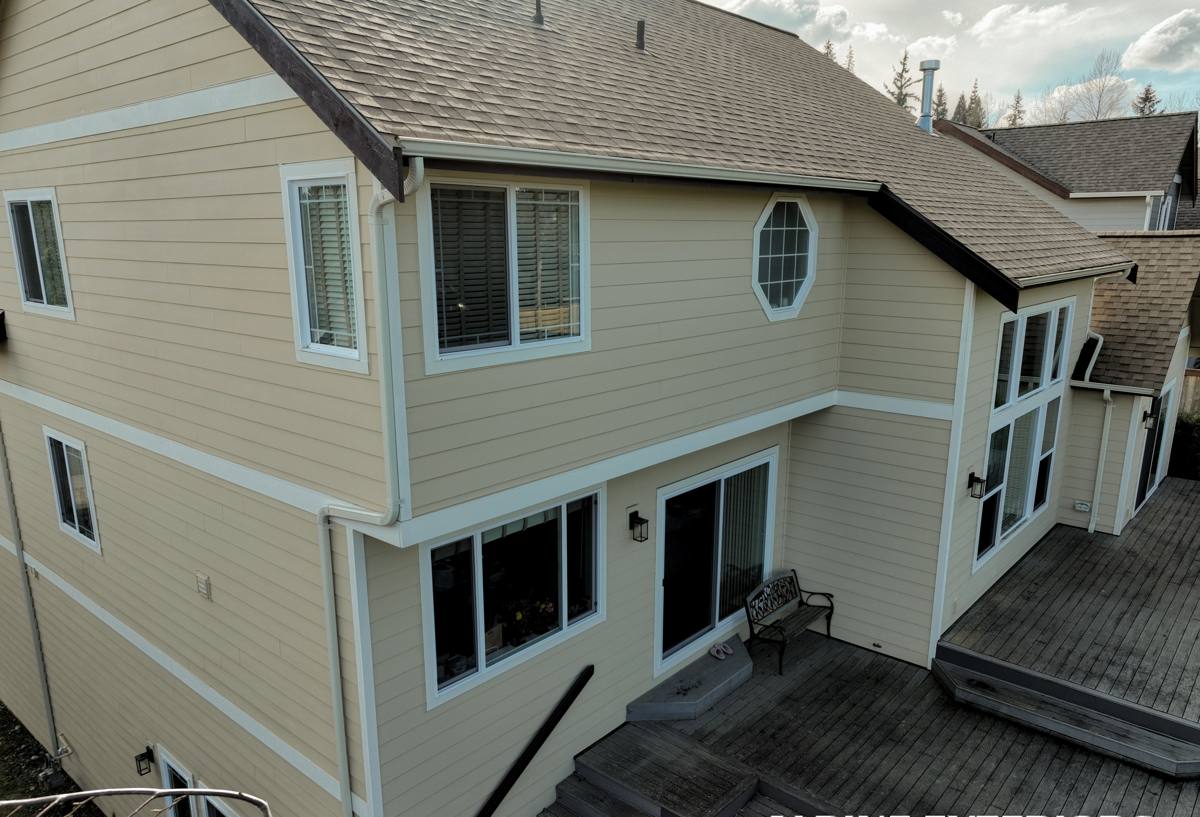
The standard choice for most Acme homes, available in several exposure widths and textures (smooth or cedar-grain). It's the workhorse product for full siding replacements and handles the wide temperature swings and constant damp of a wooded lot without the cupping or warping you'd risk with wood clapboard.
HardieShingle and HardiePanel for Accents
Homes with gable accents, dormers, or a mix of siding styles often do well with HardieShingle staggered-edge panels for texture, or HardiePanel vertical siding on porch gables and shed dormers. Neither is necessary on every home, but both are useful where a homeowner wants visual variation without switching materials or maintenance schedules.
ColorPlus Factory Finish
We push ColorPlus finish over field-painted Hardie whenever the color selection allows it. The finish is baked on at the factory in a controlled environment, which gives it better fade and chip resistance than a job-site paint job — and in a climate with this much rain, a finish that doesn't need repainting every several years is worth the modest cost difference.
What a Correct Installation Actually Involves
Hardie siding is only as good as the installation behind it. The board is engineered to handle moisture; the assembly around it is what determines whether that moisture ever reaches your wall sheathing.
- Weather-resistant barrier installed and lapped correctly, with no gaps at seams or penetrations
- Rainscreen or furring strategy considered on shaded, damp walls so the assembly can breathe and dry
- Correct flashing at every window, door, and roof-to-wall intersection — the single most common failure point on siding jobs of any brand
- Manufacturer-specified clearances: siding held up off decks, patios, and roof lines so it isn't sitting in standing water or snowmelt
- Fastener pattern, type, and placement matching Hardie's published specs for our wind and exposure zone
- Butt joints caulked or flashed according to Hardie's details, not left to guesswork
- Field-cut edges sealed before installation, especially on any board without factory-primed or ColorPlus-coated edges
Skip any one of these and you can end up with a wall that looks right on install day but traps moisture behind board that's rated to shed it. This is also where installer experience with a specific climate matters — the flashing detail that's optional in a dry region isn't optional here.
Comparing the Options for an Acme Home
Homeowners comparing quotes often see very different products bid against each other. Here's how they generally hold up against the conditions Acme actually sees:
| Material | Moisture behavior in shaded, damp lots | Maintenance burden | Typical lifespan here |
|---|---|---|---|
| James Hardie fiber cement | Does not absorb or swell; resists rot | Occasional wash for moss/algae film | 30+ years with correct install |
| Vinyl | Doesn't rot, but can warp or crack in freeze-thaw and UV cycles | Low, but repairs mean full-panel replacement | 15-25 years |
| LP SmartSide (engineered wood) | Sensitive to standing moisture at seams and cuts if seals fail | Requires diligent caulk and paint upkeep | Highly install-dependent |
| Cedar | Absorbs moisture; prone to rot without upkeep in constant damp | Re-stain or reseal on a recurring schedule | Highly maintenance-dependent |
None of this means the other products are unusable everywhere — it means that in a climate that keeps siding wet for extended stretches, a product that doesn't absorb water starts with a real advantage before a single nail is driven.
How We Handle a Job in Acme, Start to Finish
- Site walk and estimate. We look at sun and shade exposure on each wall, existing moisture damage, tree overhang, and access — a wooded lot often means different staging and cleanup planning than an open one.
- Tear-off and sheathing check. Old siding comes off and we inspect the sheathing underneath before anything new goes up. This is where hidden rot from a prior siding failure usually turns up.
- Weather barrier and flashing. Correct lapping, taping, and flashing at every penetration, before the first board is hung.
- Hardie installation to spec. Fastener pattern, clearances, and joint treatment follow Hardie's published details for our climate zone.
- Trim, caulk, and touch-up. Field-cut edges sealed and ColorPlus touch-up applied where needed.
- Walkthrough and cleanup. Full site cleanup, including a nail and debris sweep, and a walkthrough so you know what maintenance, if any, to expect.
Signs an Acme Home Needs Siding Attention Now, Not Later
- Soft or spongy spots when you press on siding, especially near ground level or under downspouts
- Persistent dark green or black staining that returns within weeks of washing
- Visible warping, cupping, or gaps opening at seams
- Paint that's peeling or bubbling rather than just fading
- Interior signs — musty smell, staining, or soft drywall — on exterior-facing walls
- Original siding on a home built more than 25-30 years ago, especially if it's wood-based
Any one of these is worth a look. Several together usually mean the damage goes deeper than the surface.
Why a Crew That Already Works Acme Is Worth Something
A lot of siding problems in this area trace back to an installer treating Acme like any other job site, without accounting for the tree cover, valley damp, and long moss season that make the assembly details matter more here. A crew that already works this part of Whatcom County knows to plan for slower dry-out times between phases, to expect well and septic setups that change where equipment and staging can go, and to build in extra flashing attention on the shaded walls that never quite dry out. That's knowledge you don't get from a general contractor bidding the job off a spec sheet without having worked the area.
Keeping New Siding Looking Right in This Climate
James Hardie siding doesn't need painting on a cycle the way wood does, but it isn't maintenance-free in a place like Acme. A yearly rinse — garden hose and soft brush, or a gentle low-pressure wash — keeps moss and algae from getting a foothold on shaded walls. Keeping tree limbs trimmed back from the house improves airflow and sun exposure, which does more to slow moss growth than any cleaning product ever will. Caulk lines at trim and joints are worth a visual check each fall before the wet season sets in, since that's the one part of the assembly that does wear over time even when the siding itself holds up for decades.
If you're weighing a siding replacement in Acme, we're glad to walk your property, look at what your home's specific exposure is dealing with, and give you a straightforward, no-pressure estimate — fill out the form below to get started.