 Lynden Siding
 Why Siding Wears Out Faster Around Aldergrove
Homes in and around Aldergrove sit in a stretch of the Fraser Valley where weather doesn't do siding any favors. Rain here doesn't just fall straight down — wind off the valley drives it sideways into wall assemblies, working into laps, seams, and trim joints that would stay dry in a calmer climate. Add a marine-influenced air mass that carries a faint salt component inland from the Strait, long stretches of overcast humidity, and shaded north-facing walls that barely dry out between storms, and you get a textbook environment for moss, mildew, and slow moisture intrusion behind the cladding.
Moss is the most visible symptom, but it's a symptom of a bigger issue: siding that stays damp for weeks at a time. Once moss and algae take hold on a wall, they hold even more moisture against the surface, which accelerates paint failure, wood rot, and — on products that aren't engineered for it — swelling and delamination. None of this is unique to any one street or subdivision; it's the baseline climate load every exterior wall in this part of Whatcom County and the neighboring Fraser Valley has to withstand, year after year.
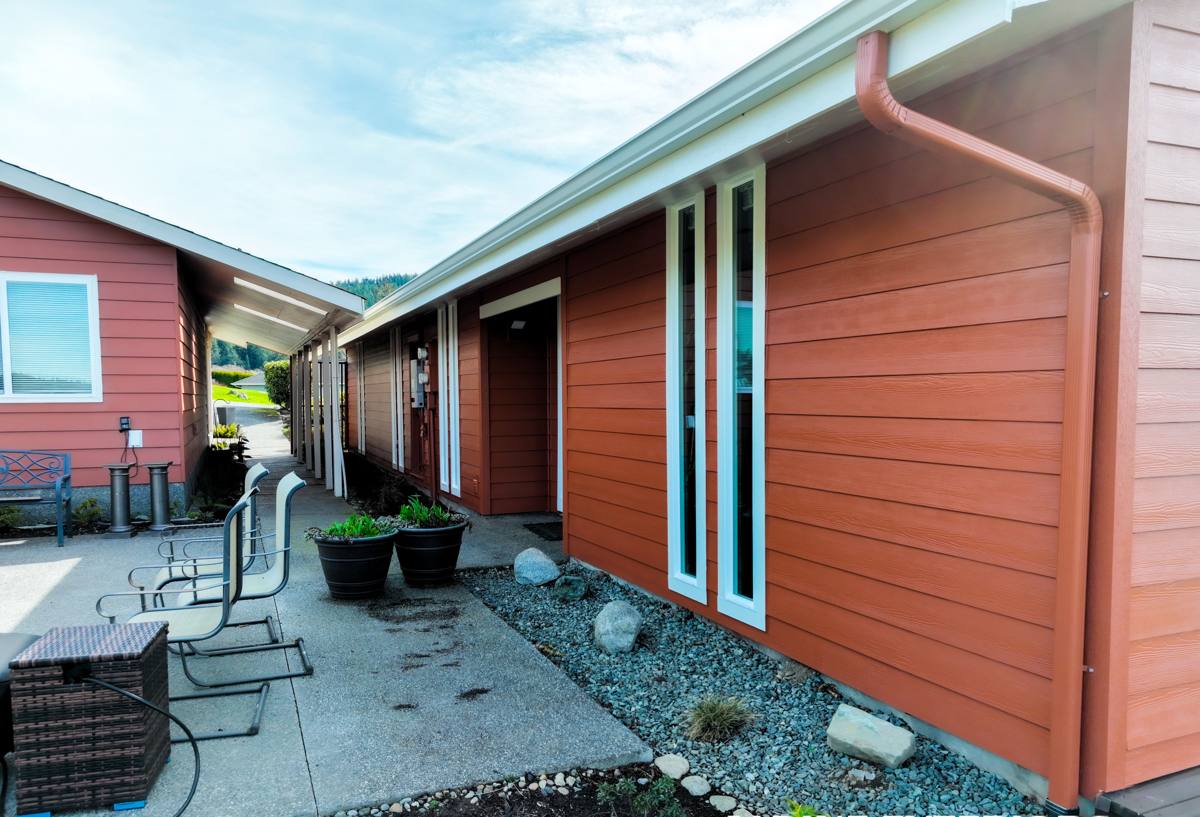
What a Correct Siding Replacement Actually Involves
Siding replacement is easy to underestimate because the visible part — new boards going up — is the smallest piece of the job. The parts that determine whether a project lasts fifteen years or fifty happen before a single piece of finish siding is installed.
Full Tear-Off vs. Installing Over Existing Siding
Nailing new siding over old siding is faster and cheaper, and it's tempting to offer it as a shortcut. We don't recommend it as a default in this climate. Existing siding that's already trapping moisture doesn't stop trapping moisture just because something new is screwed on top of it — it keeps rotting sheathing and framing out of sight. A full tear-off lets us actually see the wall: the sheathing condition, any hidden rot around window and door openings, and whether the water-resistive barrier underneath is doing its job.
The Parts You Don't See
Once the old siding is off, the real work starts. That means a continuous, properly lapped water-resistive barrier (housewrap or building paper), correctly flashed windows, doors, and any wall penetrations so water sheds outward and down rather than sideways into the wall cavity, and a fastening pattern that matches the manufacturer's specification for wind and moisture exposure. Skipping or rushing any of these steps is the single biggest reason siding fails early — not the siding material itself.
Why We Install Only James Hardie Fiber Cement
We standardized on James Hardie fiber cement siding and don't install vinyl, LP SmartSide, primed spruce, cedar, or other fiber cement brands. That's a deliberate call, not a sales pitch. Fiber cement is non-combustible, which matters in a region where wildfire smoke seasons have become a real consideration for building materials. Hardie's ColorPlus factory-applied finish is baked on under controlled conditions rather than field-painted, which gives it more consistent coverage and better resistance to fading and moisture-driven paint failure than a job-site paint job can reliably match.
Hardie also engineers its products by climate zone — the HZ5 line used in this region is formulated for the freeze-thaw cycles, sustained moisture, and temperature swings the Pacific Northwest sees, rather than being a one-size-fits-all product. And the warranty is transferable to a future homeowner, which matters if a house sells within the product's service life. Other products have real strengths — vinyl is inexpensive and low-maintenance in mild climates, wood has a look some homeowners want — but each carries trade-offs (impact sensitivity, moisture behavior, ongoing maintenance, or installation tolerances) that we're not willing to install and then stand behind in this climate. Fiber cement, installed correctly, is what we're comfortable putting our name on.
Choosing the Right Hardie Product for This Climate
James Hardie makes several distinct product lines, and the right one depends on the home's style, exposure, and the look the homeowner wants — not just budget.
| Product | Look | Best suited for |
|---|---|---|
| HardiePlank lap siding | Traditional horizontal lap | Most single-family homes; the most common choice in this area |
| HardiePanel vertical siding | Clean vertical panels | Modern designs, accent walls, gable ends, board-and-batten look |
| HardieShingle siding | Staggered or straight-edge shingle | Craftsman and cottage-style homes wanting a shingle look without cedar's maintenance |
| HardieTrim boards | Smooth or textured trim | Window and door surrounds, corners, fascia — paired with any of the above |
Texture options range from smooth to a cedar-like wood grain, and Hardie's ColorPlus palette covers a wide range of tones without requiring field painting. We'll walk through samples in person, since color and texture read very differently under this region's overcast light than they do on a screen.
Our Process, Start to Finish
- On-site inspection and estimate. We look at the existing siding, sheathing condition where accessible, trim details, and any problem areas (north-facing walls, low clearance to grade, areas with visible moss or staining).
- Product and color selection. We review Hardie product lines and ColorPlus options against the home's style and the homeowner's budget.
- Written scope and schedule. A clear, itemized scope of work before anything is torn off — no verbal-only agreements.
- Tear-off and inspection. Old siding comes off, sheathing and framing get checked, and any rot or moisture damage is documented and addressed before new material goes up.
- Weather barrier and flashing. Housewrap, flashing at every opening and penetration, and correct laps — the work that determines long-term performance.
- Installation to manufacturer spec. Fastening pattern, clearances, and joint treatment per Hardie's published installation instructions, which is also what keeps the warranty intact.
- Final walkthrough. We go over the finished job with the homeowner and register the manufacturer warranty.
Cost Factors for Siding Replacement Near Aldergrove
Every home is different, so we don't quote a number until we've seen the house, but the factors that move the price are consistent from job to job.
| Factor | Why it matters |
|---|---|
| Home size and wall complexity | More square footage and more corners, gables, and dormers mean more cutting and labor |
| Full tear-off vs. covering existing siding | Tear-off costs more up front but is the only way to inspect and repair what's underneath |
| Hidden moisture or rot damage | Sheathing or framing repairs are usually not known until the old siding is off |
| Product line and trim detail | HardieShingle and custom trim work take more labor than straight lap siding on a simple wall |
| Site access | Steep grades, tight setbacks, or two-story walls change staging and labor time |
Broadly, a full siding replacement is a mid-to-upper five-figure investment on an average single-family home, with the range driven mostly by size and how much of the underlying wall assembly needs repair. We'll give an honest, itemized number after we've actually seen the house.
Signs Your Siding Needs Replacing, Not Just Patching
Not every siding problem calls for full replacement. But in this climate, a few signs usually mean patching is only delaying a bigger repair:
- Soft, spongy spots when you press on the siding, especially near the bottom courses or window sills
- Persistent moss or algae growth that comes back within weeks of cleaning
- Paint that's bubbling, peeling, or failing in patches rather than evenly across the whole wall
- Visible warping, cupping, or gaps opening up between boards
- Staining on interior walls or ceilings near exterior corners, which often points to water already past the siding
- Siding that's original to a home built more than 25-30 years ago, especially wood or older composite products
If you're only seeing one or two of these in a limited area, a repair may genuinely be enough — we'll tell you that honestly rather than pushing a full replacement you don't need yet.
Why Hiring a Crew That Already Works This Border Region Matters
Aldergrove sits right across the border from Lynden, and we work on both sides of it regularly. That matters for a few practical reasons beyond just proximity. We already know how this specific stretch of the Fraser Valley behaves — which wall orientations hold moisture longest, how much moss pressure to expect on shaded elevations, and what wind-driven rain does to poorly flashed trim in this exposure. A crew that only occasionally works this area is learning those lessons on your house; we've already learned them elsewhere.
It also means we're realistic about scheduling and logistics for a cross-border job site, and we're not treating your project as an unfamiliar one-off. Familiarity with a specific climate and building stock isn't a substitute for good installation practice, but paired with it, it's what keeps a siding job from becoming a lesson learned the hard way.
Caring for Your New Siding
James Hardie siding is low-maintenance, not no-maintenance. A yearly rinse-down helps keep moss and algae from establishing on shaded walls, and it's worth checking caulking at trim joints and penetrations every year or two, since caulk fails well before the siding does. Keep gutters clear and downspouts directed away from the foundation — a lot of the moisture problems we see at siding replacement started as a gutter that had been overflowing onto a wall for years. None of this is heavy upkeep, but staying on top of it is what lets a correctly installed Hardie system reach the long service life it's built for.
If your siding is showing wear, or you're just planning ahead for a home in the Aldergrove area, we're happy to take a look and give you a straightforward, no-pressure estimate — use the form below to get started.