 Lynden Siding
 Birch Bay's Coastal Climate Puts Real Stress on Siding
Birch Bay sits right up against the water, and that changes what a home's exterior has to deal with compared to homes further inland around Lynden. Wind off the water carries salt spray onto exterior walls, especially the sides of a house that face open water or catch the prevailing wind. That salt film doesn't just sit there looking dull — it's mildly corrosive, and over years it will find any weak point in a siding system: exposed fasteners, unsealed trim joints, thin factory finishes.
Add to that the driving, wind-driven rain that's common along this stretch of Whatcom County, and you've got water being pushed sideways into siding, not just falling straight down onto it. Combine wind-driven rain with the region's long stretch of cool, damp months and you get an extended moss and algae season — north- and west-facing walls in particular stay damp longer, which is exactly the environment moss needs to take hold on a siding surface or in its seams.
None of this means Birch Bay is an unusually harsh place to own a home. It just means the siding and the installation details matter more here than they would on a drier, more sheltered inland lot. A product and a install job that would be perfectly adequate elsewhere can fall short a few blocks from the water.
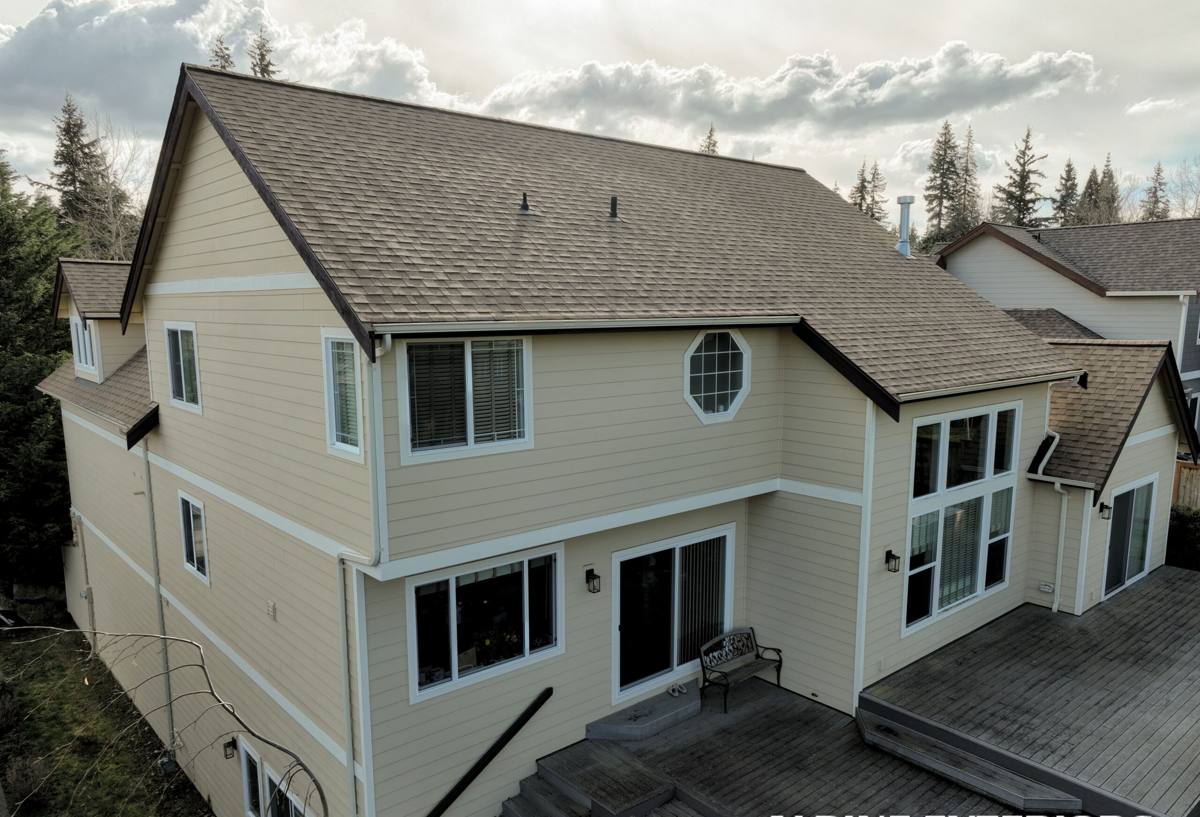
What That Actually Requires From a Siding System
Moisture management, not just moisture resistance
The siding itself is only part of the system. Behind it needs to be a properly lapped weather-resistive barrier and, ideally, a drainage gap that lets any water that does get behind the cladding find its way back out instead of sitting against the sheathing. In a climate with this much sustained dampness, a siding system that can't shed incidental moisture will eventually cause rot, no matter how good the face material is.
Corrosion resistance where metal touches the wall
Fasteners, flashing, and any exposed metal trim are the first things salt air attacks. Standard fasteners that would be fine 20 miles inland can start showing rust streaks on a waterfront-adjacent home within a few years. This is a detail that's easy to skip and expensive to fix later, because by the time you see rust bleeding through the siding, the fastener is already compromised.
A factory finish that holds up under UV and salt together
Paint applied on-site, especially over the long run, tends to chalk and fade faster when it's dealing with both strong reflected sun off the water and a constant low-level salt film. A factory-cured finish that's baked on under controlled conditions holds its color and its bond to the substrate far longer than field-applied paint in this kind of exposure.
Why We Only Install James Hardie Fiber Cement Here
We don't install vinyl, LP SmartSide, cedar, primed wood, or other fiber cement brands, and Birch Bay is a good example of why. Fiber cement is not combustible and doesn't expand and contract with temperature swings the way vinyl does, which matters when you've got both summer sun on south-facing walls and cool, wet winters. Vinyl siding's seams and panels also give wind-driven rain more places to work its way behind the cladding over time, and enough thermal cycling eventually makes older vinyl brittle and prone to cracking.
Cedar and primed wood siding need real, ongoing maintenance — recoating, caulk renewal, and vigilance about any spot where water can sit — to hold up in a marine climate, and a missed maintenance cycle here can mean trapped moisture and rot faster than it would inland. We're not saying wood or vinyl can't function; we're saying we've made a professional decision to stand behind one product system that's engineered for exactly this kind of moisture exposure, backed by a manufacturer finish warranty, rather than juggling multiple materials with different maintenance demands and failure modes.
James Hardie's fiber cement is formulated specifically for wetter, more humid climate zones like ours, and its ColorPlus finish is a factory-applied, baked-on coating designed to resist fading and hold adhesion better than field-applied paint. That combination — a stable substrate plus a durable factory finish — is what we want standing between a Birch Bay home and the weather coming off the water.
James Hardie Product Lines That Make Sense for This Area
Not every Hardie profile is the right call on every home. For a Birch Bay project we're usually choosing between a small set of options based on the home's style and how exposed each elevation is to wind and salt.
| Product | Typical Use | Why It Fits Birch Bay |
|---|---|---|
| HardiePlank lap siding | Primary wall cladding on most homes | Widest range of textures and widths; factory ColorPlus finish stands up to salt and UV without repainting |
| HardiePanel vertical siding | Accent walls, gables, modern-style homes | Fewer horizontal laps means fewer joints for wind-driven rain to work into |
| HardieTrim boards | Corners, window and door casing, fascia | Dimensionally stable trim resists the swelling and gapping that lets water in behind cut edges |
| HardieSoffit panels | Eaves and overhangs | Keeps the underside of the roof structure — a common damp/moss spot — clad in the same non-combustible, low-maintenance material |
What Correct Installation Looks Like on a Home Like This
The product is only as good as the install. Manufacturer specs exist for a reason, and in a high-moisture, salt-exposed area, skipping a detail that "probably won't matter" is how homeowners end up with hidden rot five or ten years down the road.
- Weather-resistive barrier installed and lapped correctly, with all penetrations flashed before siding goes on
- A drainage gap or rainscreen behind the siding so incidental moisture can drain and the wall can dry
- Corrosion-resistant fasteners — stainless or hot-dip galvanized — driven per Hardie's nailing pattern, not just "close enough"
- Proper clearance between the bottom edge of the siding and grade, decks, and roof lines so water doesn't wick up into the board
- Cut edges and any field-cut ends primed or sealed per manufacturer instructions before installation
- Caulking only at the joints Hardie specifies, using a sealant compatible with the ColorPlus finish — not caulking every seam "just in case," which can trap moisture
- Trim and flashing details at windows, doors, and roof intersections built to shed water outward, not channel it toward the wall
Every one of these items is inspectable. If a contractor can't walk you through how they're handling drainage, fastening, and clearances on your specific home, that's worth asking about before work starts.
Our Process for a Birch Bay Siding Replacement
We start with an on-site look at the existing siding and, where it's accessible, the sheathing underneath — homes near the water are more likely to have hidden moisture damage behind old siding than homes further inland, so we're checking for that before we ever quote a job. From there:
- Careful removal of the existing siding and trim, with a real look at the sheathing condition once it's exposed
- Repair or replacement of any damaged sheathing framing found underneath — this gets flagged and discussed with you before we cover it back up
- Installation of a new weather-resistive barrier, properly lapped, with flashing at every window, door, and penetration
- A drainage gap where appropriate for the wall assembly
- Installation of James Hardie siding, trim, and soffit per manufacturer specification, with corrosion-resistant fasteners throughout
- Final caulking, cleanup, and a walk-through so you can see the finished work and ask questions before we consider the job done
Living With Hardie Siding in This Environment
Hardie siding is genuinely low-maintenance compared to wood or field-painted alternatives, but "low-maintenance" isn't "zero-maintenance," especially this close to the water. A periodic rinse-down with a garden hose — not a pressure washer aimed at seams — helps clear the salt film before it has a chance to sit on the surface for months at a time. Where moss or algae does show up, usually on shaded north- or west-facing walls, a gentle wash or soft-bristle cleaning handles it; you don't need harsh chemicals on a factory-finished surface.
Keep gutters and downspouts clear so roof runoff isn't sheeting down a wall every time it rains — that's one of the fastest ways to shorten the life of any siding, Hardie included. It's also worth a quick annual look at the caulked joints around windows, doors, and trim; caulk is the one component in the system that does wear out over time and is cheap to renew before it fails.
Cost Factors for a Birch Bay Project
Every home is different, but these are the factors that actually move the number on a Hardie siding replacement in this area:
| Factor | Why It Matters |
|---|---|
| Removal and disposal of existing siding | More layers or heavier old material (like stucco or old wood) takes more labor to strip |
| Sheathing or framing repair | Homes near the water more often have hidden moisture damage that needs addressing before new siding goes on |
| Home size and wall complexity | Multiple gables, dormers, and cutouts mean more cutting, flashing, and labor per square foot |
| Trim and accent detail | Board-and-batten accents, wide trim, or mixed profiles add material and install time |
| Site access | Tight waterfront lots or difficult staging areas can add labor time |
| Product profile chosen | Plank width, texture, and panel vs. lap siding choices carry different material costs |
Why Local Experience in Birch Bay Matters
A crew that already works this stretch of Whatcom County knows which elevations on a given lot are going to take the worst of the wind and salt, and details those walls accordingly instead of treating every side of the house the same. We know Whatcom County's permitting process, we've seen what happens to siding jobs that skipped a drainage gap or used the wrong fasteners near the water, and we bring that experience to every estimate — not just a generic install plan copied from a drier part of the state.
If you're weighing a siding replacement in Birch Bay, we're happy to come take a look, walk the exterior with you, and give you a straightforward, no-pressure estimate for what a correctly installed James Hardie system would involve on your specific home.