 Lynden Siding
 Why Blaine's Climate Is Hard on Ordinary Siding
Blaine sits right on Semiahmoo Bay, at the northern edge of Whatcom County, which means homes here take on a combination of weather that most siding products were never engineered for. Salt-laden air moves off the water and settles on exterior walls, wind-driven rain hits siding at angles that gutters and overhangs can't fully block, and the long gray stretch from fall through spring keeps north-facing walls damp enough for moss and algae to take hold and stay there. Add in freeze-thaw cycles during cold snaps and UV exposure during the brighter summer months, and you've got a climate that punishes any weak point in a siding system - a poorly sealed seam, an absorbent substrate, a coating that can't hold up to salt.
This isn't a coastal-Florida level of salt exposure, but it's real and constant, and it's the reason siding choices that work fine forty miles inland in Sumas or Deming don't always hold up the same way in Blaine. Wood-based products swell and rot faster near the water. Vinyl can chalk, warp, or crack under repeated wet-dry cycling. Paint film on primed wood breaks down faster when it's fighting salt spray on top of rain and moss.
Why We Only Install James Hardie
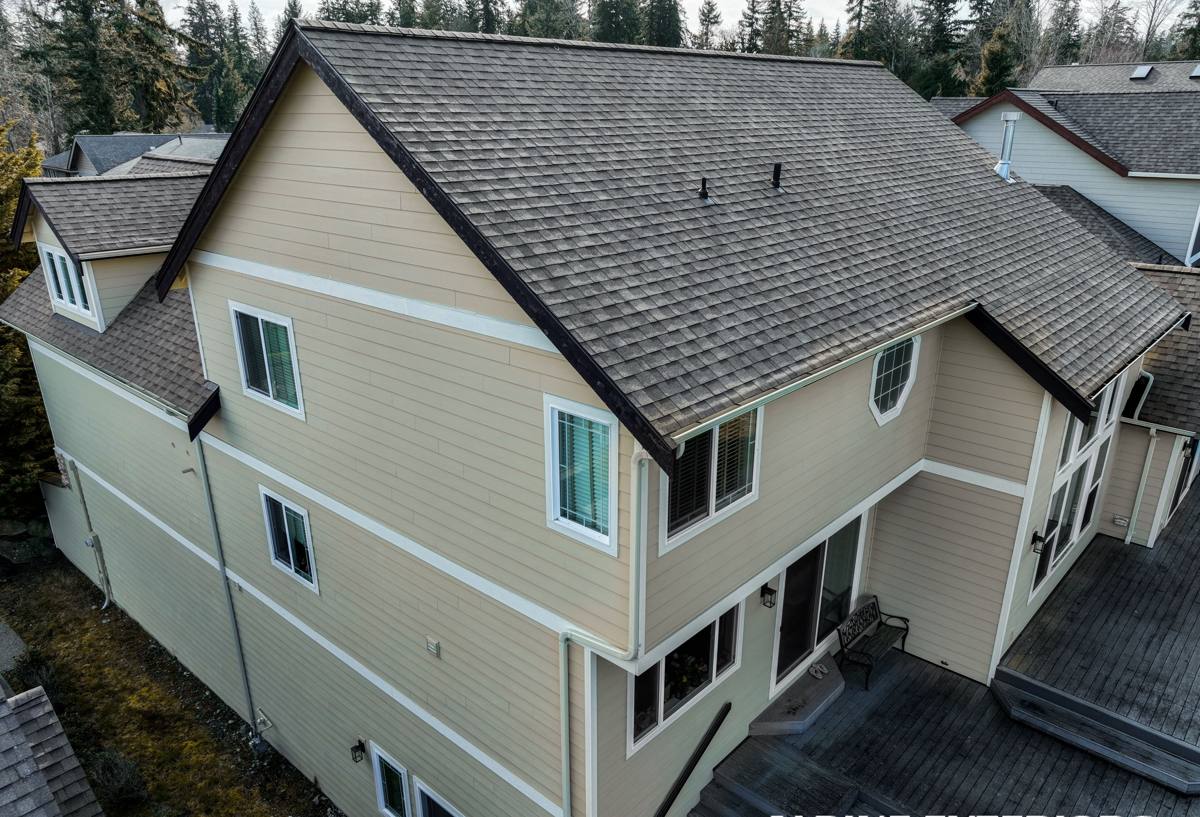
We made a deliberate decision to install James Hardie fiber cement siding exclusively, on every job, including here in Blaine. We don't install LP SmartSide, vinyl, Cemplank, Allura, primed spruce, or cedar. That's not because those products can't be installed correctly somewhere - it's because we've weighed what a Whatcom County coastal climate does to a home over 20-30 years, and Hardie's fiber cement composition, factory-applied finish, and engineered product lines give homeowners here the best combination of moisture resistance, non-combustibility, and long-term appearance retention we've found.
Fiber cement doesn't absorb water the way wood-based products do, so it doesn't swell, delaminate, or rot from prolonged dampness the way an OSB-core product can if a seam ever fails. It won't ignite or contribute fuel to a fire, which matters in a region where wildfire smoke and dry-season risk have become a real seasonal concern even on the wet side of the state. And James Hardie's ColorPlus finish is baked on and warranted against fading and flaking in a way that field-applied paint on wood siding simply isn't.
What We're Not Claiming
We're not going to tell you every other siding product is junk - that's not honest, and it's not our call to make about products we don't install. What we will say is that after installing and maintaining siding across Whatcom County, fiber cement's moisture behavior and finish durability are the trade-offs we're not willing to make on a Blaine home, and Hardie is the fiber cement manufacturer whose HZ engineering and warranty structure we trust most.
Choosing the Right Hardie Product Line for Blaine
James Hardie engineers its siding by climate zone - HZ5 for northern, wetter, freeze-prone regions like ours - which changes the formulation to better resist moisture intrusion and cracking in cold, damp conditions. Within that engineering, homeowners in Blaine typically choose between a few product lines depending on the look they want and the exposure the wall faces.
| Product Line | Look | Best Use in Blaine |
|---|---|---|
| HardiePlank Lap Siding | Traditional horizontal lap, smooth or cedar-textured | Most common choice; works on full elevations including salt-exposed sides |
| HardiePanel Vertical Siding | Clean vertical panels, often with battens | Modern facades, gable ends, accent walls |
| HardieShingle | Staggered or straight-edge shingle profile | Accent gables, dormers, coastal-cottage styling |
| HardieTrim | Boards for corners, fascia, window/door surrounds | Pairs with any line above; keeps trim from being the weak point |
Color matters here too. ColorPlus finishes are factory-cured under conditions a job-site paint job can't replicate, and that finish is what stands between the substrate and the salt air. We steer most Blaine clients toward ColorPlus over field-painted primed siding for exactly that reason - one less seam in the weather barrier, one less maintenance item for the homeowner.
What Correct Installation Actually Involves
Fiber cement siding is only as good as its installation, and this is where a lot of the real-world failures we get called to inspect actually originate - not the product, the installation. In a climate like Blaine's, a few details matter more than they would somewhere drier:
- Proper starter strip and clearance at the foundation so siding never sits in standing water or wicks moisture from grade
- Correct flashing at every window, door, and roofline penetration - the majority of moisture intrusion we find behind old siding traces back to a missed or undersized flashing detail
- Manufacturer-specified fastener pattern and type - the right nails, driven at the right depth, in the right location on the plank
- Rain screen or drainage plane behind the siding where conditions call for it, giving any incidental moisture a way out instead of trapping it against the sheathing
- Factory-cut or properly sealed field cuts, since an exposed raw edge is where fiber cement is most vulnerable to moisture uptake
- Correct caulking - the right sealant, in the right joints, not over-caulked in places that need to stay open for drainage
None of this is exotic. It's James Hardie's published installation standard, followed exactly, by a crew that's done it enough times in this exact climate to know where local weather tends to expose a shortcut.
Our Process, Start to Finish
1. On-Site Assessment
We walk the home, check the current siding and substrate condition, look at drainage and grading around the foundation, and identify problem areas - north walls with moss, sections with visible water staining, trim that's already failing.
2. Product and Color Selection
We help you choose the right Hardie line, profile, and ColorPlus color for the house and its exposure, factoring in which elevations take the most weather.
3. Tear-Off and Substrate Check
Old siding comes off and we inspect the sheathing underneath for rot or hidden moisture damage before anything new goes up - this is often where problems from the old siding system get found and fixed, not just covered over.
4. Installation to Spec
Flashing, drainage plane, fastening, and finish work done to James Hardie's installation standard, with the details above treated as non-negotiable, not optional.
5. Final Walkthrough
We go over the finished work with you, including care and maintenance specific to your home's exposure and the Blaine climate.
What It Costs and What Drives the Price
Every home is different, but a few factors consistently move the price up or down on a Blaine job:
| Factor | Effect on Cost |
|---|---|
| Tear-off complexity (layers of old siding, hidden rot) | More labor and possible sheathing repair increases cost |
| Home size and wall complexity (gables, dormers, cutouts) | More cuts and trim work increases labor time |
| Product line and profile chosen | Shingle and mixed-profile designs cost more than straight lap |
| Trim scope (windows, corners, fascia) | Full HardieTrim packages add cost but reduce future maintenance |
| Access (multi-story, tight lot lines, water-side exposure) | Harder access adds labor time and equipment cost |
We'll give you a real number after we've actually looked at your house - not a phone-estimate range that changes once the crew shows up.
Maintaining Hardie Siding in a Salt-Air, Moss-Prone Climate
Fiber cement is low-maintenance, not no-maintenance, especially this close to the water. A simple seasonal routine keeps it looking right and protects the finish:
- Rinse salt film and grime off the exterior once or twice a year, especially walls facing the bay
- Keep gutters clear so overflow doesn't run down the siding face and feed moss growth
- Trim back vegetation and tree cover on north-facing walls to cut down on the shade and dampness moss needs to establish
- Re-caulk any joint where sealant has cracked or pulled away, before the next wet season
- Touch up any chipped paint at cut edges or nail heads promptly rather than letting it sit exposed
- Check trim and flashing points annually for early signs of water staining
Why a Crew That Already Works Blaine Matters
Installation quality depends on judgment calls that don't show up in a spec sheet - how much clearance to leave at grade on a lot with poor drainage, which walls need extra flashing attention because they take the worst of the weather off the water, when a rain screen is worth the added cost versus when it isn't. A crew that's worked Whatcom County's coastal edge repeatedly has already made those calls on homes like yours and knows which shortcuts fail here even if they'd pass inspection somewhere drier. That local pattern-recognition is worth more than a generic install crew working from the manual alone.
If you're weighing a siding replacement in Blaine and want a straight answer on what your home actually needs, we're happy to take a look and put together a free, no-pressure estimate - no obligation, just an honest assessment of your siding's condition and what it would take to get it right.