 Lynden Siding
 Why Decks in Maple Falls Wear Out Differently
Maple Falls sits up in the forested foothills east of Lynden, on the way toward Mt. Baker, and that setting changes how a deck ages. Tree cover keeps yards shaded most of the day, which is nice for sitting outside but hard on lumber. Sun and wind are what dry a deck out between storms, and without much of either, water lingers in the wood grain, in fastener holes, and in the gaps between boards for days at a stretch. Add Whatcom County's driving rain and the moisture-laden marine air that pushes inland off the Salish Sea, and a Maple Falls deck can stay damp from October straight through May.
That combination is exactly the environment where rot and moss take hold. The long moss season here isn't just a roof and gutter problem — it shows up on horizontal deck boards too, especially stair treads, board edges, and anywhere leaf litter and needle drop collect. Maple Falls also sits at noticeably higher elevation than Lynden proper, so wet wood and footings go through more freeze-thaw cycling over a winter. A correct deck replacement is built around all of that, not just swapped boards on the old frame.
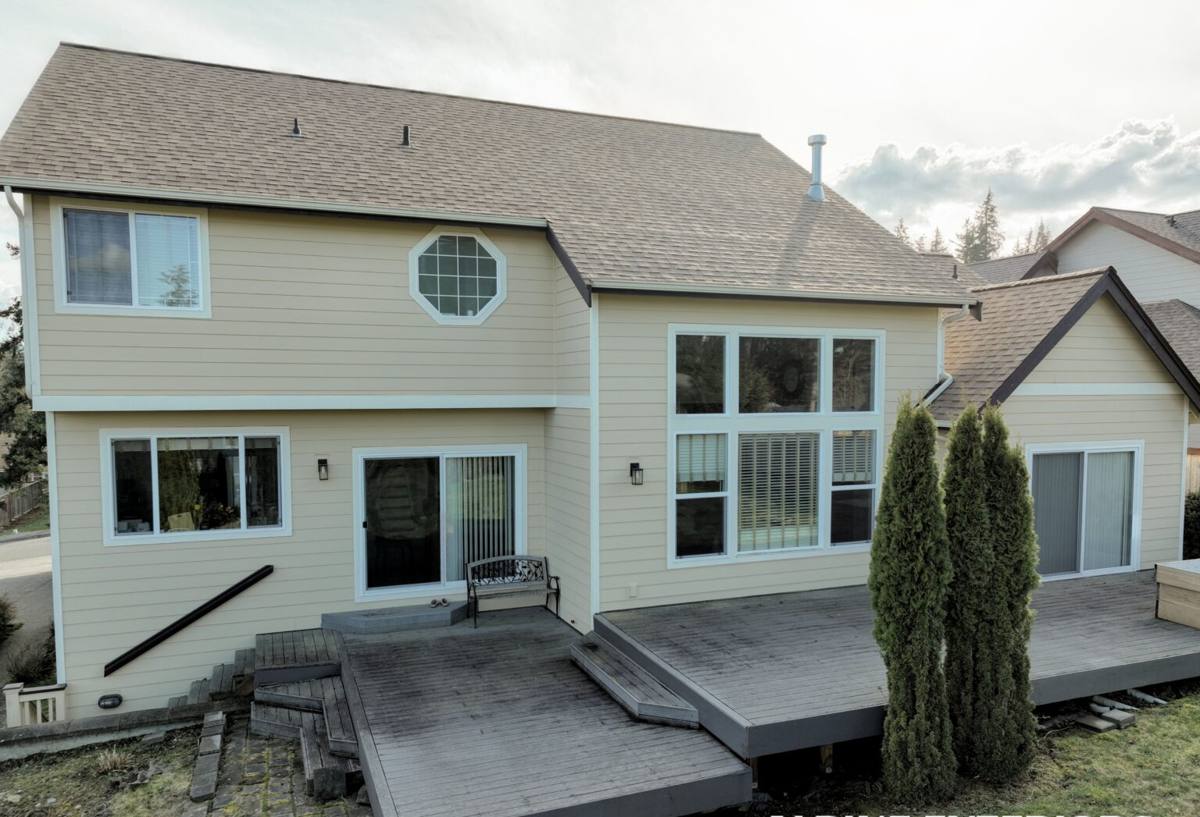
Signs It's Time to Replace, Not Repair
A lot of decks get patched for years past the point where patching still makes sense. Here's what tells us a full replacement is the honest recommendation instead of another repair:
- Boards that feel soft or spongy underfoot, especially near the ledger, the rim joist, or stair stringers
- Visible rot or crumbling at post bases where they meet grade or a concrete pier
- Rust streaking down from fasteners, a sign the hardware is failing inside the wood
- A ledger board pulling away from the house, or gaps visible behind the flashing
- Joists that flex when walked on, or show dark fungal staining on the underside
- More than a handful of individual boards already failed — at that point, spot repairs cost more over a few years than one clean replacement
- Railings or stair rails that wiggle from rotted posts, not just loose hardware
What a Correct Deck Replacement Actually Involves
A deck replacement done right in this climate means tearing back to the framing when the framing has any question marks — not laying new boards over joists that are already compromised. A few things matter more here than they would in a drier part of the state.
Framing and Ledger Attachment
The ledger board — where the deck bolts to the house — is the single most common failure point we find on older decks in this area. It needs proper lag or through-bolt spacing, structural flashing tape at the connection, and step flashing tucked behind the house's water-resistive barrier so runoff sheds away from the band joist instead of soaking into it. We also run joist tape across the top of every joist before decking goes down, so standing water isn't sitting directly on end grain and fastener holes for months at a time.
Footings for Foothill Ground
Footings need to sit below the local frost depth and bear on undisturbed, properly compacted soil — something we confirm on site rather than assume from a chart, since ground conditions at Maple Falls' elevation aren't identical to a lot down in the valley. Undersized or shallow footings are one of the quieter reasons decks start to lean or bounce a few years in.
Airflow Underneath
On shaded, tree-lined lots, the ground under a deck rarely gets direct sun to help it dry. We keep clearance and cross-ventilation in mind during framing so air can actually move underneath, instead of trapping moisture against the joists.
Choosing Decking Material for a Shaded, Wet Lot
There's no single right answer for every home, but the trade-offs are clearer once you factor in constant shade and a long wet season.
| Material | Moisture Behavior | Moss/Algae Resistance | Maintenance | Typical Lifespan |
|---|---|---|---|---|
| Pressure-treated lumber | Absorbs and releases moisture; needs to breathe and dry | Low — grows moss/algae readily in constant shade | Annual cleaning, periodic sealing | 10-15 years in this climate |
| Cedar | Naturally moisture-resistant but still absorbs some | Moderate — still needs cleaning in deep shade | Sealing every 1-2 years to hold color and resist checking | 15-20 years with upkeep |
| Capped composite/PVC | Won't rot or absorb water into the board itself | Surface film can still grow algae/mold in constant shade — needs washing | Periodic washing; no sealing or staining | 25+ years, warranty-backed |
Composite costs more up front, but on a lot with heavy tree cover it often makes more sense than on a sunny, open lot, simply because the board itself can't rot the way wood can. That said, composite still needs to be washed down — a shaded composite deck can grow a film of algae just like a wood one, it just won't rot underneath it. If you go with wood, we'll be upfront that a shaded Maple Falls lot means a shorter real-world lifespan than the same lumber would get in full sun, and we plan the maintenance schedule around that honestly rather than overselling it.
Permits and Whatcom County Requirements
Maple Falls is an unincorporated community, so a deck replacement permit here runs through Whatcom County rather than the City of Lynden. That matters for things like footing depth, setback from property lines, and guardrail/stair code on any deck attached to the house — the requirements aren't identical to a project a few miles away inside city limits. We pull the permit and schedule inspections as part of the job rather than treating it as the homeowner's problem to sort out separately.
Our Deck Replacement Process
- On-site evaluation of the existing deck — framing, footings, ledger connection, and any rot or moss damage
- A written scope and price covering tear-off, framing, and finish material, with no vague allowances
- Permit pulled with Whatcom County before any demo starts
- Full tear-off and haul-away of the old structure
- New or repaired framing, ledger flashing, and footings, inspected before decking goes down
- Decking, railing, and stair installation
- Final walkthrough so you know what routine care your new deck actually needs
What Drives the Cost of a Maple Falls Deck Replacement
Every deck is different, but the same handful of factors move the price on most jobs in this area:
| Factor | Why It Matters |
|---|---|
| Size and footprint | More square footage means more framing, decking, and labor |
| Framing and footing condition | Rotted joists or undersized footings add work that isn't visible until tear-off |
| Decking material | Pressure-treated, cedar, and composite have a wide price spread |
| Height, stairs, and railings | Taller decks and multi-run stairs bring more code requirements and labor |
| Site access | Wooded, sloped lots common around Maple Falls can slow material staging and haul-away |
| Permitting | County permit and inspection scheduling is built into the timeline and price |
Broadly, a straightforward wood deck replacement tends to land in the low-to-mid thousands, with composite and larger or multi-level decks running higher. We'll give you an actual number after we've looked at the framing in person — not a phone quote.
Why a Crew That Already Works Maple Falls Matters
A contractor who's worked this specific area knows that ground conditions and moisture exposure at Maple Falls' elevation aren't the same as a lot down in Lynden proper, and builds footings and drainage accordingly instead of using a one-size-fits-all approach. We know the permit runs through the county, not the city, so there's no delay figuring that out mid-project. We also know how to schedule around this area's wet season so framing isn't left exposed to weather any longer than it has to be, and which materials actually hold up under constant tree shade instead of just looking good on a spec sheet. That local familiarity shows up in fewer surprises during the job, not just in the finished deck.
Keeping Your New Deck Ahead of the Moss Season
A deck replacement done right still needs some seasonal attention to get its full lifespan out of this climate. A yearly cleaning — before moss and algae get a real foothold — matters more here than in a drier region. Keep an eye on where roof or gutter runoff lands; water dumped directly onto a deck year after year will outwork any material's moisture resistance. Make sure boards have room to drain between them, and don't let leaf and needle litter sit and hold moisture against the surface. If you went with wood, plan on resealing on a regular cycle; if composite, a wash-down a couple times a year is usually all it needs.
If your current deck is showing any of the warning signs above, or you're just ready to stop patching it, we're happy to come take a look. We offer a free, no-pressure estimate — use the form below to get one scheduled.