 Lynden Siding
 Siding Repair in Everson: A Local Problem With Local Causes
Everson sits in the part of Whatcom County where marine weather off the Strait of Georgia and Puget Sound meets the damp, low-lying terrain along the Nooksack River valley. That combination means siding here doesn't fail the way it does in drier parts of the state. It fails from the outside in — slowly, quietly, usually starting at a seam, a fastener, or a spot where two materials meet and water has more time to sit than it should.
Most of the repair calls we get in Everson aren't from one dramatic event. They're the result of years of driving rain hitting the same wall face, moss and algae holding moisture against siding through a long wet season, and salt-tinged coastal air slowly working on fasteners, caulk lines, and paint film. By the time a homeowner notices soft trim, a bubbling panel, or a stain that won't wash off, the underlying problem has usually been building for a while.
This page is about siding repair specifically — not full re-siding — for homes in and around Everson. If your siding is fundamentally sound but has isolated problems, repair is almost always the right call. If it's failing broadly, we'll tell you that too. Either way, the goal here is to help you understand what's actually going on with your siding before anyone touches a wall.
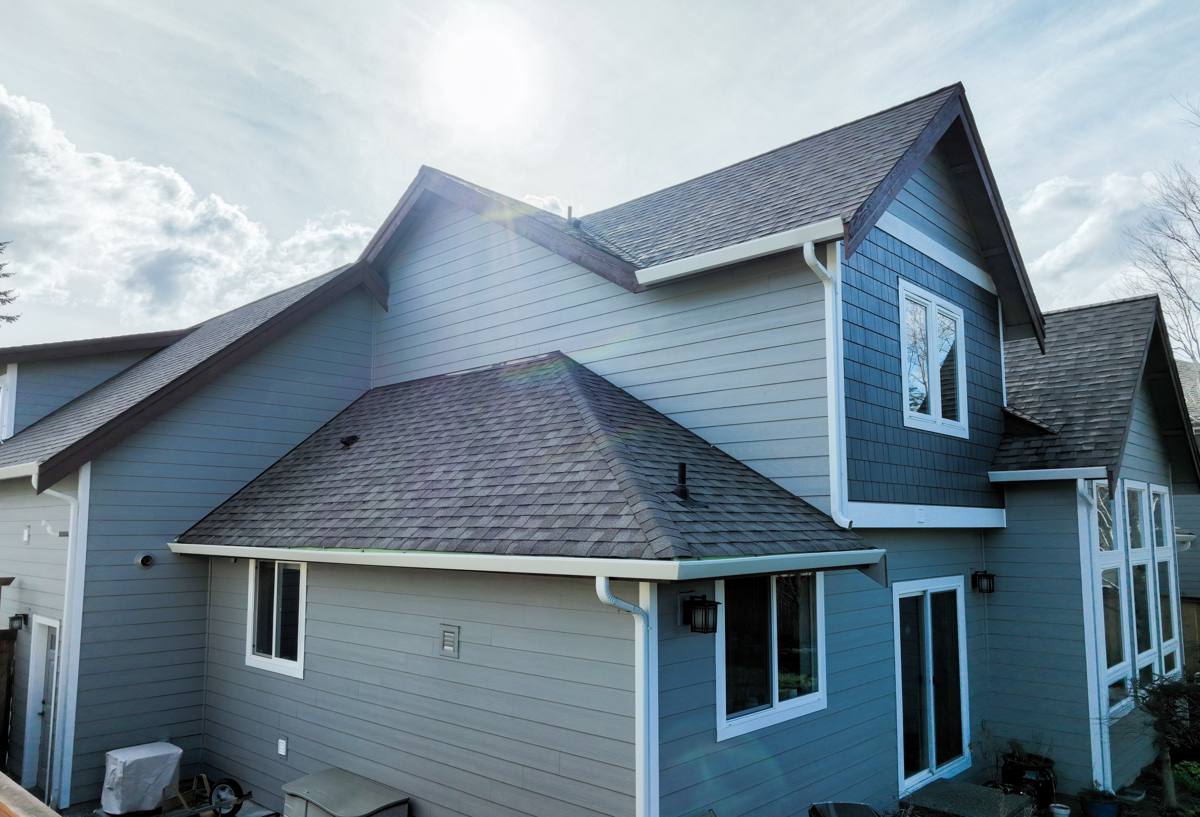
What Whatcom County's Climate Does to Siding Over Time
Three regional factors show up again and again in the repair work we do around Everson:
Driving rain
Whatcom County doesn't just get a lot of rain — it gets a lot of wind-driven rain, especially on west- and south-facing walls. Driving rain finds weaknesses that a straight-down rain never would: it pushes water sideways and upward under laps, around window and door trim, and into any gap in caulking or flashing. Over years, that's how small installation gaps turn into rot pockets.
A long moss and algae season
Between the shaded, tree-lined lots common around Everson and the region's extended wet stretch from fall through spring, siding here can stay damp for days at a time. Moss and algae don't just look bad — they hold moisture directly against the siding surface, which is exactly the condition that accelerates rot in wood-based products and breaks down caulk and paint film faster than sun and dry air ever would.
Salt-tinged, moisture-heavy air
Proximity to Puget Sound and the Strait of Georgia means the air moving through this part of Whatcom County carries more moisture and mineral content than inland climates. That combination is harder on exposed fasteners, metal flashing, and caulk joints than most homeowners expect — it's part of why we see corrosion and seal failure at these connection points well before the siding panels themselves show wear.
None of this means Everson is an unusually hostile place to own a home. It means siding here has to be installed and repaired with these conditions specifically in mind, not with a generic approach borrowed from a drier climate.
Common Siding Repair Issues We See Around Everson
- Soft or delaminating trim boards — usually where wood or composite trim meets siding without adequate flashing or gap
- Bubbling or peeling paint — often a sign of moisture trapped behind the surface, not just an aging paint job
- Cracked or missing caulk joints around windows, doors, and penetrations, letting driving rain in
- Moss and algae buildup on north-facing and shaded walls that's holding moisture against the surface
- Warped, buckled, or separated panels, particularly on older wood or engineered wood siding
- Corroded or backed-out fasteners that have loosened panels and opened water paths
- Isolated impact damage from storms, falling branches, or equipment
- Rot at the bottom courses near grade, where splash-back and ground moisture combine with rain exposure
Some of these are quick, contained fixes. Others are a visible symptom of a bigger moisture problem behind the wall — and the only way to know which you're dealing with is to actually open it up and look.
Repair vs. Replacement: How We Make the Call
Not every damaged section means the whole wall needs to come off, and not every home that "just needs a few boards fixed" is actually a good repair candidate. We look at the extent of the damage, the age and material of the existing siding, and what's happening behind it before recommending either path.
| Signal | Usually points to repair | Usually points to replacement |
|---|---|---|
| Extent of damage | Isolated to one or two areas | Recurring across multiple walls |
| Underlying sheathing | Dry and solid once opened up | Soft, stained, or rotted |
| Siding material | Fiber cement or sound wood with a clear cause | Aging wood/composite failing broadly |
| Age of siding | Younger, otherwise well-maintained | At or past its expected service life |
| Cause of damage | One-time event (impact, single leak) | Chronic moisture, systemic install issues |
Homeowners are sometimes surprised that we recommend repair when repair is genuinely the right answer — a repair-only company is going to lean toward saying you need a full job. We do both, so the recommendation is based on what we actually find, not on which answer sells more work.
What a Correct Siding Repair Actually Involves
A repair that just covers the visible problem tends to fail again within a season or two. A repair that lasts starts by finding out why the damage happened in the first place. On a typical Everson repair call, that means:
- Removing affected material — not just the damaged piece, but enough surrounding material to see the extent of moisture intrusion
- Inspecting the sheathing and framing behind the siding for rot, staining, or soft spots
- Identifying the entry point — a failed caulk joint, missing flashing, a bad panel overlap, or a fastener that never should have penetrated where it did
- Correcting the underlying cause, not just patching over it — this might mean adding flashing that should have been there originally, or re-lapping a joint correctly
- Matching material and finish as closely as reasonably possible, or recommending a broader repair if a clean match isn't realistic
- Sealing and finishing correctly for this climate, using products and techniques rated for sustained moisture exposure
Skipping straight to step 6 — just caulking and repainting over a problem — is the most common shortcut we see from past repairs, and it's why some homeowners end up calling a second or third time for the same wall.
How We Approach a Repair Call in Everson
When we get a repair request from the Everson area, the process is straightforward:
- An honest, no-pressure walk-through of the affected areas, including a look at siding condition elsewhere on the home
- Where damage is visible, opening up enough material to see what's actually happening underneath — no guessing from the outside
- A clear explanation of what we found, what caused it, and whether repair or a larger scope makes sense
- A written estimate before any work starts, with the scope spelled out plainly
- Work scheduled around the weather — driving rain and repair work don't mix, and we won't seal a wall we can't get properly dry first
Because we work this area regularly, we're familiar with how the local climate tends to hit different sides and elevations of a home, which speeds up diagnosis and helps us catch problems that aren't obvious yet.
Why We Only Repair and Install James Hardie Fiber Cement
When a repair uses new material — whether it's a few replacement boards or a larger section — we use James Hardie fiber cement, and we don't install vinyl, LP SmartSide, or other engineered wood or fiber cement alternatives. That's a standard we hold across every job, not just repairs.
The reason comes back to this climate. Fiber cement doesn't absorb water and swell the way engineered wood products can if a seam or edge stays wet for an extended period, which matters given how long Everson siding can stay damp during moss season. It's non-combustible, which vinyl is not. And James Hardie's ColorPlus factory finish is engineered to hold color and resist the kind of UV and moisture cycling this region puts siding through, backed by a strong transferable warranty when installed to spec.
Practically, this also means a repair we do blends better and lasts longer than a mismatched patch job using whatever material happens to be on hand. If your existing siding is a different product entirely, we'll say so up front and talk through what a compatible repair versus a broader replacement looks like — we're not going to quietly install a different material and hope it holds.
Choosing a Siding Repair Contractor Who Actually Knows This Area
A lot of siding repair problems around Everson trace back to a first repair that didn't account for local conditions — a caulk-only fix on a wall that gets constant driving rain, or a patch that didn't address moss buildup that caused the damage in the first place. Before hiring anyone for siding repair, it's worth checking:
- Do they inspect behind the damaged material, or just patch what's visible?
- Can they explain what likely caused the damage, in plain terms — not just what they're going to cover it with?
- Are they licensed and insured for exterior work in Washington?
- Do they give you a written scope before starting, not just a verbal price?
- Do they have experience specifically with fiber cement repair, if that's your siding material?
- Will they tell you honestly if your situation calls for more than a repair?
A crew that works Whatcom County regularly has already seen how the local climate behaves on dozens of homes similar to yours — that experience shows up in faster, more accurate diagnosis and repairs that are built for the conditions they'll actually face.
Get a Straight Answer About Your Siding
If you're dealing with soft trim, peeling paint, moss buildup, or damage from a storm or impact, we're happy to take a look and give you an honest read on whether it's a repair or something bigger — no pressure either way. Reach out for a free estimate and we'll walk you through exactly what we find.