 Lynden Siding
 Custer's Climate Is Rougher on Siding Than It Looks
Custer sits close enough to the water and open farmland that homes here take a different kind of weather beating than siding thirty miles inland. You get salt-laden air moving in off the Strait, wind-driven rain that hits walls sideways instead of straight down, and a wet season that stretches long enough for moss and algae to get a real foothold on north- and west-facing walls. None of that is dramatic on any single day. It's the accumulation — years of moisture cycling in and out of the wall assembly, salt residue slowly working at fasteners and finishes, shade and dampness feeding moss on top of siding that never fully dries out between storms — that separates siding that lasts twenty-five years from siding that starts failing at ten.
Whatcom County building stock includes a lot of homes clad in materials that were never engineered for this combination. Vinyl warps and fades under UV and temperature swings and does nothing to stop moisture at the wall. Untreated or primed wood needs repainting on a schedule most homeowners can't keep up with once moss and mildew get established. Even siding installed correctly for a drier climate can struggle here if it wasn't rated for the moisture load Whatcom County actually delivers.
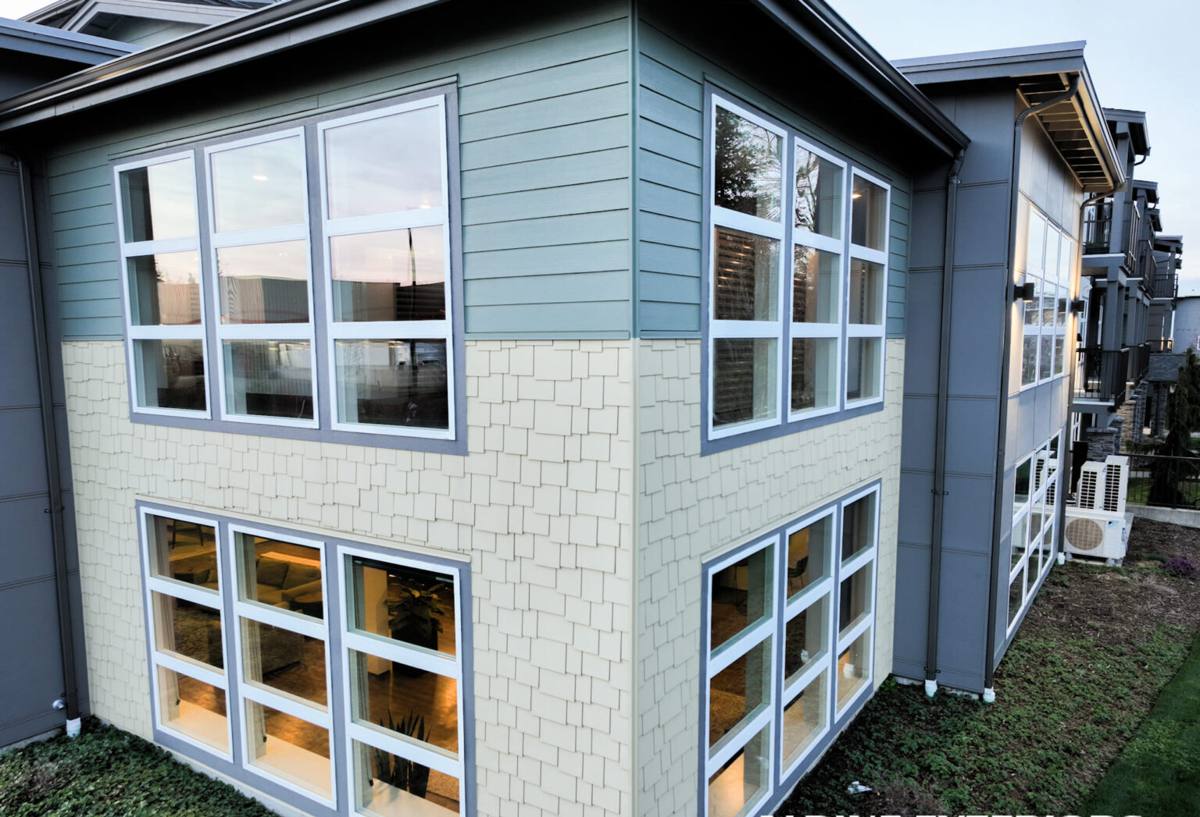
Why We Only Install James Hardie in This Area
James Hardie fiber cement is engineered specifically for climate zones like ours. The HZ5 product line is formulated for cold, wet, high-moisture regions — it resists moisture absorption far better than wood-based products, it won't rot, and it's non-combustible, which matters given how many Custer properties border open field and brush. The ColorPlus factory finish is baked on in a controlled environment rather than field-applied, which means better adhesion and a finish that holds its color and resists the kind of chalking and fading that salt air accelerates on site-painted surfaces.
That's the whole reason this company standardized on one manufacturer instead of offering a menu of siding products. We've seen what a coastal Whatcom winter does to materials that weren't built for it, and we'd rather install one product correctly than install several products and hope.
What HZ5 Actually Changes
HardieZone HZ5 isn't a marketing label — it's a formulation difference. The cement composition and moisture-management engineering are tuned for freeze-thaw cycling and sustained damp conditions, which is exactly the profile Custer sees from November through April. Homes here don't need a siding product engineered for a dry, hot climate zone; they need one engineered for ours.
What a Correct Installation Involves
Fiber cement performs the way it's supposed to only when it's installed to Hardie's actual specifications — and in a high-moisture area like Custer, the installation details matter more than the brand name on the box. A rushed or generic install can undercut even the best material.
Clearances and Flashing
Hardie specifies minimum clearances from the siding bottom edge to grade, roof lines, decks, and patios — usually a minimum of a few inches depending on the surface. Skip that clearance and you're wicking moisture straight into the bottom course every time it rains sideways, which in Custer is often. Flashing at windows, doors, and any roof-to-wall intersection has to be layered correctly so water sheds outward, not behind the cladding.
Fastening and Fit
Fasteners need to hit framing at the correct spacing and depth — overdriven nails crack the board's edge and create a moisture entry point that won't show up as a problem for a year or two, then shows up all at once. Butt joints need to be sealed or backed properly, not just butted tight and caulked over.
Weather Barrier and Drainage Plane
Behind the siding, a correctly lapped weather-resistant barrier and a drainage gap give any moisture that does get past the cladding somewhere to go besides your sheathing. This is invisible once the job is done, and it's also the single biggest factor in whether a house stays dry inside the wall cavity for the next few decades.
| Install Element | Why It Matters in Custer |
|---|---|
| Grade/roof clearance | Prevents wicking during wind-driven rain and standing moisture near foundations |
| Weather-resistant barrier, lapped correctly | Gives moisture a drainage path instead of trapping it against sheathing |
| Proper fastener depth and spacing | Avoids cracked edges that become moisture entry points over time |
| Sealed joints and factory-cut edges primed | Salt air and constant damp accelerate failure at any exposed raw edge |
| Adequate wall ventilation gap | Reduces the damp, shaded conditions that let moss and algae establish |
James Hardie vs. Other Siding in a Custer Climate
Homeowners comparing quotes often see siding materials that look similar on paper but behave very differently once they're facing years of Whatcom County weather.
| Material | Moisture Behavior | Salt Air / Coastal Exposure | Moss & Algae Resistance | Maintenance |
|---|---|---|---|---|
| James Hardie (HZ5) | Engineered for wet climates, won't rot | Factory finish resists salt-driven fading | Better performance with proper wall ventilation | Occasional wash, repaint interval measured in decades with ColorPlus |
| Vinyl | Doesn't manage moisture; traps it behind panels | Can fade and become brittle over time | Moss establishes readily in shaded, damp areas | Low upkeep but limited lifespan and repair options |
| LP SmartSide / engineered wood | Wood-based; vulnerable if any seam fails | Salt accelerates wear at cut edges | Moss and mildew are a persistent concern | Regular caulk and paint inspection required |
| Cedar / primed wood | Absorbs moisture, prone to rot without upkeep | Needs frequent refinishing near salt air | High susceptibility, especially on shaded walls | Repainting/staining on a tight cycle |
How We Approach a Custer Siding Job
The process is straightforward, but we don't skip steps to move faster.
- On-site assessment. We look at the existing siding, sheathing condition, moss and moisture patterns on the walls, and any problem areas around windows, decks, or roof lines before we ever quote the job.
- Tear-off and inspection. Removing the old siding lets us actually see the sheathing underneath. If there's rot or moisture damage, that gets addressed before anything new goes on — covering a wet wall with new siding just hides the problem.
- Weather barrier and drainage plane. Installed and lapped to spec, with attention to the areas that catch the most wind-driven rain.
- Hardie installation to manufacturer spec. Correct clearances, fastening, flashing, and joint treatment — not shortcuts that happen to look fine from the curb.
- Final walkthrough. We check clearances, caulking, trim, and cleanup before calling the job done.
Why a Crew That Already Works Custer Matters
Siding installation isn't just about following a spec sheet — it's about knowing how that spec sheet needs to be applied to the specific house in front of you. A crew that regularly works Custer and the surrounding Lynden area already knows which wall orientations take the worst of the wind-driven rain, where moss tends to establish first, and how the wet season affects scheduling and cure times for caulking and finishing work. That local pattern recognition is the difference between an installation that just meets the manufacturer's minimums and one that's actually built for the conditions on your specific lot.
It also means someone answering the phone who knows the area if a question comes up two years down the road, not a call center routing you to whoever's available.
Keeping Hardie Siding Performing Long-Term in Custer
Correct installation gets you most of the way there. A little homeowner attention keeps it performing for the decades it's built for.
- Rinse siding annually, focusing on shaded north- and west-facing walls where moss and algae establish first
- Keep gutters clear so overflow doesn't run down the wall face during heavy rain
- Trim back vegetation and tree cover that keeps siding damp and shaded longer than it needs to be
- Check caulking at trim, window, and door joints every couple of years and re-seal if it's cracked or pulling away
- Address any moss buildup early — a soft wash is far cheaper than dealing with moisture that's worked its way behind established growth
What It Costs
Every Custer home is a different job — square footage, number of stories, trim detail, and how much of the existing wall assembly needs repair before new siding goes on all move the number. In broad terms, expect fiber cement replacement to run higher up front than vinyl and comparable to or above engineered wood, with the difference paid back in reduced maintenance and a much longer service life. We don't quote a number without seeing the house first, because guessing on a job like this does homeowners no favors.
| Cost Factor | What Drives It |
|---|---|
| Sheathing condition | Rot or moisture damage found during tear-off adds repair scope |
| Wall complexity | Dormers, multiple stories, and trim detail add labor time |
| Color and profile | ColorPlus finish and specialty profiles (shingle, board-and-batten) vary in material cost |
| Access and site conditions | Tight lots or difficult staging affect labor time |
If you're weighing a siding replacement in Custer and want a straight answer on what your home actually needs, we're glad to take a look and walk you through it. Fill out the form below for a free, no-pressure estimate — no obligation, just an honest assessment of your walls and what correct James Hardie installation would involve for your house.