 Lynden Siding
 Laurel's Climate Puts Real Demands on Exterior Siding
Laurel sits in the low-lying farmland and river-bottom country northwest of Lynden, close enough to the Salish Sea and the Nooksack River drainage that homes here deal with a specific combination of weather stress: salt-laden air moving in off the water, long stretches of driving rain pushed by winter storm systems, and a shaded, damp growing season that gives moss and algae months to establish themselves on north- and west-facing walls. None of these factors is dramatic on its own. Together, over years, they're what separates a siding job that still looks good at year fifteen from one that's chalking, cupping, or rotting at the bottom courses by year eight.
Whatcom County's marine climate doesn't hit every material the same way. Wood-based products absorb and release moisture with every wet-dry cycle, which is exactly the cycle Laurel gets from October through May. Vinyl doesn't rot, but it flexes and fades under UV and temperature swings and does nothing to slow moss growth on shaded walls. Fiber cement, installed correctly, is the one exterior siding category built to shrug off all three of these stressors at once — which is the entire reason this company installs James Hardie products exclusively and nothing else.
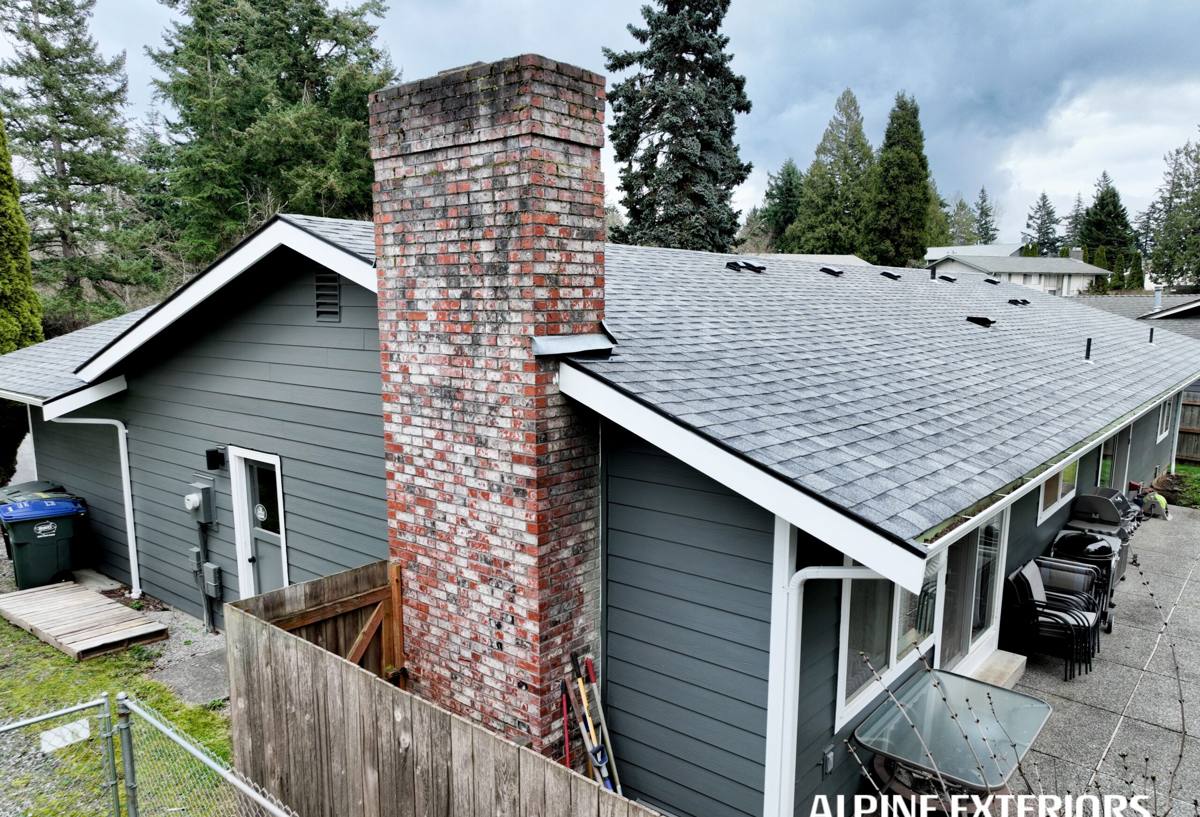
Why Salt Air, Rain, and Moss Matter More Here Than in Drier Parts of the State
Salt air and coastal drift
Even well inland from the water's edge, prevailing westerly winds carry fine salt particulates across Whatcom County's lowlands. Salt is hygroscopic — it pulls moisture out of the air and holds it against a surface longer than plain rainwater would. On siding with weak paint adhesion or exposed raw edges, that translates to faster peeling, chalking, and fastener corrosion.
Driving rain
Lynden-area storms frequently come in sideways rather than straight down, which means rain gets forced up under laps, around trim, and into any gap in the water-resistive barrier that a sloppy install left behind. Siding that isn't lapped, flashed, and caulked to spec doesn't fail from one storm — it fails from the cumulative effect of hundreds of them.
Moss and algae season
Shaded exposures near mature trees and windbreaks — common on Laurel's rural and semi-rural lots — stay damp for extended stretches in fall, winter, and spring. That's ideal growing conditions for moss and algae, which hold moisture directly against the siding surface and accelerate wear on anything that isn't dimensionally stable and factory-sealed.
What James Hardie Brings to a Laurel Home That Other Products Don't
James Hardie fiber cement is engineered specifically around the failure modes above. It's non-combustible, dimensionally stable across wet and dry cycles, and manufactured with a factory-applied finish system rather than relying on field-applied paint to do all the work.
Product lines that make sense for this area
- HardiePlank lap siding — the standard choice for most Laurel-area homes; available in several exposure widths and finish textures.
- HardieShingle — for homes wanting a shingle-style look without the maintenance burden of real cedar shakes in a wet climate.
- HardiePanel — vertical panel siding, often used for accent gables, shop buildings, or a board-and-batten look on outbuildings common on larger Laurel properties.
- HardieTrim — factory-finished trim boards that hold paint and shape far better than field-primed lumber in a damp climate.
ColorPlus factory finish
Hardie's ColorPlus finish is baked on at the factory in a controlled environment, which gives it better adhesion and more consistent coverage than paint rolled or sprayed on-site after installation — especially on cut edges, which is why factory-finished cut edges get treated with matching touch-up product rather than left raw. In an area with this much rain and salt exposure, that finish durability is a real, measurable difference over time, not a marketing detail.
What a Correct Installation Actually Involves
Most siding problems people blame on "bad material" are actually installation problems. Hardie's own installation manual is specific about clearances, fastening, and flashing details, and skipping any of them shows up later as moisture intrusion, cracking, or premature finish failure — regardless of how good the siding itself is.
| Detail | Correct approach | Common shortcut that causes problems |
|---|---|---|
| Ground clearance | Minimum clearance maintained above grade, decks, and roof lines per Hardie spec | Siding installed tight to grade or hard surfaces, wicking moisture from below |
| Water-resistive barrier | Continuous, properly lapped house wrap with all penetrations flashed | Gaps, tears, or missing flashing around windows and penetrations |
| Fasteners | Corrosion-resistant fasteners driven to Hardie's specified depth and placement | Overdriven nails that crack the board, or fasteners that aren't rated for coastal exposure |
| Joints and laps | Properly lapped and either caulked per spec or covered with H-jointers/trim | Butt joints left uncaulked or caulked with the wrong sealant |
| Cut edges | Factory or field touch-up sealant applied to any cut edge before installation | Raw, unsealed cut edges exposed to weather |
Every one of those details matters more in Laurel's climate than it would in a dry inland region, because rain, wind, and time here are relentless about finding whatever gap was left open.
Our Process for a Laurel Siding Replacement
- On-site inspection — we look at the existing siding, sheathing, and trim, and check for moisture damage or rot that needs to be addressed before new siding goes on, not after.
- Removal and substrate check — old siding comes off and we inspect the sheathing underneath; anything soft or compromised gets repaired or replaced, since covering a rotten wall with new siding just hides the problem.
- Water-resistive barrier — a continuous, correctly lapped house wrap goes on before any siding, with all windows, doors, and penetrations flashed to shed water outward.
- Installation to Hardie spec — proper clearances, fastener schedule, and lap details, matched to the specific HardiePlank, HardieShingle, or HardiePanel product chosen for the home.
- Trim and detail work — corners, joints, and penetrations finished and sealed so water has nowhere to collect.
- Final walkthrough — we go over the finished job with the homeowner before calling it done.
Cost Factors for Hardie Siding on a Laurel Property
Every home is different, but the same handful of factors drive most of the cost variation we see on jobs in this area.
| Factor | How it affects cost |
|---|---|
| Amount of substrate repair needed | Rotted sheathing or framing found during removal adds labor and material beyond the siding itself |
| Product line and profile | HardiePanel and standard lap profiles are generally more economical than HardieShingle or custom trim detailing |
| Home size and complexity | Steep rooflines, multiple gables, and lots of trim/window penetrations add labor time |
| Access | Rural lots with outbuildings, fencing, or landscaping close to the house can slow staging and cleanup |
| Color and finish choice | Factory ColorPlus finishes vs. field-painted primed siding affect both upfront cost and long-term maintenance |
We give homeowners a written estimate that breaks these factors down rather than a single vague number, so it's clear what's driving the price.
Why It Matters That We Already Work in Laurel and Around Lynden
A crew that's worked this specific stretch of Whatcom County knows which wall exposures tend to grow moss first, which older homes in the area were built with siding that's now failing at a predictable age, and how driving rain off the coast behaves differently than a straight-down downpour when it comes to flashing details. That local pattern recognition shortens the inspection phase and helps us flag problems — like a rot-prone north wall or an undersized roof overhang — before they turn into a mid-project surprise.
It also means we're not learning permitting and inspection processes on the client's dime, and we're already familiar with the building stock common to Lynden and the surrounding unincorporated county — older farmhouses, newer rural builds, and everything in between.
Signs a Laurel Home's Siding Needs Attention
- Visible moss or dark algae streaking on north- or west-facing walls
- Paint that's chalking, peeling, or fading unevenly across the house
- Soft spots or slight give when pressing on siding near the bottom courses or under windows
- Cracking or buckling boards, especially at butt joints or corners
- Visible gaps or separation where siding meets trim, windows, or the foundation line
- Interior signs like peeling paint or musty smells on exterior-facing walls
Any one of these on its own might be minor. Several together usually mean moisture has been getting behind the siding for a while.
Maintaining Hardie Siding in This Climate
Hardie siding is low-maintenance, not no-maintenance. In Whatcom County's damp, shaded conditions, a periodic soft wash to keep moss and algae from establishing on shaded walls goes a long way, along with an annual visual check of caulking at joints and trim — caulk is the one component that wears out well before the siding itself does, and catching a failed joint early prevents water from ever reaching the sheathing behind it.
If you're weighing a siding replacement for a home in Laurel or anywhere around Lynden, we're glad to walk the property, look at what's actually going on with the existing siding, and put together a straightforward, no-pressure estimate for James Hardie siding built for this specific climate.