 Lynden Siding
 Custom Decks Built for Kendall's Climate
Kendall sits up against the foothills northeast of Lynden, and homes out here take weather differently than a house closer to town. You get more shade from tree cover, more standing moisture after a storm rolls off the Cascades, and a longer stretch of the year where surfaces just don't fully dry out. A deck built without that in mind will look fine for a season or two and then start showing problems — soft spots, black staining, boards that cup or crown, ledger connections that trap water against the house. A deck built for Kendall's actual conditions holds up because the choices were made around moisture, not around what looked good on a showroom sample.
We build custom decks for homeowners throughout the Lynden and greater Whatcom County area, and Kendall properties get the same attention we'd give any site with heavy shade, salt-tinged air moving up from the coast, and a moss season that can run from October through April. That's not a marketing line — it's just what the calendar looks like here, and it changes how a deck should be framed, fastened, and finished.
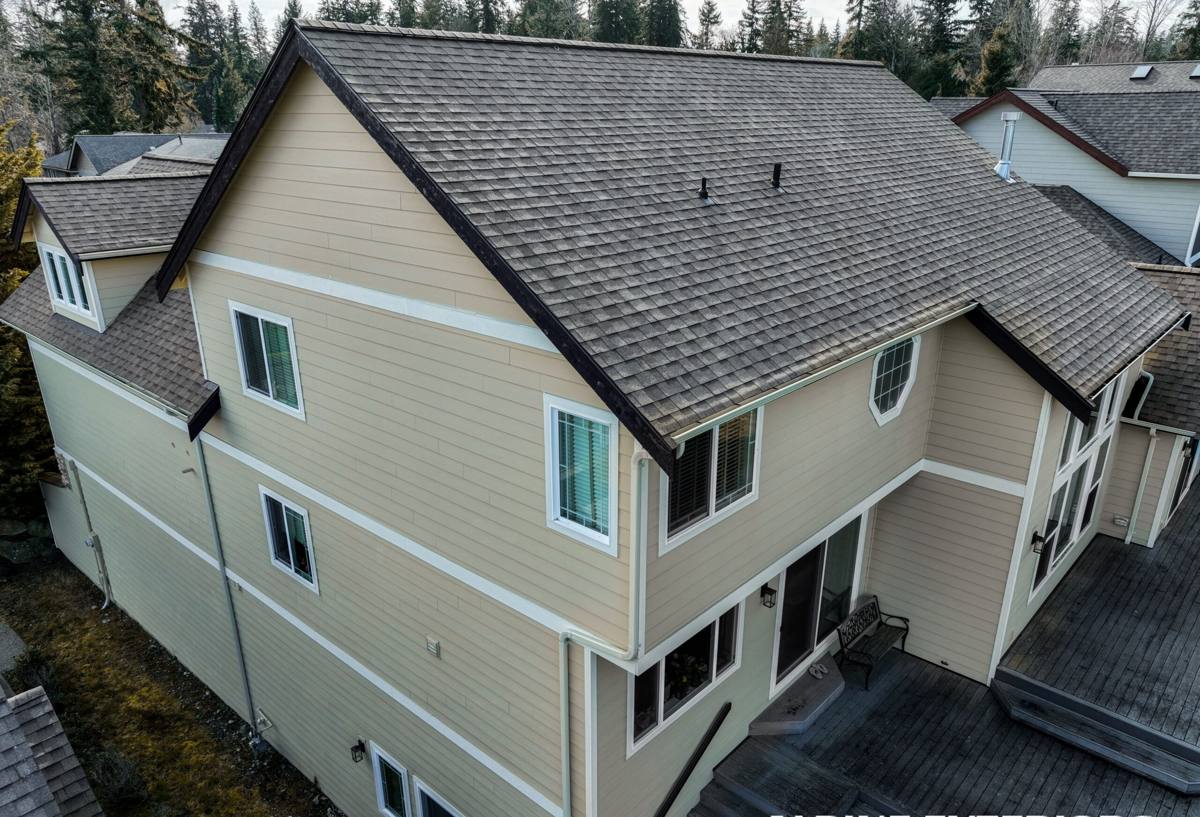
What Kendall Homes Actually Need From a Deck
Drainage Before Anything Else
The single biggest factor in how long a deck lasts in this area is whether water can get out from underneath it and away from the house. Decks built low to grade, or tight against a slope, are the ones we see rotting from the joists up rather than the boards down. Before we talk decking material or railing style, we look at grade, how the ledger ties into the house, and whether the substructure can actually shed water instead of holding it.
Airflow Under and Around the Structure
Shaded lots near tree lines dry out slower after rain, sometimes staying damp for days. That's fine for the deck itself if the framing underneath has room to breathe. Skirting that seals the underside completely, or joists packed too close to grade, turn a shady deck into a slow-drying one — and slow-drying wood is where rot and moss both get a foothold.
Fasteners and Hardware That Match the Exposure
Whatcom County isn't right on the water, but there's enough marine influence in the air moving inland that standard fasteners corrode faster than homeowners expect, especially on decks with any western or coastal exposure. We spec stainless or heavy-duty coated fasteners and structural hardware rated for wet-use, not the minimum the lumber yard stocks.
Decking Materials: An Honest Comparison
There's no single "best" decking material — there's the right one for how a homeowner actually wants to maintain it. Here's how the common options actually perform in a shaded, wet Whatcom County setting:
| Material | Moisture Behavior Here | Maintenance | Trade-Offs |
|---|---|---|---|
| Pressure-treated fir/hem-fir | Handles moisture fine if sealed and re-sealed on schedule | Annual cleaning, re-stain every 2-3 years | Lowest upfront cost, most maintenance-dependent |
| Cedar | Naturally rot-resistant, still needs sealing in shaded spots | Cleaning plus periodic oil/stain | Good look, softer surface, moss-prone if left untreated |
| Composite (capped) | Doesn't absorb water, resists cupping and rot | Periodic washing to keep moss/algae from gripping the surface texture | Higher upfront cost, no re-staining needed |
| Uncapped composite (older-style) | Can wick moisture at cut ends and fastener holes | More prone to surface mold in constant shade | We steer clients toward capped composite when they want low-maintenance |
In a heavily shaded Kendall yard, we generally point people toward either well-maintained cedar (if they like the natural look and don't mind the upkeep) or capped composite (if they want to stop thinking about it). We don't push uncapped composite in shaded, moisture-heavy locations — not because it's a bad product everywhere, but because its moisture behavior at cut ends and fastener points is more sensitive in exactly the conditions Kendall provides, and we'd rather steer a client toward something that matches their site than sell them on a lower price point that costs more in five years.
Framing and Structure: Where Corners Actually Get Cut
Most deck failures aren't decking failures — they're framing failures that show up as decking problems. A few things we won't skip regardless of budget:
- Ledger board flashed and sealed properly where it meets the house — this is the single most common source of hidden rot on older decks
- Joist spacing sized to the actual decking product, not the widest spacing code allows
- Post bases set above grade with proper drainage, never buried or set in standing dirt
- Beam and footing sizing that accounts for snow load and the actual span, not a generic minimum
- Joist tape or a moisture barrier on top of framing lumber to slow water intrusion at fastener points
None of this is visible once the deck is finished, which is exactly why it's worth asking a contractor directly how they handle each of these before signing anything.
Moss, Algae, and Surface Care
A long wet season plus shade equals moss, and moss on a deck surface isn't just cosmetic — it holds moisture against the boards and turns a walking surface slick. The fix isn't a one-time pressure wash; it's a combination of design and habit:
Design Choices That Reduce Moss
Where the site allows it, we angle deck placement and railing design to let in more direct sun, thin problem tree cover only where a homeowner wants that trade-off made, and choose decking profiles (grooved vs. smooth) based on how much debris and moisture the surface will realistically hold.
What Homeowners Can Do Between Visits
- Sweep leaves and needles off the deck regularly through fall — they hold moisture underneath
- Rinse with a deck-safe cleaner once or twice a year rather than waiting until moss is established
- Keep gutters above the deck clear so runoff isn't dumping directly onto one section
- Check railing posts and stair stringers each spring for soft spots before they become structural
Railings, Stairs, and Custom Details
Railings and stairs take more direct weather exposure than the deck surface itself, since they're vertical and don't shed water as fast. We build railing systems using the same fastener and hardware standards as the structural frame — no mixing a stainless-rated deck frame with hardware-store railing brackets that'll streak and corrode within a couple of seasons. For custom details — built-in bench seating, privacy screening, multi-level layouts working with a sloped Kendall lot — the same moisture rules apply: every added feature is another place water can pool if it's not planned for drainage from the start.
Our Process for a Kendall Deck Project
- Site walk and grade assessment — we look at drainage, sun exposure, tree cover, and how the deck will tie into the house before discussing material
- Design and material selection — sized to the site's actual moisture exposure, not a one-size template
- Permitting — most custom deck work in Whatcom County requires a permit; we handle that so it's not left to the homeowner to figure out
- Framing — ledger, footings, joists, and hardware built to the standards above, inspected before decking goes on
- Decking, railing, and finish work — installed to manufacturer spec, including expansion gaps and fastener spacing that account for our wet-dry cycles
- Final walkthrough — we go over maintenance expectations specific to the material chosen, so there are no surprises a year in
Why a Local Crew Matters for This Job
Deck-building advice that works in a dry inland climate doesn't automatically transfer to Whatcom County, and generic advice for "the Pacific Northwest" doesn't always account for how much wetter and shadier a specific Kendall lot can be compared to a more open, sun-exposed property closer to town. A crew that already works this area knows which fastener grades actually hold up, which decking profiles shed water instead of collecting it, and which framing details matter most given how long moisture sits on a shaded lot here. That's the difference between a deck that needs real maintenance and one that needs constant repair.
Cost Factors to Expect
Deck project costs vary widely based on size, material, height off grade, and how much structural work the site requires — we don't quote broad numbers without seeing the site, since a ground-level deck and a multi-level deck over a slope are entirely different jobs. Rough factors that move the price:
| Factor | Impact on Cost |
|---|---|
| Decking material (treated vs. cedar vs. composite) | Composite typically costs more upfront, less over time |
| Height and substructure complexity | Elevated or multi-level decks need more framing and footings |
| Site access and grading | Sloped or hard-to-reach Kendall lots add labor time |
| Railing and custom features | Built-ins, privacy panels, and stair complexity add cost |
| Permit and inspection requirements | Usually a fixed cost, handled as part of the project |
If you're planning a new deck or replacing one that's showing its age in Kendall, we're happy to come take a look and give you a straight assessment — no pressure, no upsell, just an honest read on what your site needs. Use the form below to request a free estimate.