 Lynden Siding
 Custom Windows Built for Kendall's Weather, Not a Catalog Size
Kendall sits in the stretch of Whatcom County east of Lynden, where older farmhouses, ranch homes, and cabins sit close to tree lines, creek bottoms, and open fields. Most of these houses were built before window openings were standardized, which means a lot of them don't match anything you'll find pre-cut on a big-box shelf. "Custom windows" here isn't a marketing phrase — it's the only way to get a window that actually fits the rough opening without tearing into framing, and the only way to get a seal tight enough to hold up through a Whatcom County winter.
The climate does the work of exposing bad installs. Driving rain off Puget Sound and the foothills doesn't just fall straight down — wind pushes it sideways into every gap, seam, and nail hole. Add a long moss and algae season where shaded north-facing walls stay damp for months at a stretch, and any window that isn't properly flashed and sealed will eventually show it, either as a soft spot in the sill, a musty smell inside, or fogged glass that means the seal already failed.
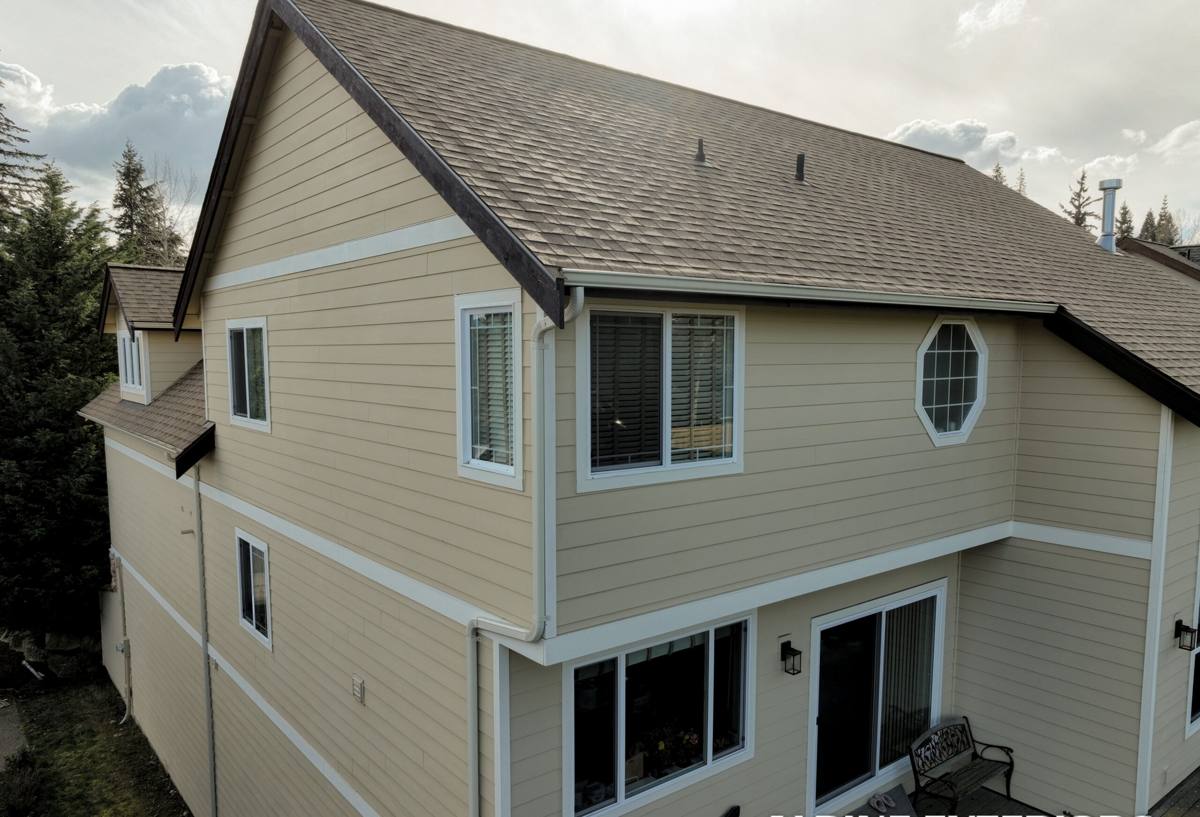
What "Custom" Actually Means for a Window Job
A custom window isn't just a special order — it's a window built and installed to match the specific opening, wall assembly, and orientation of your house. For Kendall homes that can mean:
- Non-standard rough openings in older farmhouses, additions, or hand-built outbuildings that were converted to living space
- Odd shapes — arched tops, angled bays, or transom combinations added over the years
- Matching sightlines and trim profiles so a replacement doesn't look bolted on next to original windows
- Sizing for specific rooms — larger glass on south and west exposures for light, smaller or more weather-resistant units on the north and west walls that take the worst of the wind-driven rain
Custom doesn't mean more expensive across the board. Sometimes it means one or two windows on a job need to be built to spec while the rest are standard sizes — the point is measuring and speccing every opening individually instead of forcing a house into stock dimensions.
Signs a Window Is Past Its Working Life
Whatcom County's damp cycle tends to hide window problems until they're well established. Look for:
| What You See | What It Usually Means |
|---|---|
| Fogging or haze between panes | Seal failure on a double- or triple-pane unit — the gas fill has escaped and can't be repaired, only replaced |
| Soft or discolored wood at the sill or lower corners | Water has been getting behind the trim for a while; framing underneath may need repair, not just a new window |
| Visible moss or dark streaking below the window | Water is shedding off the frame instead of being carried away by proper flashing |
| Drafts you can feel even with the window latched | Failed weatherstripping or a frame that's shifted out of square |
| Difficulty opening, closing, or locking | Frame movement from moisture cycling — wood swelling and shrinking over repeated wet seasons |
What a Correct Installation Involves
Flashing and Water Management Come First
The window unit itself is only part of the job. In a region with as much sideways rain as Whatcom County gets, how the opening is flashed matters more than the brand of glass. A proper install includes sill pan flashing to catch and direct any water that gets past the primary seal, house wrap integration so water sheds over the wrap rather than behind it, and head flashing above the unit to break the path of water running down the wall face.
Sealing Without Trapping Moisture
It's tempting to caulk every seam solid and call it weathertight, but a window wall assembly needs to manage the moisture that does get in — from condensation, from minor seal imperfections, from the sheer volume of rain this area sees. We use sealants and backer rod at the exterior joint, but leave the assembly able to drain and dry rather than sealing it into a trap. A window that can't dry out eventually rots from the inside, and by the time you can see it, the damage is already done.
Squaring and Shimming
Older Kendall-area homes have settled over decades. Rough openings are rarely perfectly square anymore. Shimming a new window into an out-of-square opening without correcting for it puts stress on the frame, which shows up later as a window that won't latch cleanly or a corner seal that opens back up.
Frame Material Options for This Climate
There's no single right answer for every house — it depends on exposure, budget, and how the rest of the home is trimmed. Here's how the common options hold up under Whatcom County's rain and moss cycle:
| Material | Moisture Resistance | Maintenance | Best Fit |
|---|---|---|---|
| Vinyl | Good — won't rot, some UV fading over many years | Low — rinse off algae/moss film occasionally | Budget-conscious full-house replacements |
| Fiberglass | Very good — dimensionally stable, resists warping | Low | Larger openings, higher-exposure walls |
| Wood-clad (exterior clad, wood interior) | Good on the clad face, but any breach at joints or cuts lets moisture into the wood core | Higher — clad seams need periodic inspection | Homes prioritizing an interior wood look, with a crew that details the exterior joints carefully |
| Bare wood | Poor without disciplined upkeep — this region's damp cycle is hard on unprotected wood | High — regular repainting/sealing | Historic restorations where matching original material is the priority |
For most Kendall homes we recommend vinyl or fiberglass on exposed walls and reserve wood-clad for protected elevations or where matching existing trim really calls for it. That's a professional judgment call based on how the wall takes weather, not a knock on any one product — every material has trade-offs, and the installation detailing matters as much as the material choice.
Our Process for a Kendall-Area Window Job
- On-site measure and assessment. We check every opening individually, look at the existing flashing and sheathing condition, and flag any rot or framing repair needed before a new window goes in.
- Custom order or on-site build spec. Openings that are standard get standard units; anything odd-sized or shaped gets built to match.
- Removal and opening inspection. Old windows come out carefully so we can see the actual condition of the sill and framing underneath — this is where hidden moisture damage shows up.
- Repair framing if needed. Any soft or rotted wood gets replaced before the new window goes in. Installing a new window over compromised framing just hides the problem for a few more years.
- Flash, set, shim, and seal using the water-management approach above.
- Interior and exterior trim finish to match the house.
- Walkthrough so you can see the operation, the seal, and ask questions before we call it done.
Why a Crew That Already Works Kendall Matters
A window install done by someone unfamiliar with this specific stretch of Whatcom County can still look fine the day it's finished. The difference shows up over the following winters. Crews who've worked houses in and around Kendall and Lynden know which wall orientations take the worst of the driving rain, how fast moss establishes on shaded siding and trim here, and how the older housing stock in this area tends to be framed — which affects everything from how an opening squares up to how flashing needs to integrate with existing siding. That local pattern recognition is what keeps a window job from becoming a callback.
There's also a practical side: a local crew can get to a Kendall job without a long drive eating into the workday, which matters when weather windows for exterior work are already tight for a chunk of the year.
Questions Worth Asking Any Window Contractor
- Will you inspect and repair framing/sheathing if it's found to be damaged, or just install over it?
- What flashing method do you use at the sill and head of each opening?
- Are you measuring every opening individually, or assuming standard sizes?
- What's the warranty on the window unit versus the warranty on your installation labor?
- Can you walk me through how water that gets past the seal is drained away?
What This Costs
Pricing depends on size, material, whether an opening needs framing repair, and how many windows are done at once — a full-house project typically costs less per window than piecemeal replacement over several years. Rather than quote a number that won't match your actual house, we'd rather walk the property, look at each opening, and give you a real figure.
If you're weighing whether your Kendall-area home needs a window or two replaced or a full custom order, we're happy to take a look and give you a straight, no-pressure estimate — just fill out the form below.