 Lynden Siding
 Building a Deck for Maple Falls' Wet, Shaded Climate
Maple Falls sits up in the forested foothills east of Lynden, and that changes what a deck needs to survive. Down in the open, flatter parts of Whatcom County, a deck gets more sun and more airflow. Up here, mature tree cover means more shade, more standing moisture on horizontal surfaces, and a moss season that can run most of the year instead of just the wet months. Add in the driving rain and salt-tinged marine air that blow through this part of the Pacific Northwest during fall and winter storms, and you've got a climate that's genuinely harder on outdoor structures than a lot of homeowners expect.
A deck built to a generic spec — the kind that would hold up fine on an open lot closer to town — often underperforms here. Wood decking that would dry out between rains on a sunny lot stays damp for days under a conifer canopy. Fasteners that would be fine on a south-facing deck corrode faster in the persistent dampness of a shaded, tree-lined property. None of this means a deck can't be built well in Maple Falls — it means it has to be built for the site it's actually on, not for a textbook average.
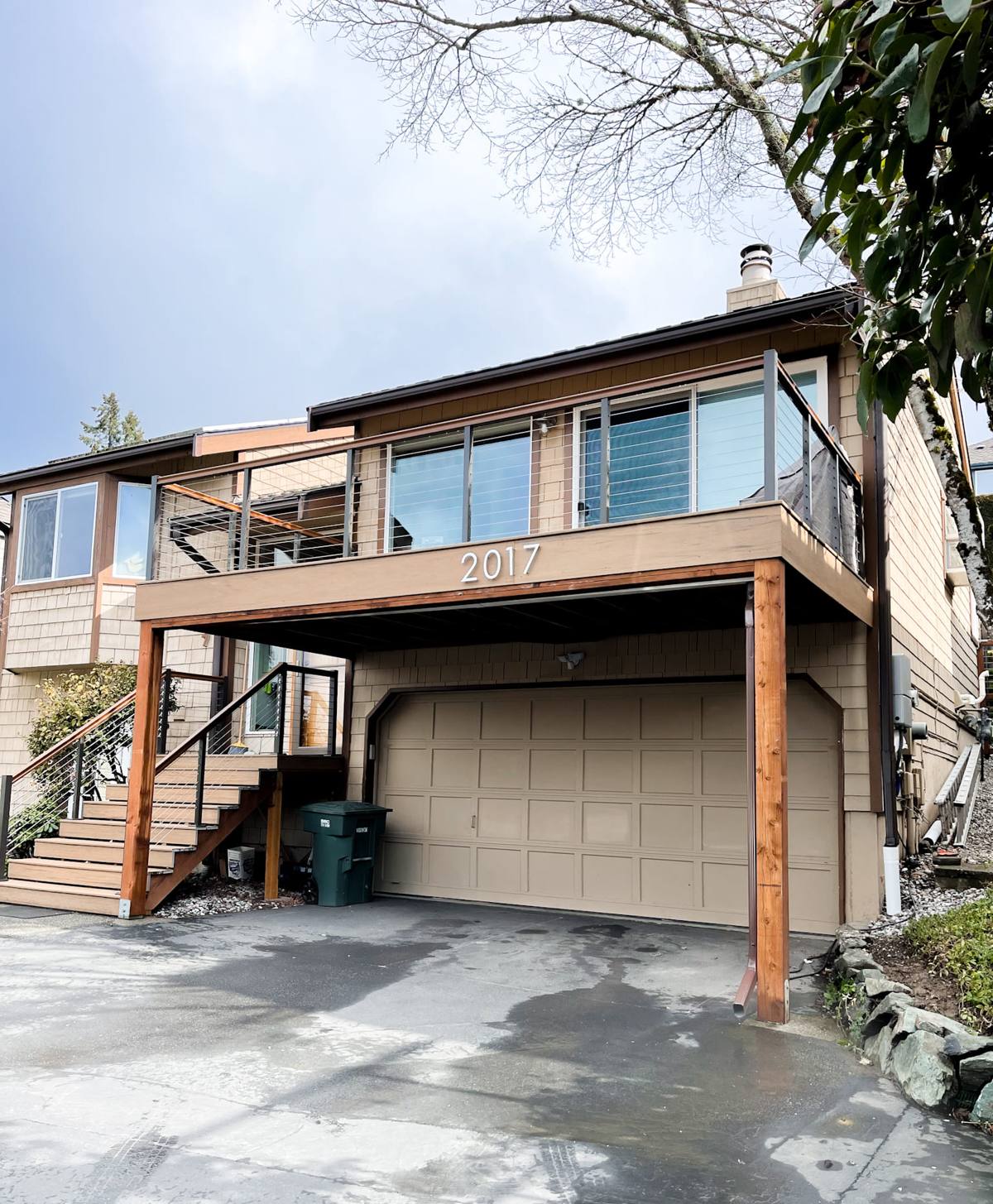
What Maple Falls Properties Typically Demand From a Deck
Shade and moisture load
Many lots in this area sit under mature conifers, which is part of what makes the area appealing to live in — but it also means less direct sun on the deck surface for more of the year. Rain sits longer, needles and organic debris collect in the gaps between boards, and any section that stays shaded and damp long enough will start growing moss, whether it's on the decking itself, the stair treads, or the top rail.
Ground conditions and drainage
Forested soil in the foothills tends to hold moisture longer than open, well-drained lowland ground. That matters for anything going into the ground — footings need to be sized and set correctly for the load and the soil conditions on that specific lot, and the grading around and under the deck needs to actually move water away from posts and framing rather than letting it pool against them season after season.
Choosing Decking Material for a Shaded, Wet Site
There's no single "best" decking material for every project — it depends on how much sun and shade the deck actually gets, what look the homeowner wants, and how much upkeep they're willing to put in. On a shaded, moisture-heavy lot, though, some materials clearly hold up better than others, and it's worth understanding the tradeoffs before committing.
| Material | Moisture & Moss Resistance | Maintenance | Typical Lifespan |
|---|---|---|---|
| Cedar | Naturally rot-resistant but still needs airflow and sun to dry between rains | Annual cleaning and periodic sealing/staining | 15–20 years with upkeep |
| Pressure-treated pine | Chemically treated against rot, but moss and algae still colonize the surface in shade | Regular cleaning; sealing recommended | 15–20 years with upkeep |
| Composite decking | Doesn't absorb moisture like wood, but still needs cleaning to keep moss/algae from gripping the textured surface | Occasional washing, no staining or sealing | 25–30+ years |
| PVC decking | Fully synthetic, sheds water and resists moss better than any wood-based option | Lowest — occasional rinse | 25–30+ years |
Our standard for heavily shaded Maple Falls lots is to steer homeowners toward composite or PVC decking on the main deck surface, simply because it holds up to constant dampness with far less maintenance than any wood product. That's not a knock on wood — cedar and treated lumber are honest, attractive materials, and we still use them for framing, rails, and accent work where they make sense. It's a matter of matching the material's real-world moisture behavior to a site that doesn't dry out quickly.
What's Underneath Matters More Than What's on Top
Footings and framing built for wet, shaded ground
A deck is only as good as what's holding it up. Footing depth and sizing need to match the load and the actual soil conditions on that lot — not a generic assumption. Framing lumber should be properly rated for exterior, ground-contact, or above-ground use depending on where it sits, and every cut end and notch needs to be sealed, because a factory-treated board that gets field-cut and left raw is exactly where rot starts first in a damp climate.
Ledger board attachment and flashing
Where a deck attaches to the house is the single most common place we find hidden problems on older decks — including ones that look fine from the outside. If the ledger board isn't properly flashed to shed water away from the house's siding and framing, moisture works its way behind the board and rots both the ledger and the wall structure behind it, often for years before it's visible. Because we're a siding crew as well as a deck-building crew, we pay close attention to this connection specifically — it's the one spot where deck work and exterior wall integrity are the same job.
Railings, Fasteners, and Hardware That Won't Let You Down
Hardware failure is a quieter problem than rot, but it's just as real. In a climate with persistent dampness and occasional salt-laden coastal air moving through, standard zinc-coated fasteners corrode faster than they would in a drier inland climate. We use stainless steel or coated fasteners rated for treated lumber and exterior exposure, and we favor hidden fastener systems on composite and PVC decking where the manufacturer supports it — both for a cleaner look and because exposed screw heads are one more place water and grime collect.
Railings get the same consideration. A rail system that isn't properly through-bolted or that relies on undersized hardware is a safety issue as much as a durability one, and it's one of the first things we check when we're asked to look at an older Maple Falls deck.
Our Deck-Building Process for Maple Falls Homes
- Site visit and assessment. We look at sun exposure, tree cover, drainage, existing structure (if any), and how the deck will connect to the house.
- Design and material selection. We walk through decking, railing, and framing options with honest tradeoffs for that specific lot — not a one-size-fits-all recommendation.
- Permitting. We handle the permit process for the jurisdiction the property falls under, including the structural details reviewers typically want to see.
- Footings and framing. Correctly sized footings, properly rated framing lumber, and sealed cuts — the part of the job that doesn't show but determines how long the deck lasts.
- Decking, rails, and hardware installation. Installed to the manufacturer's specifications, with attention to fastening, spacing for drainage, and flashing at the house connection.
- Final walkthrough. We go over the finished deck with the homeowner and cover what upkeep, if any, the chosen materials need going forward.
What Affects the Cost of a Custom Deck
Every deck project is priced around its own specifics, and we'd rather walk a property and give an honest number than throw out a figure that doesn't hold up. That said, a few factors consistently move the price more than others.
| Factor | Why It Changes the Price |
|---|---|
| Size and footprint | More square footage means more material, more footings, and more labor hours |
| Height and levels | A raised or multi-level deck needs more framing, stairs, and structural engineering than a low, single-level deck |
| Decking material | Composite and PVC cost more upfront than wood but require far less long-term maintenance |
| Railing style | Cable, glass, and custom metal rail systems cost more than standard wood or composite spindles |
| Site access and grading | Sloped, wooded, or hard-to-access lots — common in the Maple Falls area — take more time to prep and build on |
In broad terms, a modest single-level deck tends to land in the lower five figures, with larger, multi-level, or premium-material decks running higher from there. We'll always give you a specific number for your project rather than asking you to guess from a range.
Keeping a Maple Falls Deck Looking Good Year-Round
Whatever material you choose, a little seasonal attention goes a long way in a climate like this. A homeowner willing to do the basics can add years to a deck's appearance and lifespan.
- Sweep needles, leaves, and debris off the deck surface regularly, especially in fall — trapped organic matter holds moisture and feeds moss growth
- Rinse or gently wash the deck surface a few times a year to keep moss and algae from getting a foothold, especially on shaded sections
- Check and re-seal or re-stain wood decking on the manufacturer's or installer's recommended schedule — don't wait until it's visibly graying
- Inspect railings and stair connections annually for loose fasteners or movement
- Check the ledger board flashing where the deck meets the house for any sign of gaps, cracking, or water staining
- Trim back overhanging branches and nearby vegetation where practical to improve airflow and sun exposure on the deck surface
Why Hiring a Crew That Already Works Maple Falls Matters
A deck built by someone unfamiliar with this area's conditions can look fine on the day it's finished and still be in trouble within a few years — undersized footings for damp soil, decking that traps moisture under heavy shade, or a ledger connection that wasn't flashed for the amount of rain this region actually sees. A crew that regularly works Maple Falls and the surrounding Lynden area already knows which lots need extra drainage attention, which decking materials actually hold up under year-round tree cover, and what the permitting process looks like for properties in unincorporated Whatcom County.
That local familiarity isn't a marketing line — it's the difference between a deck spec'd for a national average climate and one spec'd for the specific combination of shade, rainfall, and dampness this area sees more of than most.
If you're planning a new deck or replacing an aging one in Maple Falls, we're happy to walk the property, talk through material options honestly, and give you a straightforward estimate — no pressure, no obligation. Use the form below to get started.