 Lynden Siding
 Maple Falls' Climate Is Hard on Siding
Maple Falls sits up in elevation from the valley floor around Lynden, tucked into heavier tree cover as the land climbs toward Mt. Baker. That combination — shade, moisture, and a Whatcom County climate that stays damp for most of the year — is a tough environment for exterior materials. Homes here deal with driving rain off the Nooksack River drainage, long stretches of overcast humidity, and a moss and algae season that, thanks to the tree canopy, can run nearly year-round on north-facing walls and anywhere sunlight doesn't reach.
That same marine-influenced weather system that carries salt-tinged, moisture-heavy air off the Salish Sea and inland through the county doesn't spare the higher, wooded pockets like Maple Falls — it just shows up differently: as standing dampness in shaded siding, slower drying times after storms, and organic growth that spreads faster where a house sits under fir and cedar. Siding that isn't built and installed for this environment shows it within a few years — soft spots, peeling paint, swollen seams, and moss creeping up from the bottom courses.
This page is about one thing: correctly installed fiber cement siding on Maple Falls homes, and why the material and the installation both matter as much as each other in this particular climate.
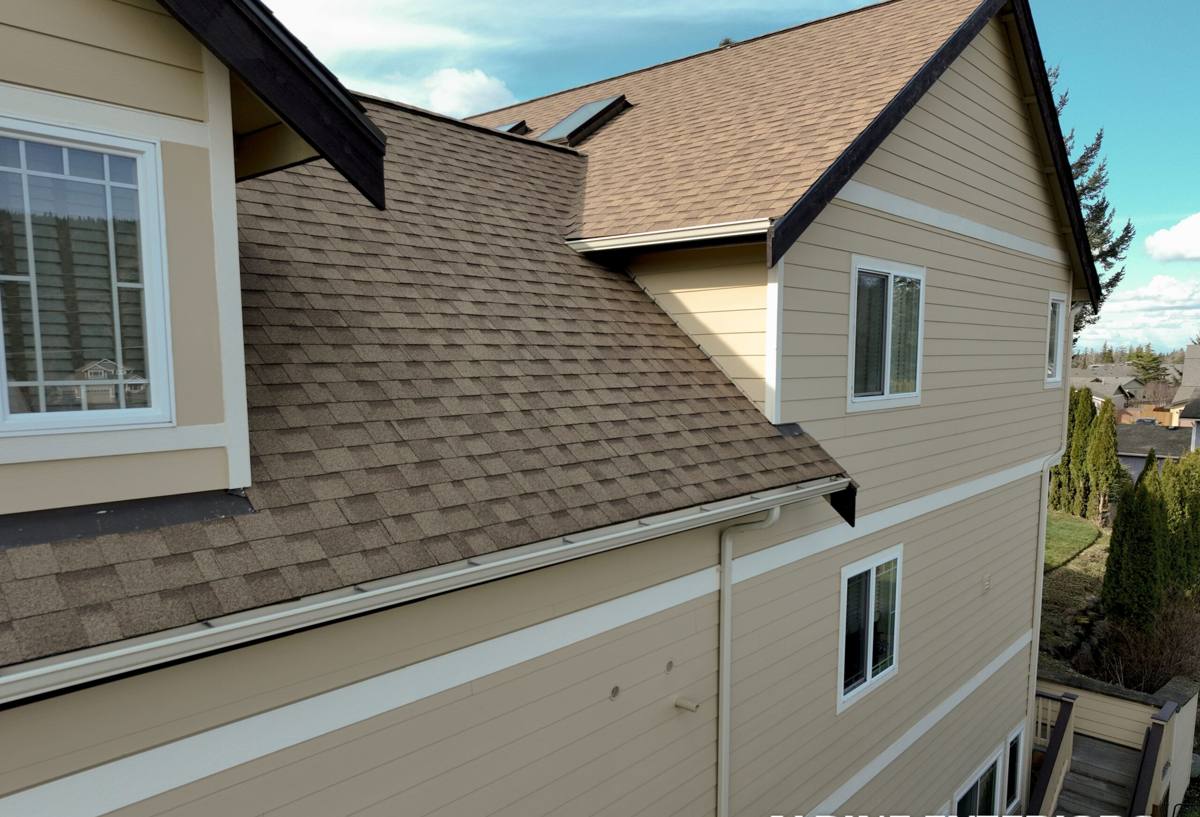
Why We Install Only James Hardie Fiber Cement
We don't install vinyl, LP SmartSide, Cemplank, Allura, or primed wood siding. That's a deliberate standard, not a sales pitch. Every one of those products has legitimate uses somewhere — but for the moisture load and moss pressure a Maple Falls home deals with, we've settled on one system we trust to hold up: James Hardie fiber cement, installed to Hardie's spec.
What Fiber Cement Is Built From
Fiber cement is a blend of Portland cement, sand, and cellulose fibers, cured into a dense, stable board. It doesn't absorb and swell the way engineered wood products can, and it doesn't expand and contract with temperature swings the way vinyl does — both of which matter in a climate that cycles between soaking wet and freezing more than people expect for Western Washington. It's also non-combustible, which is a real consideration this far into forested terrain near Mt. Baker, where wildfire risk is part of the regional conversation.
Why Not the Alternatives
Vinyl siding is affordable and low-maintenance, but it's a thin plastic product that can crack in a hard freeze and it doesn't hold paint if a homeowner ever wants to change the color. LP SmartSide and other engineered wood products use a wood strand core — they perform well when installed and caulked perfectly and maintained on schedule, but any breach in that seal lets moisture into the core, and a shaded, damp lot like the ones common around Maple Falls doesn't give a wood-based product much room for error. Cedar and primed spruce are honest, traditional materials, but they require repainting and moisture vigilance on a cycle most homeowners don't want to keep up with in a climate this wet. We'd rather put one product on every home we work on and stand behind it fully than split our expertise across five.
The Hardie Product Lines That Make Sense Here
| Product | Best Use | Why It Fits Maple Falls |
|---|---|---|
| HardiePlank Lap Siding | Standard horizontal siding, most home styles | Widest color and texture range; proven track record in wet climates |
| HardiePanel Vertical Siding | Board-and-batten, cabin and craftsman styles | Common look for wooded, rural properties; sheds water well when flashed correctly |
| HardieTrim | Corners, fascia, window/door trim | Matches the siding's moisture resistance so trim doesn't become the weak point |
Homes in this region are typically installed with Hardie's HZ5 climate-engineered formulation, which is manufactured for regions that see real seasonal moisture and freeze-thaw swings, as opposed to the hot-humid HZ10 line built for southern climates. It's a small distinction most homeowners never hear about, but it's part of why we spec Hardie by name rather than "fiber cement" as a generic category — the formulation is matched to the climate it's going on.
Where color is concerned, ColorPlus factory-applied finish matters more here than in a drier climate. A factory-baked finish resists the fading and moisture intrusion at the paint layer that a field-applied coat is more prone to, and it comes with its own finish warranty separate from the substrate warranty — worth knowing since siding here spends more days wet than dry for a good chunk of the year.
What a Correct Installation Actually Involves
Fiber cement is only as good as the installation behind it. Most of the siding failures we get called out to inspect on older homes trace back to installation shortcuts, not the material itself.
Clearances and Flashing
Hardie's own installation instructions call for a minimum clearance from grade, roof lines, and decks, plus specific flashing at every horizontal transition — window heads, roof-to-wall intersections, deck ledgers. In a climate where wall surfaces stay wet longer under tree cover, skipping or shortcutting flashing is exactly how water gets behind the siding and rot starts in the sheathing underneath, where nobody sees it until it's a bigger job.
Fastening and Gaps
Fiber cement needs to be fastened correctly — proper nail placement, not overdriven, into framing rather than just sheathing — and it needs expansion gaps at butt joints and trim. Caulking those joints with a quality, paintable sealant (not skipping it, and not over-relying on it to do a flashing detail's job) is part of doing it right the first time.
Rainscreen and Drainage Plane
On a shaded, damp lot, how the wall assembly drains matters as much as the siding itself. A proper water-resistive barrier and, where the wall design calls for it, a rainscreen gap behind the siding gives moisture a way to escape instead of sitting against the back of the boards. This is one of the details that separates a crew that understands wet-climate installation from one that's just hanging boards.
Correct vs. Incorrect: What Separates a Good Install From a Problem Install
| Detail | Done Right | Common Shortcut |
|---|---|---|
| Flashing at windows/roof lines | Integrated flashing at every horizontal transition | Relying on caulk alone to seal a joint |
| Ground clearance | Meets Hardie's minimum clearance from grade and hardscape | Siding installed too close to soil, mulch, or a deck surface |
| Fastening | Correct nail type, spacing, and depth into framing | Overdriven nails or fastening into sheathing only |
| Joints and gaps | Manufacturer-spec expansion gaps, properly caulked | Boards butted tight with no room to move |
| Warranty registration | Filed with Hardie so the transferable warranty is active | Skipped, leaving the homeowner without coverage |
How Our Process Works
- On-site walkthrough and assessment of the existing siding, sheathing condition, and any moisture or moss issues already present
- Straightforward, written estimate covering material, labor, and any sheathing repair the assessment turns up
- Product and color selection from Hardie's ColorPlus lineup, matched to the home's style and the site's sun/shade exposure
- Removal of old siding and inspection of the wall assembly before anything new goes up
- Installation to Hardie's published specifications — flashing, clearances, fastening, and drainage detail included, not treated as optional
- Final walkthrough and warranty registration so the homeowner has documentation on file
Why It Matters to Hire a Crew That Already Works Maple Falls
A lot of siding problems in this region aren't about the product — they're about a crew applying a one-size-fits-all install that would be fine in a drier part of the state but doesn't account for how long these walls stay wet under tree cover. A crew that regularly works Whatcom County properties like the ones around Maple Falls already knows to plan around the moisture load, size up existing rot before it's covered by new siding, and detail flashing for a climate that doesn't give a wall much time to dry out between storms. That familiarity shows up in fewer callbacks and a siding job that's still doing its job fifteen and twenty years out.
Living With Fiber Cement Siding in a Moss-Prone Area
Correctly installed Hardie siding is low-maintenance, but "low" isn't "none" — especially with the tree cover common around Maple Falls. A little seasonal attention keeps it looking right and keeps small issues from becoming siding-replacement issues.
- Rinse siding annually (a garden hose is usually enough) to clear moss spores, pollen, and organic buildup before it takes hold, especially on shaded, north-facing walls
- Keep gutters clear so water isn't sheeting down the siding face during heavy rain
- Trim back branches and vegetation that keep a wall surface shaded and damp longer than it needs to be
- Check caulking at trim and joints every couple of years and re-caulk if it's cracked or pulling away
- Repaint on the cycle recommended for your finish if you didn't go with ColorPlus factory finish, or touch up any field-painted trim as needed
- Watch for any soft spots, staining, or gaps at flashing points and call it in early rather than waiting
What This Job Costs and What Moves the Number
| Factor | How It Affects Cost |
|---|---|
| Home size and wall complexity | More square footage, more corners, dormers, and gables mean more labor and trim work |
| Existing sheathing condition | Rot or water damage found during tear-off adds repair cost before new siding goes up |
| Product line and profile | Lap width, panel style, and trim selections vary in material cost |
| Finish choice | ColorPlus factory finish carries a premium over field-primed boards, offset by longer finish life |
| Site access | Steep or heavily wooded lots, common around Maple Falls, can add setup and material handling time |
Every home is different, and the only honest way to give a real number is to look at the house. If you're in Maple Falls and thinking about replacing your siding, we're glad to come take a look and put together a straightforward, no-pressure estimate — no obligation, just a clear picture of what your home needs.