 Lynden Siding
 Maple Falls Sits in a Different Microclimate Than Downtown Lynden
Maple Falls is up in the wooded foothill country east of Lynden, closer to the mountains than to the water, and that changes what a home's exterior has to deal with year-round. You get more tree cover here, more shade from conifers that never fully drop their canopy, and rainfall that tends to run heavier and linger longer than it does out on the flatter farmland closer to town. Whatcom County's weather still comes largely off the Salish Sea and the broader Pacific system, so that moisture carries a salt-tinged marine quality even this far inland — it just arrives wetter and stays wetter once it's pinned against the foothills.
The practical result for siding is simple: homes in and around Maple Falls fight moss, mildew, and slow moisture intrusion more aggressively than a similar house sitting in full sun a few miles away. A siding installation done for "generic Whatcom County weather" isn't the same job as one done specifically for a shaded, rain-heavy foothill lot. The material, the water management behind it, and the finish all need to be chosen with that in mind.
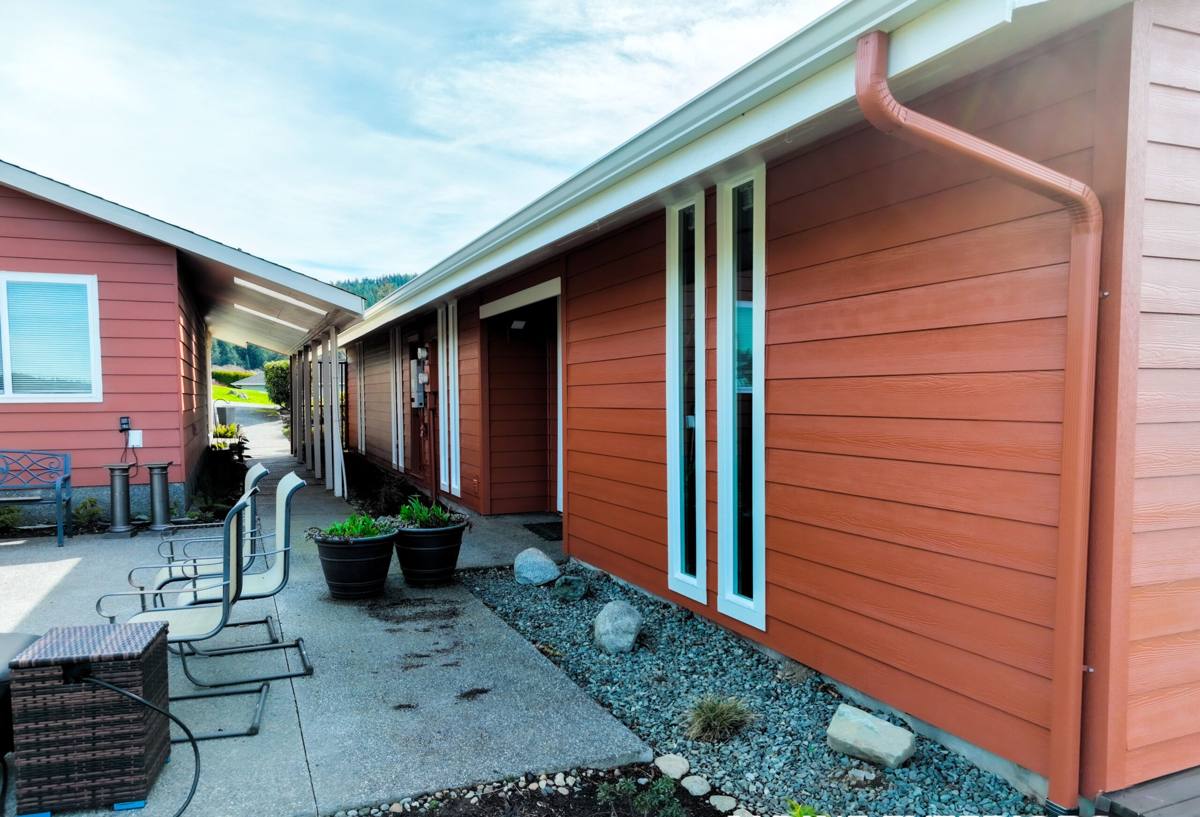
What Long, Wet, Shaded Winters Do to the Wrong Siding
Moss Doesn't Just Sit There — It Works
Moss and algae growth on north-facing and shaded walls isn't only a cosmetic issue. Moss holds moisture directly against the siding surface far longer than open air would, and on materials that swell, delaminate, or absorb water at the edges, that constant dampness accelerates whatever failure mode the product is already prone to. On a wood-based product it feeds rot. On an under-primed or poorly finished product it breaks down the paint film early.
Driving Rain Finds Every Weak Seam
This area doesn't just get a lot of rain — it gets wind-driven rain that hits siding at an angle instead of falling straight down. That matters because it pushes water into laps, seams, and trim joints that would stay dry in a calmer climate. Any installation shortcut that would go unnoticed in a drier region shows up here as a stain, a soft spot, or a paint failure within a few winters.
What a Correct Siding Installation Actually Involves
Good siding is only as good as what's behind it. The visible board or panel is the last layer of a system, and in a climate like this, the layers underneath matter as much as the finish everyone sees.
- A continuous weather-resistive barrier installed shingle-style so every layer sheds water downward and outward
- Properly lapped and sealed flashing at every window, door, and roofline intersection — the highest-risk spots for leaks
- A drainage gap or rainscreen strategy that lets any moisture that does get behind the siding actually dry out instead of sitting against the sheathing
- Correct fastener type, spacing, and placement for the specific siding product, not a one-size-fits-all approach
- Factory-cut and factory-sealed panel edges wherever possible, since field-cut edges are the most common point of moisture entry on any fiber cement product
- Proper clearance at grade, decks, and roof lines so siding never sits in standing water or constant splash-back
Skip any one of these and the siding itself almost doesn't matter — water will find the gap. This is also why we don't treat re-siding as a cosmetic swap. Every tear-off is a chance to inspect the sheathing, correct old flashing mistakes, and fix any rot that's already hiding behind the old siding before it gets covered up again.
Why We Only Install James Hardie Fiber Cement
We've made a deliberate call to install one product line — James Hardie fiber cement — rather than offering a menu of siding brands. In a climate like Maple Falls', the reasons are practical, not just brand preference.
Non-Combustible and Dimensionally Stable
Fiber cement doesn't expand and contract with moisture the way wood-based products do, which matters when a house sits shaded and damp for months at a stretch. It also won't ignite from wildfire embers or a neighboring structure fire, which is worth something even in a wet-climate area like this one.
ColorPlus Factory Finish
Hardie's ColorPlus finish is baked on at the factory under controlled conditions, which gives it a far more consistent bond and UV/moisture resistance than a field-applied paint job on wood or engineered wood siding. In a moss-prone, shaded environment, a finish that resists mildew staining and holds its color longer means fewer repaint cycles over the life of the siding.
Climate-Engineered Product Lines
Hardie doesn't make one universal product — it engineers different HZ (HardieZone) formulations for different climate zones. Western Washington, including the Maple Falls and Lynden area, falls into the zone that calls for the HZ5 formulation, engineered around freeze-thaw cycling and sustained damp conditions rather than the heat-and-humidity formulation used in the South. That's a meaningful distinction most homeowners never hear about until they're comparing quotes.
Fiber Cement vs. the Alternatives, for This Climate
| Material | Typical Installed Cost | Moisture/Moss Resistance | Maintenance | Realistic Lifespan Here |
|---|---|---|---|---|
| Vinyl siding | Lower | Fair — won't rot, but seams and edges can trap moisture and moss behind panels | Low, but can warp or fade and is hard to patch invisibly | 15–25 years |
| Engineered wood (e.g. LP-style) | Mid | Sensitive — depends heavily on caulking, flashing, and paint upkeep | Moderate to high — edge-swelling risk if a coating is neglected | 15–25 years with diligent upkeep |
| Cedar / solid wood | Higher | Poor in constant shade/moisture without frequent refinishing | High — regular staining or painting required | Variable, often shorter in shaded, wet exposures |
| James Hardie fiber cement | Mid to higher | Strong — non-combustible, dimensionally stable, factory-sealed finish | Low — occasional wash, no recoating cycle | Decades, with a strong transferable warranty backing it |
These are broad, industry-general ranges meant to help with planning, not a quote — actual pricing depends on your home's size, tear-off condition, trim complexity, and access.
Signs Your Current Siding Is Already Struggling
A lot of siding failure in this area happens quietly, behind a wall that still looks fine from the driveway. Walk your exterior, especially the shaded and north-facing sides, and look for:
- Soft or spongy spots when you press on a wall, especially near the bottom courses
- Persistent moss or dark streaking that comes right back after cleaning
- Paint that's peeling, bubbling, or chalking heavily in patches
- Visible gaps opening at seams, corners, or trim boards
- Boards or panels that are cupping, bowing, or separating from the wall
- A musty smell near exterior walls inside the house, especially in closets or corners
- Rising heating bills without another clear explanation, which can point to moisture-compromised insulation behind failing siding
Any one of these alone isn't necessarily an emergency, but a couple together usually means water has already been getting behind the siding for a while.
How Our Installation Process Works
- On-site inspection — we look at the existing siding, sheathing condition, trim, and any problem areas specific to your lot's sun and shade pattern
- Full tear-off — old siding and trim removed down to the sheathing, not installed over the top of an existing layer
- Sheathing repair — any rot, soft spots, or old flashing mistakes get fixed before anything new goes on
- Water management install — weather-resistive barrier, flashing, and drainage details installed correctly the first time
- Hardie installation to manufacturer spec — correct fastener pattern, joint treatment, and clearances, following Hardie's published installation requirements exactly
- Trim, caulking, and finish detailing — the parts that determine whether the job still looks tight in ten years, not just on move-out day
- Final walkthrough and cleanup — job site cleared, and a chance for you to walk the exterior with us before we consider it done
Why It Matters That We Already Work This Area
A crew that regularly works Maple Falls and the surrounding Lynden-area foothills isn't guessing at how to sequence a job around this weather. We know that a stretch of dry days here can close quickly, so tear-off and water management steps get scheduled to minimize how long a wall sits open. We know which sides of a house are going to need extra attention to shade and moss exposure before we even climb the ladder. And we know that rural and wooded lots sometimes mean tighter access, more careful material staging, and more coordination around trees and slope than a straightforward in-town job.
That local familiarity isn't a marketing line — it's the difference between a crew that treats every job as a first attempt at this climate and one that's already made its adjustments.
Keeping Hardie Siding Performing Long-Term
Correctly installed fiber cement is low-maintenance, not no-maintenance. In a moss-heavy area like Maple Falls, a periodic soft wash on shaded walls keeps growth from taking hold, and keeping gutters clear prevents overflow from running down and staining siding at the corners. Trimming back vegetation that shades a wall year-round also helps that section dry out faster after storms, which matters more here than in a drier neighborhood.
If you're weighing a siding replacement on a Maple Falls home, we're happy to walk the exterior with you, point out what we're seeing, and put together a straightforward, no-pressure estimate — just fill out the form below to get started.