 Lynden Siding
 Built for the Fraser Valley's Wet Side of the Border
Abbotsford sits in the Fraser Valley just north of the Lynden and Sumas border crossings, and the weather doesn't stop at the line. Homes here deal with the same marine-influenced climate we see throughout Whatcom County: long stretches of driving rain off the Strait of Georgia and Puget Sound, salt-laden air that migrates inland on winter storms, and short, low-angle winter sun that turns north-facing walls and shaded soffits into a moss farm for half the year. Siding that isn't engineered for that combination doesn't fail overnight — it fails slowly, from the inside out, usually years before a homeowner notices anything wrong on the surface.
We've installed siding across both sides of the border long enough to know which failure patterns show up first in this specific climate, and which products and installation details actually prevent them. This page covers what siding installation looks like when it's done right for an Abbotsford home, and why we only do it one way.
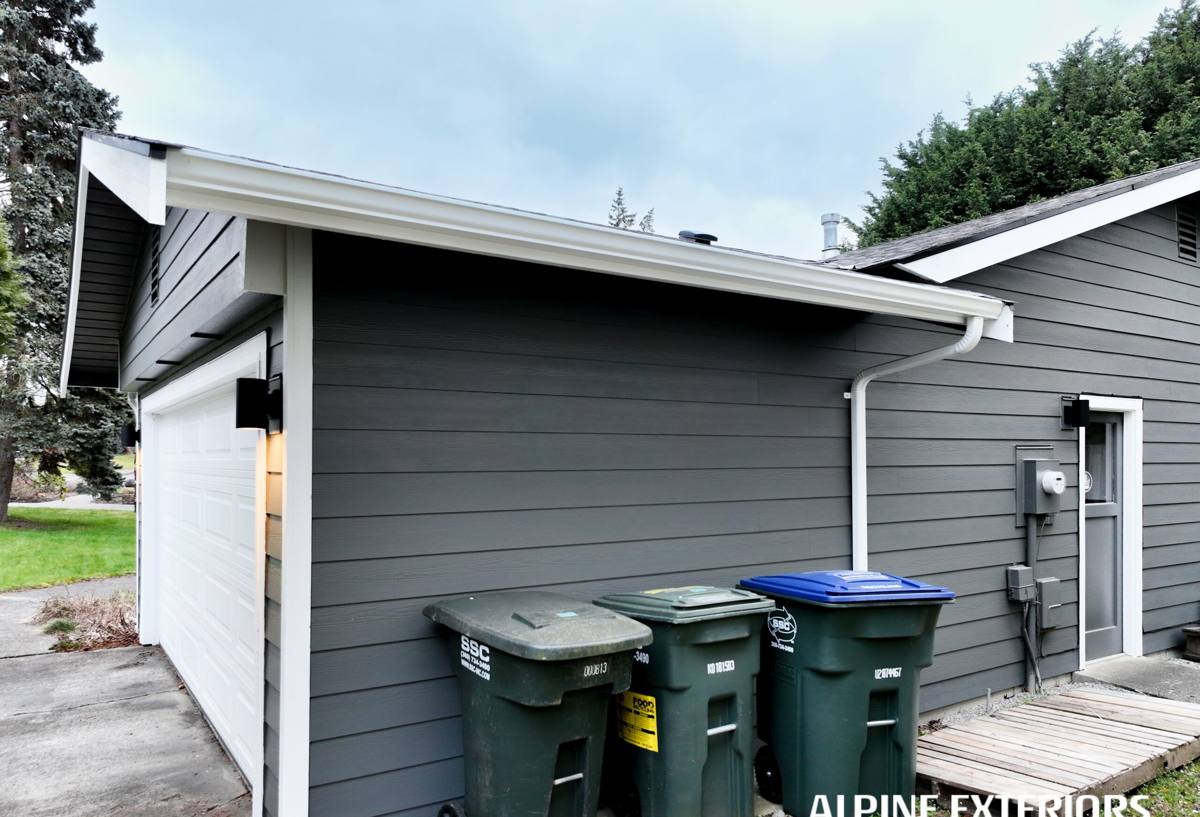
What This Climate Does to Siding
Salt Air and Moisture
Salt-carrying moisture doesn't just sit on the surface of a wall — it works into fasteners, seams, and any place water can collect and linger. Metal fasteners corrode faster, caulked joints degrade faster, and any siding product that relies on paint film or a surface coating for protection starts showing chalking, fading, and cracking sooner than the manufacturer's brochure suggests. Wood-based products, including engineered wood, are the most vulnerable, because the substrate itself swells when it absorbs moisture and shrinks when it dries, and that repeated movement is what eventually opens up the joints and edges where water gets in.
The Long Moss Season
Between the rain and the tree cover common to properties throughout the Fraser Valley and Whatcom County, siding here spends a good part of the year damp. Moss and algae need exactly that: shade, moisture, and time. On some materials, moss growth is cosmetic. On others — particularly anything with a wood component or a fiber that can absorb water — sustained moss cover holds moisture against the surface long enough to start real deterioration underneath. The fix isn't just picking a siding color that hides green streaking; it's picking a material that doesn't degrade when moss and mildew inevitably grow on it between cleanings.
Driving Rain and Wind-Driven Water
Storms coming off the water don't just fall straight down — wind pushes rain sideways into wall assemblies, which is why flashing details, house wrap laps, and caulking at penetrations matter as much as the siding material itself. A premium siding product installed with sloppy flashing will leak. A modest siding product installed with correct water management will often outperform it.
What Correct Installation Actually Involves
Siding installation is a system, not just a material nailed to a wall. The parts that don't show up in a driveway estimate are usually the parts that determine whether a job lasts fifteen years or fifty.
- Removal of old siding down to the sheathing so the wall can actually be inspected, not covered over
- Repair of any rotten sheathing, framing, or trim found underneath before anything new goes up
- A continuous, properly lapped weather-resistive barrier installed shingle-style so water sheds outward, not inward
- Correct flashing at every window, door, deck ledger, and roof-to-wall transition
- Manufacturer-specified fastener type, spacing, and penetration depth — not "close enough"
- Proper clearance between the bottom edge of the siding and the ground, roof lines, and decks so water and moss-holding debris don't sit against it
- Caulking and sealant only where the manufacturer calls for it — over-caulking traps moisture just as badly as under-caulking lets it in
Skip or rush any one of these steps and the siding product on the outside becomes almost irrelevant — the wall behind it will fail regardless of brand.
Why We Install Only James Hardie Fiber Cement
We made a decision years ago to install one siding system, on every job, rather than offer a menu of products and let price shop the decision. James Hardie fiber cement is what we install because it's the material we've found holds up to this specific climate without asking homeowners to accept a shorter service life or a heavier maintenance schedule as the trade-off.
| Factor | James Hardie Fiber Cement | Vinyl | Engineered Wood (e.g. LP SmartSide) |
|---|---|---|---|
| Moisture behavior | Non-organic core; doesn't swell, rot, or absorb water like wood | Doesn't rot, but seams and channels trap moisture and debris | Wood-fiber core; vulnerable to swelling and rot if any edge is exposed |
| Moss/algae exposure | Surface growth doesn't degrade the substrate | Surface growth is cosmetic but hard to fully remove from texture | Prolonged moss contact can accelerate edge and surface breakdown |
| Fire resistance | Non-combustible | Combustible; can melt or deform near heat | Combustible; treated but still wood-based |
| Finish/paint life | Factory-baked ColorPlus finish, warrantied against fade and peel | Color molded through, but fades and chalks over time | Field- or factory-painted; repainting eventually required |
| Typical service life | 30+ years when installed to spec | 20-30 years, variable | 15-25 years, heavily dependent on maintenance |
None of this means the other products are junk — vinyl and engineered wood both have a place, and plenty of homes carry them without incident for years. It means that when we weighed long-term performance against installation sensitivity, moisture behavior, and maintenance burden for this exact climate, fiber cement won every time, so it's the only thing we put on a wall.
Choosing a Line and Color for an Abbotsford Home
James Hardie makes climate-specific product lines — HZ5, for the colder, wetter zones this region falls into — engineered for moisture and temperature swings rather than a one-size-fits-all formulation. For most Abbotsford homes, that means choosing between lap siding, board-and-batten, and shingle-style panels, often mixed on gables or accent areas, finished in a ColorPlus factory color rather than field-painted. Factory-applied finish matters more here than in drier climates: it's cured under controlled conditions rather than exposed to rain mid-application, and it carries its own finish warranty separate from the product warranty. Darker colors show less green streaking between cleanings; lighter colors show more but hide dust and pollen better. Neither is "wrong" — it's a maintenance-preference decision worth talking through before ordering material.
Our Process for Abbotsford Projects
Assessment and Measurement
We walk the exterior, check the condition of the sheathing where we can access it — around outlets, vents, and existing damage — and measure for material takeoff. This is also when we flag anything that's likely hiding rot, like soft trim, stained soffits, or gaps around windows, so it's priced into the estimate rather than discovered as a surprise mid-project.
Scheduling and Material Logistics
Because Abbotsford sits across the border from our Lynden base, we build crossing time and material delivery into the schedule up front rather than treating it as an afterthought. Fiber cement siding is heavy and ships on pallets, so staging delivery and coordinating any documentation your project needs is part of quoting the job, not something worked out after the crew shows up.
Installation and Cleanup
Old siding comes off, sheathing gets inspected and repaired where needed, the weather barrier and flashing go in correctly the first time, and Hardie panels go up to manufacturer spec — proper fastener schedule, clearances, and joint treatment. We clean up debris daily rather than leaving a work site sitting exposed to rain overnight.
Signs Your Current Siding Is Already Failing
- Soft or spongy spots when you press on the siding, especially near the bottom courses
- Paint that's bubbling, peeling, or chalking heavily between repaints
- Persistent moss or algae that returns within weeks of cleaning
- Visible warping, buckling, or gaps opening at seams and corners
- Rising heating bills with no other explanation, suggesting water-damaged insulation behind the wall
- Interior signs — a musty smell, peeling wallpaper, or staining on interior walls near exterior corners
Any one of these is worth a look before it's addressed with paint or caulk alone; on aging wood-based siding, surface fixes usually buy a season or two, not years.
What Drives the Cost
| Factor | Why It Matters |
|---|---|
| Home size and wall complexity | More corners, gables, and dormers mean more cutting, flashing, and labor time |
| Condition of the sheathing underneath | Rot repair found during tear-off adds material and labor not visible in a driveway quote |
| Siding profile and finish | Lap vs. shingle-style vs. board-and-batten, and factory color vs. standard colors, price differently |
| Height and access | Two-story walls, steep grades, and limited access add scaffolding or lift time |
| Tear-off and disposal | Full removal of old siding costs more upfront than installing over it, but it's the only way to actually inspect and fix the wall |
For a typical single-family home, full fiber cement siding replacement generally lands in the low-to-mid five figures, with the final number driven mostly by size, wall condition, and how much repair the tear-off uncovers. We won't quote a real number without seeing the house, but we'll give you a straight answer on where a project like yours tends to fall once we have.
Why Local Experience on Both Sides of the Border Matters
A crew that already works the Lynden-to-Abbotsford corridor knows the climate specifics that matter here — how much moss exposure a north-facing wall in the Fraser Valley actually sees, how far salt-carrying storms typically reach inland, and how to schedule around the logistics a cross-border project adds that a purely local job doesn't have. That experience shows up in the details: where we add extra flashing attention, which walls we recommend a darker color for, and how we sequence a job so materials and crew aren't sitting idle waiting on a delivery. It's the difference between a contractor executing a generic install and one who's already seen how this exact siding performs on this exact kind of home, in this exact weather.
If your Abbotsford home's siding is showing its age, or you're planning ahead of a bigger renovation, we're happy to take a look and walk you through what we'd recommend — no pressure, no obligation. Request a free estimate below and we'll get back to you with straight answers.