 Lynden Siding
 Why Siding Repair Looks Different in Nooksack
Nooksack sits in the Whatcom County river valley east of Lynden, in a stretch of the county where damp air, low winter sun angles, and long stretches of overcast weather are simply the normal operating conditions for a house exterior. Siding here isn't fighting one big storm event — it's fighting months of low-grade moisture exposure that never fully dries out between rain events. That changes what "repair" needs to mean. A patch that looks fine on day one but doesn't address how water is getting behind the cladding will fail again, usually in the same spot, within a season or two.
We service Nooksack as part of our regular Lynden-area route, not as a special trip. That matters more than it sounds like it should — a contractor who's already in the neighborhood sees the same wall assemblies, the same trim details, and the same failure patterns over and over, and that repetition is what makes a repair actually hold.
Moisture and a Long Moss Season
Whatcom County's mix of salt-tinged marine air moving inland and a mild, wet climate means siding rarely gets a hard, fast dry-out the way it might in a drier region. Moss and algae get a long runway to establish on north-facing walls, under eaves, and anywhere siding stays shaded. Left alone, that growth holds moisture directly against the siding surface, which is exactly the condition that causes soft, swollen, or delaminating boards — especially where the original material wasn't a true fiber cement product.
Driving Rain and Wind-Loaded Walls
Rain in this part of the county doesn't always fall straight down. Wind-driven rain pushes water sideways into laps, seams, and fastener penetrations, which is why repair work almost always needs to happen at a joint, a corner, or a penetration point rather than in the middle of an open field of siding. If the flashing detail behind that joint was never right, no amount of caulk on the surface will fix it long-term.
Freeze-Thaw Cycling
Whatcom County gets enough near-freezing nights each winter that any water trapped behind or inside a compromised siding panel goes through repeated freeze-thaw cycles. That's what turns a small crack into a large one, or a soft spot into a hole, over the course of a winter.
Signs a Nooksack Home Needs Siding Repair
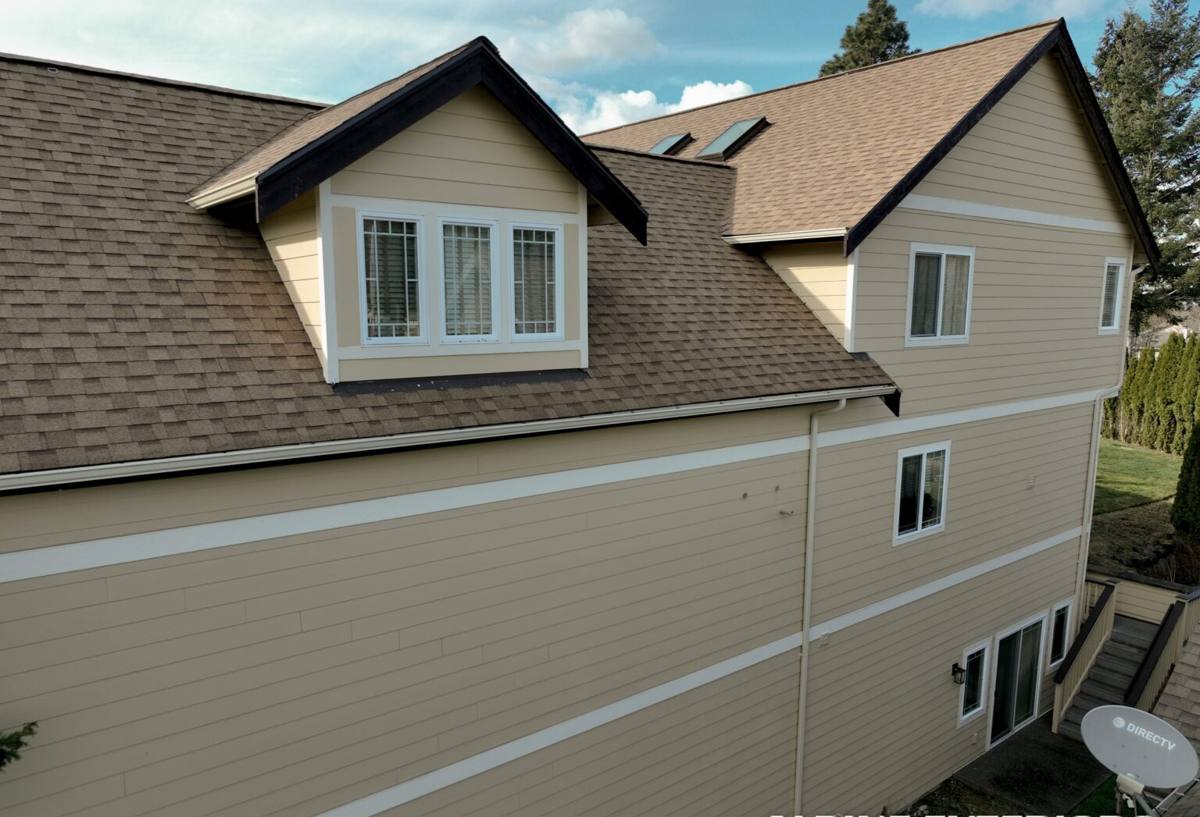
Most homeowners notice siding problems late, because the early signs are subtle and easy to write off as cosmetic. Here's what we actually look for during an inspection:
- Soft or spongy spots when you press on the siding, especially near the bottom courses or below windows
- Visible gaps, cracks, or separation at butt joints and corners
- Paint that's bubbling, peeling, or failing in one specific area rather than uniformly across the wall
- Persistent moss or dark staining that keeps returning after cleaning
- Warping, buckling, or boards that no longer sit flat against the wall
- Water stains or musty smells on interior walls that back up to exterior siding
- Fastener heads that have backed out, rusted, or left streaking
- Caulk joints that have shrunk, cracked, or pulled away from the substrate
Any one of these can be a minor, contained fix. Several of them together, especially on the same wall, usually point to a moisture problem that's bigger than the visible damage suggests.
What a Correct Siding Repair Actually Involves
A siding repair that's done right isn't just about making the wall look even again. It has three parts, and skipping any of them is how "repairs" turn into repeat service calls.
1. Find the Actual Cause
Damaged siding is almost always a symptom, not the root problem. Before we touch a single board, we're looking at what's behind it: flashing at windows and doors, the condition of the water-resistive barrier, whether the original installation left gaps at penetrations, and whether the damage is isolated or spreading under intact-looking siding nearby. Replacing a rotted board without correcting the flashing or gap that let water in just resets the clock on the same failure.
2. Match the Material and the Reveal
Siding repairs stand out immediately if the replacement piece doesn't match the existing plank width, reveal, texture, and profile. When the original siding is James Hardie fiber cement, we repair with matching Hardie product so the patch is invisible once painted. When we're called to a home with a different original material — vinyl, LP SmartSide, cedar, or an older fiber cement product — we'll be straightforward about it: we repair what's there when a like-for-like patch is realistic, but if the underlying material is failing broadly, we'll tell you that a section-by-section repair isn't the right long-term answer and explain what replacing that section with Hardie would look like instead.
3. Seal and Flash It Properly
The visible board is the easy part. The joints, laps, and fastener penetrations around it are where the repair either holds or doesn't. That means correct lap sequencing so water sheds outward and down, proper flashing tie-in at any penetration, and fastening to manufacturer spec rather than just "close enough."
Repair vs. Replace: How We Help You Decide
| Factor | Points Toward Repair | Points Toward Replacement |
|---|---|---|
| Extent of damage | Isolated to one or two areas | Spread across multiple walls or elevations |
| Age of existing siding | Under 10-15 years, otherwise sound | Near or past expected service life |
| Original material | James Hardie fiber cement, still structurally sound | Material prone to widespread moisture failure |
| Cause of damage | Isolated flashing or impact issue, now correctable | Systemic moisture intrusion behind large sections |
| Paint/finish condition | Localized failure only | Finish failing uniformly across the house |
We'll walk you through where your home falls on this table honestly. A contractor who tells every homeowner they need a full replacement isn't doing you any favors, and neither is one who patches over a problem that's clearly bigger than the spot in front of them.
Why We Repair With James Hardie, Not Whatever's Convenient
We only install James Hardie fiber cement siding on this company's projects, and that standard carries through to repair work. There are cheaper, faster patch materials on the market, but they don't share Hardie's moisture behavior, don't hold ColorPlus factory finish the same way, and don't carry the same manufacturer backing. When a repair section is going to sit next to 15-20 more years of Hardie siding, patching it with a different product creates a mismatched wall — different expansion behavior, different weathering pattern, different long-term durability — even if it looks fine the day we leave.
For homes with non-Hardie siding where the damage is contained enough for a true repair, we'll do honest, competent work in the original material. But if you're looking at a wall that's failing broadly, we'll say so, and we'll explain what a transition to Hardie fiber cement would mean for that section rather than talk you into another round of temporary patching.
Our Repair Process for Nooksack Homes
- Inspection: We look at the damaged area and the surrounding wall, not just the spot you called about, since moisture problems rarely stay contained to one board.
- Diagnosis: We identify whether the cause is flashing, a gap, impact damage, or broader material failure, and we tell you which one it is.
- Straight quote: A written estimate that separates the repair scope from anything we think should be addressed as replacement, so you're not guessing what you're paying for.
- The work: Removal of damaged material, correction of the underlying cause, installation of matched or replacement Hardie material, and proper sealing and flashing.
- Finish and cleanup: Paint-matched or factory-finished material blended into the existing wall, site cleaned up, debris hauled off.
Why a Crew That Already Works Nooksack Matters
A repair crew that's unfamiliar with this part of Whatcom County is guessing at things a local crew already knows: how the local moisture pattern behaves against different wall orientations, what the older housing stock in this area was typically sided with, and how quickly a small gap turns into a real problem given the local weather. Working Lynden and the surrounding communities on a regular basis also means faster response — we're not routing a special trip out from somewhere across the county for a single repair call, and we're not learning the area's climate behavior for the first time on your house.
What Affects the Cost of a Siding Repair
| Factor | Why It Matters |
|---|---|
| Size and number of damaged areas | More affected boards means more material and labor |
| Accessibility | Second-story or hard-to-reach sections take more time and equipment |
| Underlying cause | Flashing or barrier repair adds scope beyond the visible board |
| Material match | Matching existing Hardie profile and finish vs. a broader color-match repaint |
| Hidden damage found | Rot or moisture behind the siding discovered once boards come off |
We don't give ballpark numbers over the phone for repair work, because the range between "one board" and "a wall with hidden rot behind it" is too wide to be useful. An on-site look is quick and gives you a real number.
Keeping Repaired Siding in Good Shape
- Rinse moss and algae off shaded walls before it builds up thick enough to hold moisture
- Keep gutters clear so overflow doesn't run down the wall face
- Trim back vegetation that keeps siding shaded and damp
- Recaulk joints if you notice cracking or shrinkage before it becomes a leak path
- Walk the exterior once a year, particularly after winter, and check the areas we repaired
If you're seeing soft spots, gaps, or recurring moisture damage on a Nooksack-area home, we're glad to take a look and give you a straight answer about what's actually going on — no pressure, no upsell, just an honest read on whether it's a repair or something bigger. Use the form below to request a free estimate.