 Lynden Siding
 Maple Falls Decks Take a Beating That Flat-Ground Decks Don't
Up here, a deck doesn't fail the way it does in a dry climate. It fails from the underside first, from moisture that never fully leaves, and from moss and algae that get a foothold and never let go. Whatcom County as a whole deals with a long wet season, but the combination of shade from tree cover, cooler air pooling in low spots, and the driving rain that comes through this part of the county means decks in and around Maple Falls hold moisture longer than decks closer to open, sunnier lots. That extra time wet is what breaks down a poorly built deck years before it should.
The Moss Problem Is a Moisture Problem
Moss on a deck surface isn't just cosmetic. It holds water against the board, blocks airflow, and on wood decking it feeds rot right at the surface. On a composite deck, moss and algae mostly stay on the surface rather than penetrating the board, but if the boards were installed without enough gap between them, or without ventilation underneath, moss and slime can still build up in the joints and turn the whole surface slick and green within a season or two.
Driving Rain Finds the Gaps
Rain here doesn't just fall straight down — wind-driven rain gets up under railings, into ledger connections, and behind fascia boards. A deck built to a "dry climate" standard, with minimal flashing and loose attention to water paths, will show problems at the house connection long before the decking itself wears out. That's usually the first thing we check on any Maple Falls deck project, new build or replacement.
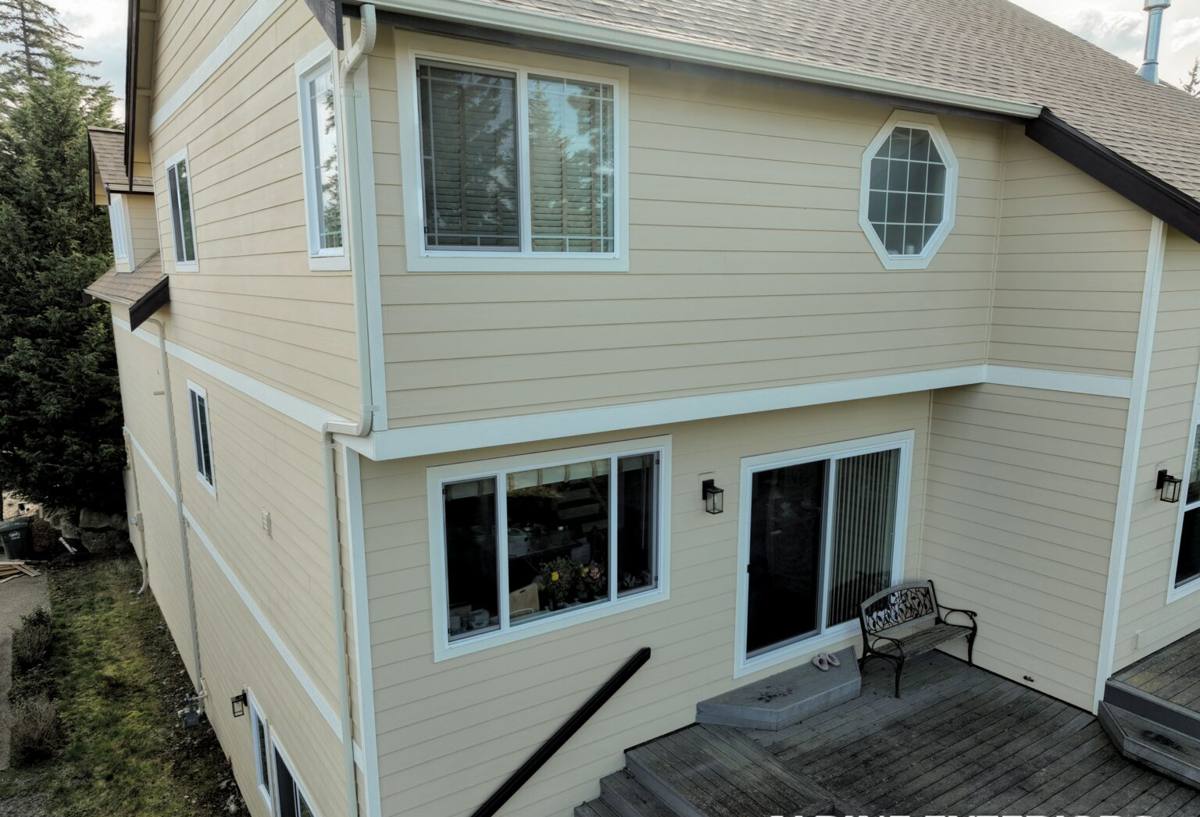
Why Composite Decking Makes Sense Here
Composite decking is made from a blend of wood fiber and plastic, usually with a cap layer of pure polymer on the newer product lines. That cap layer is the part that matters most in this climate — it's what keeps moisture, mold, and moss from working into the board itself the way it would with untreated or even pressure-treated wood. Composite won't splinter, won't need annual staining, and won't cup or crack the way wood decking does after a few wet-dry cycles.
That doesn't mean composite is maintenance-free — nothing exposed to Whatcom County weather year-round truly is — but it shifts the maintenance from sanding, staining, and replacing boards to simple periodic cleaning. For homeowners who want a deck that still looks good after a decade of Pacific Northwest winters, that trade-off is usually worth it.
What We Won't Do
We don't install composite decking over a substructure that isn't built to handle the added weight and the local frost and moisture conditions, and we don't cut corners on fastening just because the board looks finished from the top. A composite deck that's installed like a wood deck — same joist spacing, same fastener pattern, no attention to airflow underneath — will still trap moisture and can void the manufacturer's warranty. We build to what the product actually requires, not to habit.
What a Correct Composite Deck Installation Involves
Substructure First
The framing underneath is where most deck problems actually start, composite or not. Joist spacing for composite boards is typically tighter than for wood — most manufacturers call for 16" on-center for straight installations and closer spacing on diagonal patterns or stairs. We also treat the joists themselves with a protective tape or coating at the top edge, since that's the surface most exposed to standing moisture, and it's an easy step to skip if a crew is rushing.
Fasteners and Spacing
Most composite boards today use a grooved edge with a hidden fastener clip system, which keeps the surface free of screw heads and also leaves a small, consistent gap between boards. That gap matters twice over in this area: it lets water drain through instead of pooling, and it lets air move underneath to help boards dry out between rain events. Getting that gap wrong — too tight — is one of the more common shortcuts we see on decks that were installed by crews unfamiliar with the product or the climate.
Flashing at the House Connection
Where the deck attaches to the house is the single most important detail on the whole project. Proper ledger flashing, correctly lapped with the house's water-resistive barrier, is what keeps driving rain from working its way behind the siding and into the wall assembly over time. This is also where we look closely on any deck we're asked to inspect or repair — a failed ledger connection is often invisible until there's already damage behind the wall.
Composite vs. Other Decking Materials
| Material | Moisture Behavior in This Climate | Maintenance | Typical Lifespan Here |
|---|---|---|---|
| Pressure-treated wood | Absorbs moisture, prone to cupping and splitting through repeated wet seasons | Annual cleaning, periodic staining/sealing | 10-15 years before major repair or replacement |
| Cedar | Naturally moisture-resistant but still needs sealing to resist moss and graying | Regular sealing, moss treatment | 15-20 years with upkeep |
| Capped composite | Cap layer resists moisture absorption and moss penetration into the board | Periodic washing, no staining or sealing | 25-30+ years, warranty-backed |
| PVC decking | Fully synthetic, essentially immune to moisture absorption | Low, similar to composite | Comparable to composite, higher material cost |
We install composite most often on Maple Falls projects because it lands at the point where moisture performance, appearance, and long-term cost make sense for this specific climate. PVC is a reasonable alternative for homeowners who want the lowest possible moisture absorption and don't mind the added cost; we're happy to walk through both during an estimate.
Our Process, Start to Finish
- On-site assessment. We look at the existing deck or ground conditions, drainage, sun/shade exposure, and how the new deck will tie into the house.
- Substructure evaluation. If we're replacing an existing deck surface, we inspect the framing underneath before quoting — reusing framing that's already compromised by moisture just moves the problem to a new deck.
- Material selection. We go over board tiers, color/grain options, and railing systems based on your budget and how much sun or shade the deck gets.
- Permitting. Deck projects of most sizes require a building permit in Whatcom County; we handle that paperwork as part of the job.
- Framing and flashing. Ledger attachment, joist layout, and flashing details get built to spec before a single board goes down.
- Decking installation. Boards go down with the correct gap and fastening system for the product, including stairs and railing integration.
- Final walkthrough. We check fastener lines, gaps, railing stability, and drainage before calling the job done.
Living With a Composite Deck in This Climate
Composite decking cuts down on maintenance dramatically compared to wood, but "low maintenance" isn't "no maintenance," especially with the moss season this area sees every year. A simple annual routine keeps a composite deck looking like it did on install day.
- Sweep debris and fallen leaves off the surface regularly, especially in fall — trapped organic material is what feeds moss and mildew growth.
- Wash the deck once or twice a year with a soft-bristle brush and a composite-safe cleaner; avoid pressure washing at close range, which can damage the cap layer.
- Keep gutters and downspouts near the deck clear so runoff isn't dumping directly onto the surface or substructure.
- Check underneath the deck once a year for standing water or blocked airflow paths, particularly if the deck sits low or in a shaded part of the yard.
- Address any green or black buildup in board grooves early with a mild cleaning solution before it spreads across the surface.
Cost Factors to Expect
Every deck is different, but the same handful of factors drive the price on most composite deck projects we quote in this area.
| Factor | Why It Matters |
|---|---|
| Deck size and shape | Square footage and complexity (angles, multiple levels) both drive labor and material |
| Board tier | Entry-level capped composite vs. premium lines with deeper wood-grain texture and longer warranties |
| Substructure condition | New framing vs. reusing sound existing framing changes the labor scope significantly |
| Railing system | Composite, aluminum, and cable railing all carry different material and install costs |
| Site access and grading | Sloped or hard-to-access lots, common around Maple Falls, add labor time |
As a rough guide, most composite deck projects in this size range land somewhere in the moderate range per square foot installed, with the final number moving based on the factors above. We give exact numbers only after seeing the site — anything else is a guess.
Why It Matters to Hire a Crew That Already Works This Area
A lot of deck problems we get called out to fix weren't caused by bad materials — they were caused by a crew building to a generic standard instead of the standard this climate actually requires. Joist spacing, flashing details, and board gapping that would hold up fine in a drier region don't hold up the same way once you factor in the rain and moss season Whatcom County sees for a good chunk of the year. A crew that already works Lynden and the surrounding communities, including Maple Falls, has seen how decks age here over real winters, not just how they look on install day.
That local track record also means we're not guessing on permitting requirements, typical soil and drainage conditions, or how a deck will sit relative to sun exposure and tree cover on a given lot. Small details, but they're the difference between a deck that needs attention in five years and one that doesn't.
Checklist: What to Ask Before You Hire
- Will you inspect and, if needed, replace the substructure, not just the surface boards?
- What joist spacing and fastening system will you use for this specific composite product?
- How will the deck be flashed at the house connection?
- What's the manufacturer's warranty, and does your installation method keep that warranty valid?
- Do you pull the required building permit, or is that left to the homeowner?
If you're planning a new composite deck or replacing a tired one in Maple Falls, we're glad to come take a look and give you a straightforward, no-pressure estimate — just fill out the form below.