 Lynden Siding
 Sumas sits about as far north as you can go in Whatcom County before you're looking at the border crossing, and that location comes with its own weather personality. Homes out here take on a mix of marine-influenced rain off the Sound, cold air draining down from the Cascade foothills, and long stretches of gray, damp weather that keep exterior walls wet for days at a time. Add in the salt-laden air that moves inland from Bellingham Bay and the Strait of Georgia on prevailing winds, and you've got a climate that's genuinely hard on cladding — harder than most siding products, and most installation crews, are built to handle.
This page is about one job, done right, in one area: siding installation for homes in and around Sumas. Not a general overview of siding — the specific realities of building an exterior wall system that holds up here.
What Sumas Homes Are Actually Fighting
Three climate factors do most of the damage to siding in this part of Whatcom County, and they compound each other:
Salt Air
Even well inland from saltwater, airborne salt travels on wind and settles on exterior surfaces. It accelerates corrosion of fasteners and metal trim, and it can degrade cheaper paint finishes faster than the manufacturer's warranty accounts for. Siding that isn't factory-finished for coastal-adjacent exposure tends to chalk, fade, or lose adhesion at the surface years ahead of schedule.
Driving Rain
Whatcom County storms don't just fall straight down — wind pushes rain sideways into wall assemblies, working it into every gap, lap, and fastener penetration that isn't detailed correctly. A siding system with weak water-shedding geometry, or installed with tight butt joints and no drainage plane, will eventually let moisture behind the cladding. Once that happens, the sheathing and framing pay the price long before the siding itself visibly fails.
A Long Moss Season
Whatcom County's moss and algae season isn't a few weeks — it's most of the year. North-facing walls, shaded elevations, and anything near overhanging trees stay damp long enough for organic growth to take hold. Porous or absorbent siding materials hold that moisture at the surface, feeding mildew and slowly breaking down paint film. Non-porous, factory-sealed materials shed that moisture instead of absorbing it.
None of this is unique to Sumas specifically, but it's more pronounced here than in drier inland parts of the county — you're getting coastal moisture patterns without being directly on the water, which is a combination that catches a lot of homeowners off guard when their siding starts failing faster than expected.
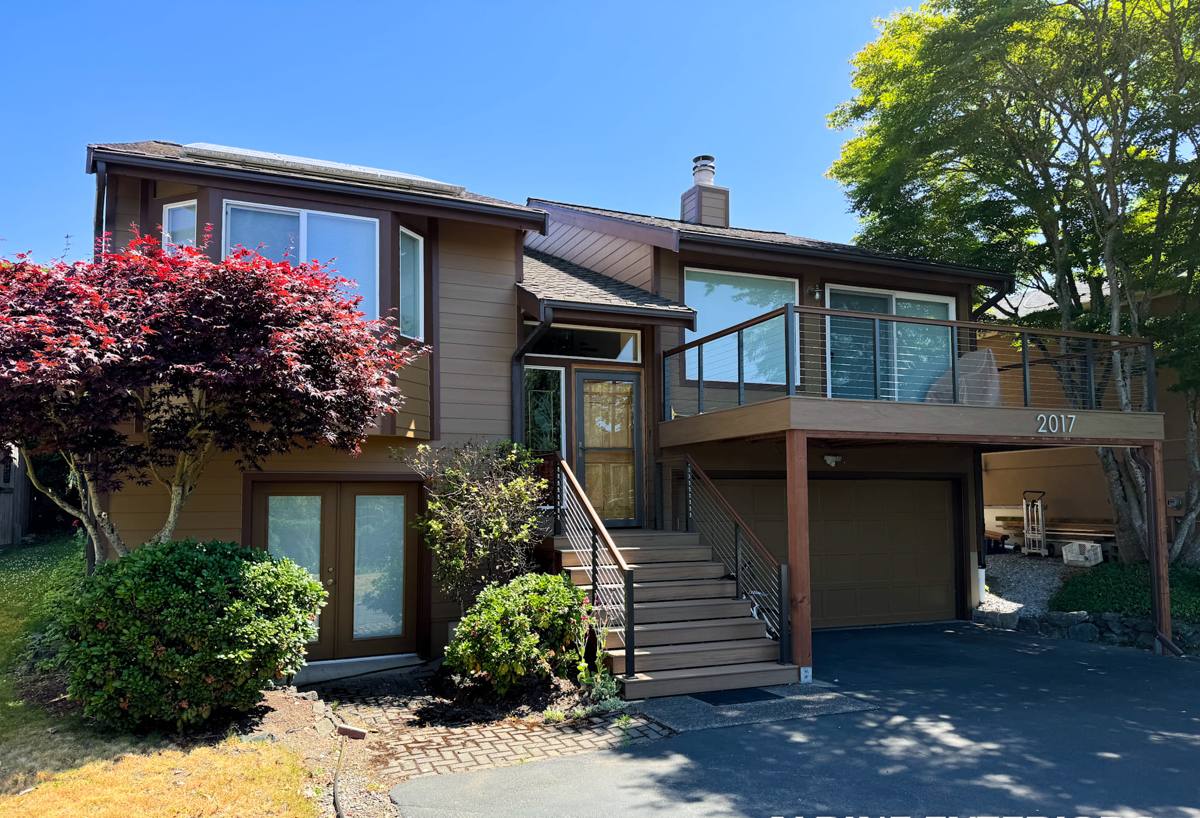
Why We Only Install James Hardie Fiber Cement
We've made a deliberate call not to install vinyl, LP SmartSide, primed wood, or other fiber cement brands like Cemplank or Allura. That's not a marketing position — it's a standard we hold because of what we've seen happen to those products in exactly this climate.
- Vinyl expands and contracts with temperature swings, warps under sustained UV and heat exposure, and can crack in a hard freeze — none of which is common here, but the bigger issue is that vinyl simply isn't rigid or dense enough to hold up to decades of driving rain without gaps opening at seams.
- LP SmartSide is an engineered wood product — solid where it's kept dry, but wood-based siding is inherently more vulnerable to moisture intrusion at cut edges and fastener points. In a climate with this much sustained dampness, that's a real long-term risk.
- Other fiber cement brands use similar base chemistry to Hardie but don't all match its factory-cured ColorPlus finish system, and finish quality is exactly what determines how a product handles salt air and UV over 20-plus years.
James Hardie's fiber cement is non-combustible, dimensionally stable, and engineered specifically for regional climate demands through its HZ5 product line — built for exactly the moisture and temperature profile the Pacific Northwest delivers. The ColorPlus finish is baked on at the factory under controlled conditions, which gives it far better fade and moisture resistance than field-applied paint. That's the difference that matters most in a place where a wall can stay wet for days.
What Correct Installation Actually Involves
Siding is a system, not just a material. A quality product installed incorrectly will still fail early — and in a climate like this, "early" can mean five years instead of thirty. Here's what has to happen for a Sumas installation to actually perform:
Water Management Behind the Siding
A drainage plane (weather-resistant barrier plus a rainscreen or properly lapped house wrap) has to be in place before the first course goes up. This gives any moisture that does get past the siding a path to drain and dry out instead of sitting against the sheathing.
Correct Fastening
Hardie siding has specific nailing patterns, fastener types, and embedment depth requirements. Over- or under-driven nails, wrong fastener spacing, or the wrong fastener material (especially given local salt exposure) all shorten the life of the installation and can void the manufacturer's warranty.
Flashing and Penetrations
Every window, door, vent, and utility penetration is a place water wants to get in. Head flashing, kick-out flashing at roof-wall intersections, and proper caulking at penetrations — done in the right order relative to the drainage plane — are what actually stop driving rain, not the siding surface itself.
Joint and Gap Spacing
Hardie specifies minimum gaps at butt joints, trim, and abutting surfaces to allow for material movement and to keep water from being trapped and held against the plank. Installers who don't follow spec — often to make a job look tighter — create the exact conditions that trap moisture and encourage moss and mildew growth.
Our Process for Sumas Projects
| Step | What Happens | Why It Matters Here |
|---|---|---|
| Site assessment | Inspect existing siding, sheathing condition, and moisture history on all elevations | Identifies hidden rot or trapped moisture before it's covered up again |
| Product selection | Confirm Hardie plank profile, exposure, and color line for the home | Match HZ5 formulation and finish to actual exposure conditions |
| Water barrier install | Weather-resistant barrier and drainage plane installed correctly, seams taped and lapped | Primary defense against wind-driven rain reaching the sheathing |
| Flashing detail | Window, door, and roof-wall flashing installed to manufacturer and code spec | Closes off the most common failure points for water intrusion |
| Siding installation | Correct fastening, joint spacing, and course alignment per Hardie specifications | Preserves warranty coverage and long-term weather performance |
| Final inspection | Walk every elevation, check caulking, trim, and fastener finish | Catches small issues before they become callbacks |
Signs Your Siding Is Already Behind This Climate
- Persistent moss or algae staining that returns within weeks of cleaning
- Soft spots, bubbling, or visible warping, especially on north-facing or shaded walls
- Paint that's chalking, peeling, or fading unevenly across elevations
- Visible gaps opening at butt joints or trim over time
- Rusting or streaking fastener heads showing through the surface
- Rising energy bills that suggest moisture-compromised insulation behind the wall
If any of these sound familiar, the underlying wall assembly is often further along in deterioration than the surface suggests — fiber cement doesn't hide problems the way some other materials do, which is part of why it's a better long-term choice, but it also means visible symptoms are worth acting on rather than waiting out.
Why Local Installation Experience Matters
A crew that installs siding across a wide range of climates might default to generic best practices. A crew that regularly works Whatcom County homes — Lynden, Sumas, and the surrounding areas — has already seen how salt air, driving rain, and a long moss season interact with specific wall orientations, roof lines, and tree cover typical of this area. That experience shows up in small decisions: where to add extra flashing attention, which elevations need closer drainage detailing, and how to sequence work around the region's wet stretches so the wall assembly isn't exposed longer than necessary.
It also means a crew that's still standing behind the work years later, in the same community, answering to the same reputation — not a traveling install crew that's moved on to the next region by the time problems show up.
What Homeowners Should Ask Before Hiring
- Are you a certified James Hardie installer, and can you explain the specific fastening and gap requirements you follow?
- What's your process for the drainage plane and flashing details, specifically for this home's elevations?
- Do you carry manufacturer warranty backing, and what does that warranty actually cover versus your workmanship warranty?
- Can you walk me through how you'll handle penetrations, trim, and joint spacing before work starts?
- How do you sequence the job around wet weather so the sheathing isn't left exposed?
Getting Started
If your Sumas-area home is showing signs of wear from salt air, driving rain, or year-round moss and mildew pressure, a proper siding replacement — done with the right water management details and a factory-finished, non-combustible material built for this climate — solves the problem at the source instead of masking it season after season. We'd be glad to take a look at your home, walk you through what we're seeing, and put together a straightforward, no-pressure estimate. There's a form below to get that conversation started.